
This page contains affiliate links. Far Cornel may earn a commission if you buy through them, at no extra cost to you.
See the top-rated gear on Amazon →
Quick answer: The right setup for a touring vehicle is a quality electric winch rated to about 1.5 times your loaded weight, on a bar actually engineered for winching, with synthetic rope, rated recovery points, gloves and a line blanket behind it. Synthetic suits most people because it is lighter and safer than steel. Sort the mount, wiring and recovery points before you fixate on the winch itself, or the shiny motor solves nothing.
A winch is the most misunderstood recovery buy going. People fixate on the pulling number on the box, bolt the thing to whatever bar came with the vehicle, and never practise with it until the day it matters, which is exactly the wrong day to learn. A winch is a system: motor, rope, mount, wiring, recovery points and the person operating it. Get any one of those wrong and the expensive part fails at the moment you are relying on it.
Here is the myth worth killing first. A bigger rated pull is not automatically better, and it is not the figure you get in the field. Rated pull is measured on the first wrap of rope on a bare drum; as rope layers build, the effective pull drops, sometimes by a third or more. So you size for a margin, keep the drum from filling, and learn to double your line when you need real force.
Quick Picks
- Best all-round: a quality electric winch rated near 1.5x your loaded weight.
- Best rope upgrade: synthetic rope, for weight and safer handling than steel.
- Best force multiplier: a snatch block or recovery ring to double your pull.
- Best safety buy: a winch recovery kit with a line blanket, gloves and shackles.
- Best anchor helper: a tree trunk protector for when there is no vehicle to pull from.

How to Choose a Winch and Set It Up
Start with the loaded weight of the vehicle, not the brochure kerb figure. A touring rig carrying fuel, water, drawers, a fridge, a roof load and passengers weighs far more than the showroom number, and the usual guide of about 1.5 times that loaded weight is a floor, not a promise. Weigh it heavy, size up from there, and remember the drum-wrap effect that quietly eats your rated pull as rope builds up.
Then look at what you will bolt it to, because plenty of factory bumpers and cosmetic bars are not built to take winch loads. Confirm the bar or cradle is rated for winching and takes the winch’s bolt pattern. The electrical side matters just as much: a winch pulls heavy current, so battery, cabling and alternator all have to cope, and a vehicle already straining under a fridge and lights may need a second battery first.
On rope, synthetic has taken over most recreational setups for good reason. It is a fraction of the weight of steel, it is far safer if it lets go because it drops rather than whipping back, and it is kinder to handle. The trade-offs are real: it abrades on rock, ages in sun, and needs rinsing and inspecting. Brands like Runva, Bushranger and Saber all offer honest ratings; a name such as Warn sits at the premium end. Steel still suits a budget build if you accept the weight and handle it with respect.
The Winch System, Part by Part
Check today’s prices on Amazon →
A quality electric winch
The winch itself should be a known-brand electric unit rated near 1.5 times your loaded weight, with a sealed motor and a clutch lever you can actually reach. Do not buy this if your bar is cosmetic and not winch-rated, because a cheap winch on a decorative bar is worse than no winch at all: it fails exactly when you lean on it. Runva and Bushranger cover the mid-market sensibly, while Warn sits at the premium end for those who want it. Match the winch to the vehicle and the mount, not to the biggest pull figure you can find. Find the right 4×4 electric winch on Amazon
Synthetic winch rope
If your winch still wears steel cable, synthetic rope is the single upgrade that changes how safe and pleasant winching feels. It weighs a fraction of steel, so respooling by hand is easy, and if it fails it flops to the ground instead of lashing back with stored energy. The cost is upkeep: keep it out of sharp rock, rinse grit out, protect it from constant sun, and inspect it for fraying. Do not buy this if you regularly drag over abrasive rock without edge protection, where steel’s toughness still earns its place. Price up a synthetic winch rope on Amazon
A snatch block or recovery ring
This is the cheapest way to make a modest winch punch above its weight. Running the rope through a snatch block or a recovery ring on an anchor roughly doubles your pulling force, halves the speed, and lets you change the direction of pull so you are not fighting a straight line you cannot use. It is also how you keep the drum from filling with rope and losing power. A rated pulley or soft recovery ring belongs in every kit. See current snatch block prices on Amazon
A winch recovery kit
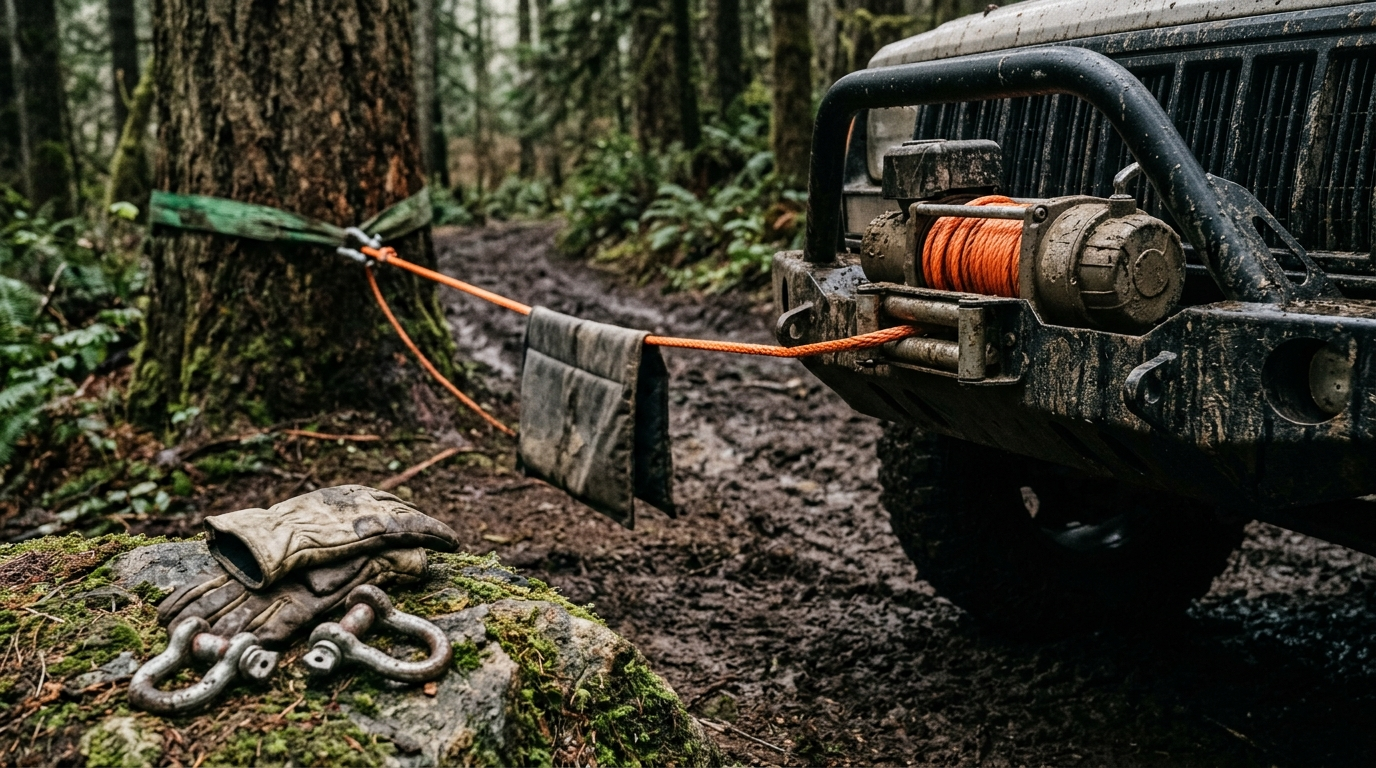
The winch is only one part of a safe recovery, and the supporting kit is where corners get cut. A proper kit bundles a recovery blanket to smother stored energy if something lets go, heavy gloves for handling rope, and rated shackles or soft shackles. Buy these as a set matched to your rope type rather than assembling odds and ends of unknown rating. The blanket alone earns its price: laid over the line, it drops a failed rope instead of letting it fly. Compare winch recovery kit on Amazon
A tree trunk protector
When there is no second vehicle and no rated point ahead of you, a solid natural anchor and a tree trunk protector are how you winch yourself out. The wide webbing strap wraps a trunk without cutting the bark, for a stronger, kinder connection than a bare rope ever gives. Pair it with a rated shackle and your snatch block, and a lone winch becomes a genuine self-recovery system. Check the latest tree trunk protector on Amazon

Comparison
| Item | Role in the system | Key spec | Skip it if |
|---|---|---|---|
| Electric winch | Does the pull | ~1.5x loaded weight | Your bar is not winch-rated |
| Synthetic rope | Safer, lighter line | Rated to the winch | You drag over sharp rock a lot |
| Snatch block / ring | Doubles force, changes angle | Rated above winch pull | Never, every kit needs one |
| Recovery kit | Makes it safe | Blanket, gloves, shackles | Never, this is the safety layer |
| Tree protector | Anchors to a trunk | Wide webbing, rated | You always travel in a convoy |
Frequently Asked Questions
What size winch should I get?
Aim for a rated pull of at least one and a half times your fully loaded weight, then remember that rated figure is the best case on a bare drum and drops as rope layers build. A margin genuinely helps, and a snatch block lets a modest winch double its force when a job is heavier than expected. Weigh the vehicle loaded before you decide.
Synthetic rope or steel cable?
Synthetic rope, in almost every case. It is far lighter, safer if it fails because it drops rather than whips back, and much nicer to handle and respool. Steel resists abrasion better and costs less, but it is heavy and dangerous under load. Unless you routinely drag over sharp rock without edge protection, synthetic is the better pick.
Can I mount a winch to my factory bumper?
Almost never safely. Most factory bumpers and cosmetic bars are not engineered for winch loads and can bend or tear away. Fit a bar or cradle specifically rated for winching, matched to your winch’s bolt pattern and fairlead. Getting this wrong is expensive to unwind and dangerous to use, so confirm it before you buy the winch.
Do I need a second battery for a winch?
Often, yes. Winches pull heavy current, and a vehicle already loaded with a fridge, lights and a compressor can struggle to feed repeated pulls without flattening the crank battery. Check the cabling, solenoid and alternator can cope, and have the install looked over by an auto electrician if you are unsure. Reliable power is part of the winch, not an optional extra.
The Bottom Line
Put the money into a properly rated winch on a genuine winch-rated bar, with synthetic rope, sound wiring and a kit of rated recovery gear behind it. A cheap winch on a cosmetic bar is worse than none, because it fails at the exact moment you depend on it. And remember a winch does not replace the basics: lower tyre pressures, a shovel and recovery boards solve most mild bogs long before the winch comes out. Practise somewhere low-stakes, keep bystanders well clear of a loaded line, and treat the winch as the last tool, not the first.
For the rest of the system, see the beginner 4×4 recovery gear checklist, our roundup of the best 4×4 winches, and the guide to soft shackles.