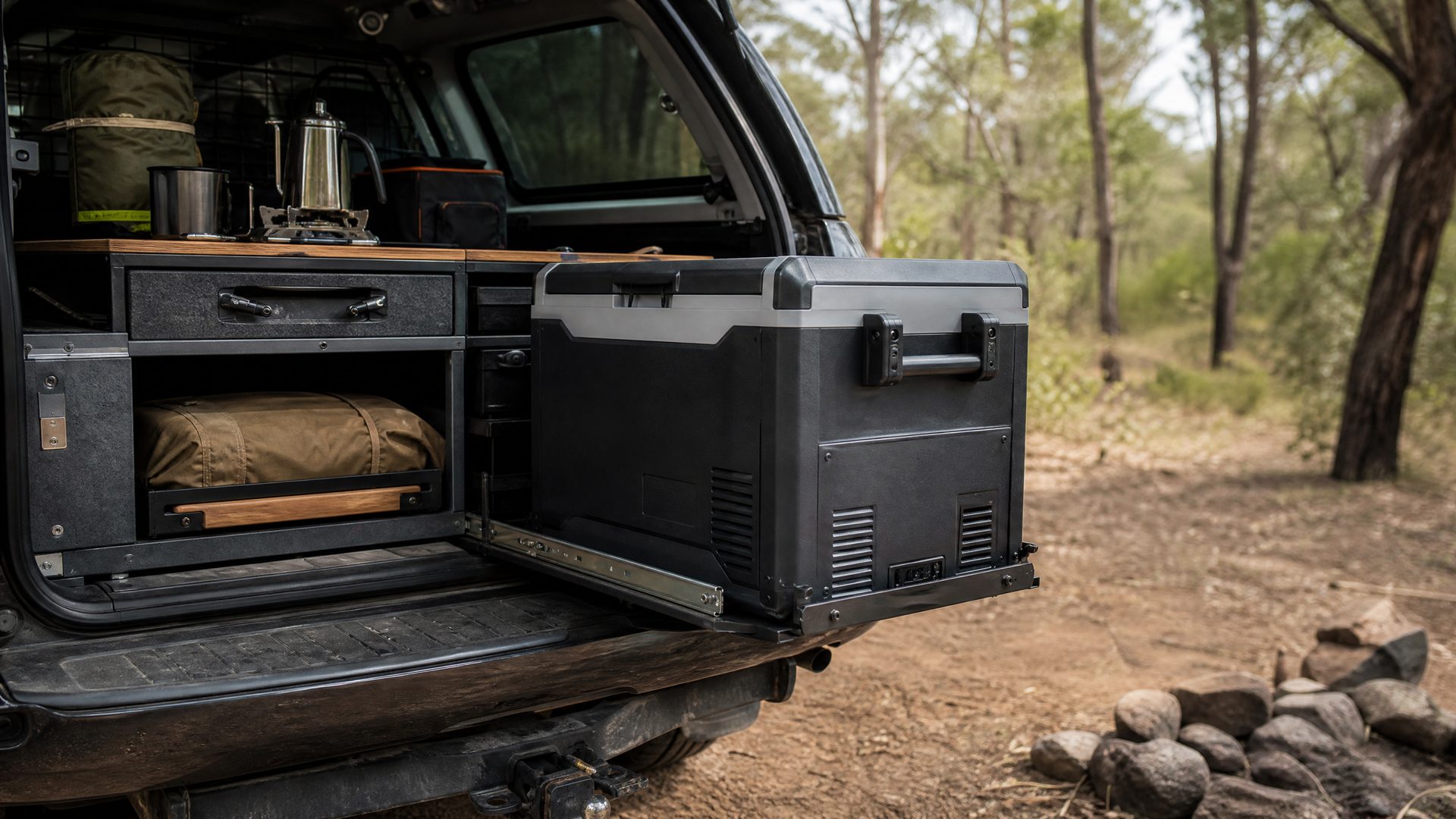
A 12V portable camping fridge freezer open on a 4x4 tailgate at an Australian campsite.

Best Portable Fridges for Camping in 2026: 12V Fridge Freezers, Dual-Zone Setups and Cooler Alternatives

Affiliate disclosure: Far Cornel may earn from qualifying purchases made through some links in this guide, at no additional cost to you. This guide is general information only and is not a substitute for manufacturer specifications, product manuals, food-safety advice, vehicle electrical advice, battery-system design, or current product listings.

A 12V portable camping fridge freezer open on a 4x4 tailgate at an Australian campsite.
Keep your food fresh off-grid with a reliable 12V camping fridge. Image source: Canadian National maintenance vehicle (5999051605) by Andrew Bowden from London, United Kingdon, BY-SA.

A good 12V portable fridge can change how often a camping trip actually happens. It removes the need to chase ice, keeps meat and dairy under control for longer weekends, and pairs naturally with a power station, solar panel, dual-battery setup, or powered campsite. The wrong fridge, however, can be heavy, power-hungry, awkward to pack, or far more expensive than your actual use case requires.

This Far Cornel guide is written for Australian campers who want a practical buying shortlist rather than a generic list of cold boxes. If you are still deciding whether you need a compressor fridge at all, start with the portable fridge versus cooler guide. If you already know you want powered refrigeration, use this article to choose the right size, power plan, and purchase path. For the electrical side, pair it with the portable power station sizing guide.

Quick answer: which portable fridge should most campers consider first?

Most weekend campers should start with a single-zone compressor fridge around 40 to 46 litres. That size is large enough for a couple, a small family food pack, or a long weekend of drinks and meals, but it is still manageable to lift, fit in a wagon or 4WD, and power from a reasonable battery setup. The strongest first shortlist is the 40L to 45L 12V portable fridge range.

Best premium starting point: the Engel MT-V45 shopping shortlist is the first place to look if reliability and long service life matter more than app controls or trendy features. Engel Australia lists the MT-V45 at 40 litres, 24 kg, with built-in 240V AC plus 12V/24V DC power, 0.5 to 3.0 amp DC consumption, a 5-year warranty, robust handles, corner protectors, and 60 x 375 ml can capacity.

Buyer situationBest starting pointWhy it makes sensePurchase path
Camper who wants proven reliability over extra featuresEngel MT-V45 40L classStrong warranty, compact 40L capacity, multi-voltage input, robust casing, and conservative power draw.Shop the premium reliability pick
Buyer who wants app controls and modern compressor-fridge featuresDometic CFX3 45 class46L volume, app control, colour display, AC/DC power, battery protection, and a wide cooling range.Compare the modern premium option
Weekend camper who wants a balanced single-zone fridgemyCOOLMAN Weekender 44L class44L capacity, 23.4 kg weight, Bluetooth app control, 12/24V DC and 240V AC operation, baskets, and a 5-year warranty.Buy the weekender-size setup
Camper who wants one fridge to run both fridge and freezer zonesEcoFlow GLACIER Classic 45L or 55L classDual-temperature zone options, 45L or 55L volumes, large can capacity, and battery-system compatibility depending on bundle.Shop dual-zone fridge freezers
Buyer who mainly needs cold drinks, simple lunches, or one-night tripsCompact 20L to 30L compressor fridgeSmaller footprint, easier lifting, lower food volume, and often a smaller battery requirement.Choose a compact fridge

1. Choose the trip first, then the fridge

The best portable fridge is not automatically the largest or most expensive model. It is the fridge that fits your trip length, vehicle space, lifting ability, food volume, and power system. A single person who buys supermarket food on the way out of town does not need the same fridge as a family carrying meat, dairy, pre-cooked meals, fruit, drinks, and frozen food for a remote long weekend.

Start by deciding what must stay cold. Food Standards Australia New Zealand states that potentially hazardous foods such as meat, poultry, eggs, dairy, seafood, cut fruit, cooked rice, pasta, sandwiches, and sushi generally need to be kept at 5 °C or colder, or 60 °C or hotter. That means a camping fridge should be chosen as part of a food-safety system: pre-chill the fridge, load cold food cold, use a thermometer, and avoid leaving the lid open while people browse for drinks.

Trip typeFridge size to consider firstPower planning noteSmart shopping move
Solo day trips and drinks15L to 25LOften manageable from a compact power station or vehicle socket for short use, but verify draw and runtime.Shop compact day-trip fridges
Couple weekend camping35L to 45LPlan for overnight battery capacity, pre-chilling, and conservative thermostat settings.Build a weekend-fridge shortlist
Family long weekends45L to 60LExpect more lid openings, higher food volume, and stronger need for solar or vehicle charging.Choose a family-size fridge
Fridge plus freezer useDual-zone 45L to 75LFreezer zones increase energy demand, so battery size matters more than the advertised litre figure.Shop dual-zone fridge freezers
Touring and remote travelPremium 40L to 60L compressor fridgePrioritise reliability, service support, battery protection, mounting, ventilation, and proven 12V operation.Compare touring-grade fridges

2. Compressor fridge, thermoelectric cooler, or ice esky?

A compressor fridge is the right choice when you need controlled refrigeration. It works more like a miniature household fridge/freezer, can usually run from 12V or 24V DC, and may also include 240V AC input. It costs more than an ice esky, but it removes repeated ice purchases and gives better control over food temperature.

A passive cooler or esky still makes sense when the trip is short, the budget is tight, or the contents are mostly drinks. Ice can be simple and reliable when there is no battery plan. A thermoelectric cooler is usually less compelling for camping food because it often cools relative to ambient temperature rather than holding a precise fridge/freezer setpoint. If the aim is safe food storage for meat, dairy, or seafood, a compressor fridge is usually the higher-confidence purchase.

Cooling optionStrengthsTrade-offsBest buyer fit
Compressor portable fridgeTemperature control, 12V touring use, freezer potential, no ice melt.Higher upfront cost, battery planning, ventilation needs, and more weight.Campers carrying perishable food, multi-day trips, touring, and people who camp often.
Ice esky or hard coolerSimple, no electrical system, low running complexity, useful backup.Ice melts, food can get wet, temperature control depends on packing and ice supply.One-night trips, drinks, picnics, backup cold storage, and low-budget setups.
Thermoelectric coolerUsually cheaper and simple for vehicle use.Less precise cooling and less suitable for demanding Australian summer conditions.Short errands and low-risk items rather than serious camping refrigeration.

3. Compare the key portable fridge picks

The models below are included because their official product pages provide useful buyer-relevant specifications. Always confirm the current listing before buying because inclusions, plugs, baskets, protective covers, battery packs, warranties, dimensions, and regional variants can change. Treat the table as a purchase-direction tool, then check the live listing before checkout.

Model or classVerified specifications from official sourcesBest roleBuyer notesAction
Engel MT-V45 40L40L capacity, 60 x 375 ml can capacity, 24 kg weight, 0.5–3.0 amps DC use, 240V AC / 12V / 24V DC, 5-year warranty, H508 W631 D360 mm external dimensions plus handles.Premium reliability-focused touring fridge.Choose this direction if you value proven brand reputation, simple controls, robust construction, and a conservative long-term setup.Buy the Engel-style setup
Dometic CFX3 4546L total volume, +20 °C to −22 °C cooling range, AC/DC power, Wi-Fi/Bluetooth app control, colour display, ExoFrame construction, aluminium alloy handles, and three-stage battery protection.Modern premium compressor fridge/freezer.Best for buyers who want strong cooling, app control, display feedback, and premium design around a very useful mid-size volume.Shop the Dometic CFX3 45 range
myCOOLMAN Weekender 44L44L gross volume, 65 x 375 ml can capacity, L652 x W412 x H488 mm dimensions, 23.4 kg weight, 12/24V DC and 240V AC operation, Bluetooth app connectivity, baskets, LED light, and 5-year warranty for qualifying purchases after October 2024.Balanced weekender fridge/freezer.A good middle path for buyers who want useful size, app convenience, baskets, and a camping-ready layout without immediately jumping to larger dual-zone models.Compare myCOOLMAN Weekender options
EcoFlow GLACIER Classic 45L45L usable volume, 72 x 330 ml can capacity, 706 x 400 x 480 mm external dimensions, 23.1 kg net weight, and dual temperature zone.Tech-forward dual-zone camping fridge.Consider this if you already like EcoFlow power gear or want a fridge that sits naturally inside a larger battery and solar ecosystem.Buy a dual-zone EcoFlow setup
EcoFlow GLACIER Classic 55L55L usable volume, 90 x 330 ml can capacity, 706 x 466 x 480 mm external dimensions, 25.2 kg net weight, and dual temperature zone.Family or longer-weekend dual-zone option.The extra volume helps when one compartment needs to behave more like a freezer, but power planning and lifting weight become more important.Choose the larger EcoFlow option

4. Engel MT-V45: best for buyers who want proven simplicity

The Engel MT-V45 is the fridge to examine first if you want a rugged, traditional camping fridge rather than a screen-heavy gadget. Engel Australia lists the 40 litre MT-V45 with 60 x 375 ml can capacity, 24 kg weight, built-in 240V AC plus 12V/24V DC operation, automatic voltage selection, and 0.5 to 3.0 amps DC consumption. The official dimensions are H508 W631 D360 mm, with an extra 60 mm for each handle, and the internal cabinet is listed as H370 W380 D260 mm.

That specification set is attractive because it focuses on the camping basics. Forty litres is a practical touring size, not a show-off number. The weight is still substantial, but it is realistic for a serious compressor fridge. The multi-voltage setup lets it move from the vehicle to mains power at home or at a powered site. The 5-year warranty also makes it a safer first premium direction than unknown-name fridges where support may be less clear.

Best buyer fit: choose the Engel direction if you want a fridge that feels like long-term camping equipment, not a disposable accessory. It is particularly suitable for 4WD touring, regular weekend use, and buyers who want simple operation with fewer software-dependent features. Shop Engel MT-V45 portable fridge options here.

5. Dometic CFX3 45: best modern premium single-zone direction

The Dometic CFX3 45 is the modern premium alternative. Dometic describes it as a mobile compressor cooler and freezer with 46 litres total volume, AC or DC power, heavy-duty ExoFrame construction, aluminium alloy handles, a high-resolution colour display, and Wi-Fi or Bluetooth app temperature control. Its listed cooling range runs from +20 °C down to −22 °C, which gives it both fridge and freezer potential depending on how it is used.

The strongest reason to consider the CFX3 45 is usability. A display and app can make temperature monitoring easier when the fridge is buried in the vehicle or mounted in the rear of a wagon. Dometic also lists a three-stage dynamic battery protection system, which matters when a fridge is running from a vehicle or auxiliary battery. Battery protection does not replace proper electrical planning, but it is a useful safeguard in a camping fridge.

Best buyer fit: choose the Dometic direction if you want a polished premium fridge with strong feature depth and are willing to pay for modern controls. It is a strong match for campers who already understand the value of powered refrigeration and want a mid-size fridge they can keep using as their setup improves. Compare Dometic CFX3 45 listings here.

6. myCOOLMAN Weekender 44L: best balanced weekender-size option

The myCOOLMAN Weekender 44L makes sense for buyers who want a practical mid-size fridge/freezer without going oversized. The official product page lists 44 litres gross volume, 65 x 375 ml can capacity, L652 x W412 x H488 mm dimensions, and 23.4 kg weight. It includes 12/24V DC and 240V AC operation, Bluetooth app connectivity and control, removable baskets, LED interior lighting, a digital control panel, interior light, flat tie-down handles, dual DC inputs, and Turbo mode.

This is the sort of fridge that fits a common Australian camping pattern: leave Friday, camp two nights, come home Sunday, and carry enough cold food to avoid town runs. The basket layout and app control can make daily use easier. The listed 5-year warranty for purchases after October 2024 also gives buyers a clearer support expectation than many bargain listings.

Best buyer fit: choose this direction if your trips are mostly weekends and you want a single-zone fridge that is still large enough to feel useful. It is not as simple and traditional as the Engel, and not as premium-positioned as the CFX3, but it occupies a sensible middle lane. Shop myCOOLMAN 44L fridge options here.

7. EcoFlow GLACIER Classic: best dual-zone direction for battery-first campers

The EcoFlow GLACIER Classic is most interesting for campers who already think in terms of power stations, solar input, and integrated off-grid systems. EcoFlow’s official specs page lists a 45L model with 45 litres usable volume, 72 x 330 ml can capacity, 706 x 400 x 480 mm external dimensions, 23.1 kg net weight, and a dual-temperature-zone layout. The 55L model increases usable volume to 55 litres, can capacity to 90 x 330 ml cans, dimensions to 706 x 466 x 480 mm, and net weight to 25.2 kg.

The reason to consider this direction is not simply size. It is system thinking. A dual-zone fridge makes sense when one side needs to stay chilled and the other side needs to run colder for frozen items. The trade-off is energy demand. A freezer zone, more food volume, frequent openings, poor ventilation, and hot ambient temperatures can all increase power consumption. If you are buying a dual-zone fridge, budget for the battery and charging plan at the same time.

Best buyer fit: choose the EcoFlow direction if you want a larger, tech-forward fridge/freezer and you are already building a battery-and-solar camping kit. It is overkill for basic day trips, but it can make sense for food planning on longer weekends. Shop EcoFlow GLACIER Classic options here.

8. How much battery do you need for a camping fridge?

Do not size a power station only from the fridge’s maximum wattage or the litre figure on the box. Compressor fridges cycle on and off, so real use depends on ambient temperature, thermostat setting, insulation, ventilation, loading temperature, lid openings, whether a freezer zone is active, and how much pre-chilled mass is inside. A fridge that behaves well in mild weather can draw much more energy during a hot, exposed weekend.

For a practical estimate, think in daily watt-hours rather than headline watts. If a fridge averaged 30 watts across a day, that would be 720 Wh before inverter losses, battery reserve, or solar variability. If it averaged 45 watts in hotter conditions, the same day becomes 1,080 Wh. The safe approach is to oversize the battery, add solar if you are staying more than one night, and test the exact fridge at home before relying on it for food safety.

Power questionWhy it mattersBuying move
Will the fridge run overnight without the car?Vehicle starter batteries are not camping batteries. You need a safe auxiliary system or separate power station.Shop camping power stations
Will you stay more than one night?Battery capacity becomes less important than recharge strategy once the trip extends.Add a portable solar panel
Will one zone run as a freezer?Freezing generally increases energy demand and makes power planning less forgiving.Compare dual-zone setups carefully
Is the fridge mounted in a hot vehicle?Poor ventilation and heat make compressors work harder.Plan mounting and ventilation

9. Single-zone versus dual-zone: do not pay for complexity you will not use

A single-zone fridge is usually the smarter first purchase. It is simpler to pack, easier to manage, and often enough for normal weekend food. You can use it as a fridge or a freezer, but not both at the same time. For many campers, that is not a limitation because they are trying to keep meat, dairy, drinks, and meal prep cold rather than carry frozen food for a week.

A dual-zone fridge is worth considering when you regularly need separate temperature areas. This can help on family trips, remote touring, fishing trips with bait and food separated, or longer campouts where frozen meat or ice blocks are part of the system. The downside is that dual-zone fridges tend to be larger, heavier, more expensive, and more power-sensitive. Buy dual-zone because your food plan requires it, not because the listing looks more impressive.

10. Features that matter in the real world

Most product pages highlight capacity, cooling range, and app control, but the real trip often depends on smaller practical features. Handles matter every time the fridge is lifted. Basket design matters when food is stacked. A drain plug can help after cleaning. Battery protection matters when running from a vehicle system. Tie-down points matter if the fridge rides in the rear of a 4WD. A reversible or removable lid can decide whether the fridge works in your vehicle layout.

FeatureWhy it mattersWhen to prioritise it
Battery protectionHelps reduce the chance of flattening a vehicle or auxiliary battery.Any setup running from a car, ute, trailer, or auxiliary battery.
Strong handlesA loaded 40L to 55L fridge can be awkward and heavy.Solo campers, wagon users, and anyone moving the fridge in and out each trip.
App or remote monitoringMakes it easier to check temperature without opening the lid.Mounted fridges, rear cargo setups, and buyers who like data visibility.
Baskets and dividersReduce digging and keep food categories organised.Family camping, meal prep, and longer weekends.
Ventilation clearanceCompressor efficiency suffers if heat cannot escape.Drawer systems, fridge slides, canopy builds, and packed wagons.
240V AC inputLets you pre-chill at home and use powered campsites.Most campers; it makes setup easier even if 12V is the main travel power.

11. What to buy with the fridge

The fridge is only one part of the cold-storage system. If you spend the entire budget on the box and ignore power, ventilation, and measurement, the setup can still fail. The highest-value accessories are not flashy; they are the things that make the fridge reliable in real use.

AccessoryWhy it helpsPurchase path
Fridge thermometerVerifies real internal temperature instead of relying only on the display.Add a fridge thermometer
Portable power stationRuns the fridge away from the vehicle and simplifies overnight power.Choose a camping power station
Solar panelExtends runtime on longer stays when sunlight is available.Shop portable solar panels
Fridge slide or tie-down kitImproves access and helps secure the fridge in transit.Secure the fridge properly
Insulated fridge coverCan help protect the cabinet and reduce heat exposure depending on model fit.Add an insulated cover

12. Common buying mistakes

The first mistake is buying too large. A huge fridge looks useful until it fills the cargo area, needs two people to move, and requires a much larger battery plan. The second mistake is buying too small, especially for families who underestimate drinks, sauces, fruit, meal prep, and leftovers. The third mistake is ignoring power. A fridge that cannot run through the first night without stressing the battery is not a complete camping solution.

The fourth mistake is trusting temperature displays without checking food temperature. Displays show what the fridge senses, not necessarily the warmest item in a poorly packed cabinet. A cheap thermometer can reveal whether the setup is actually holding a safe range. The fifth mistake is failing to pre-chill. A portable fridge should maintain cold food, not rescue warm groceries in a hot vehicle five minutes before leaving.

Final recommendation

If you want the safest first purchase direction, choose a reputable 40L to 46L compressor fridge/freezer and build the power system around it. For traditional reliability, start with the Engel MT-V45 class. For modern features and premium controls, compare the Dometic CFX3 45 class. For a balanced weekender path, look at the myCOOLMAN 44L range. If you need separate fridge and freezer zones, step up to a dual-zone 45L to 55L fridge/freezer.

For most campers, the winning setup is not the biggest fridge. It is a mid-size compressor fridge, pre-chilled at home, packed with cold food, verified with a thermometer, powered by a suitable battery system, and ventilated properly in the vehicle. Buy the fridge that makes food storage boring and dependable, because that is what lets the rest of the trip feel easy.

References and specification sources

Manufacturer and official guidance sources used for specifications and safety context: Engel Australia MT-V45 product page; Dometic CFX3 45 product page; myCOOLMAN 44L Weekender product page; EcoFlow GLACIER Classic specifications; and Food Standards Australia New Zealand temperature-control guidance.