
This page contains affiliate links. Far Cornel may earn a commission if you buy through them, at no extra cost to you.
See the top-rated gear on Amazon →
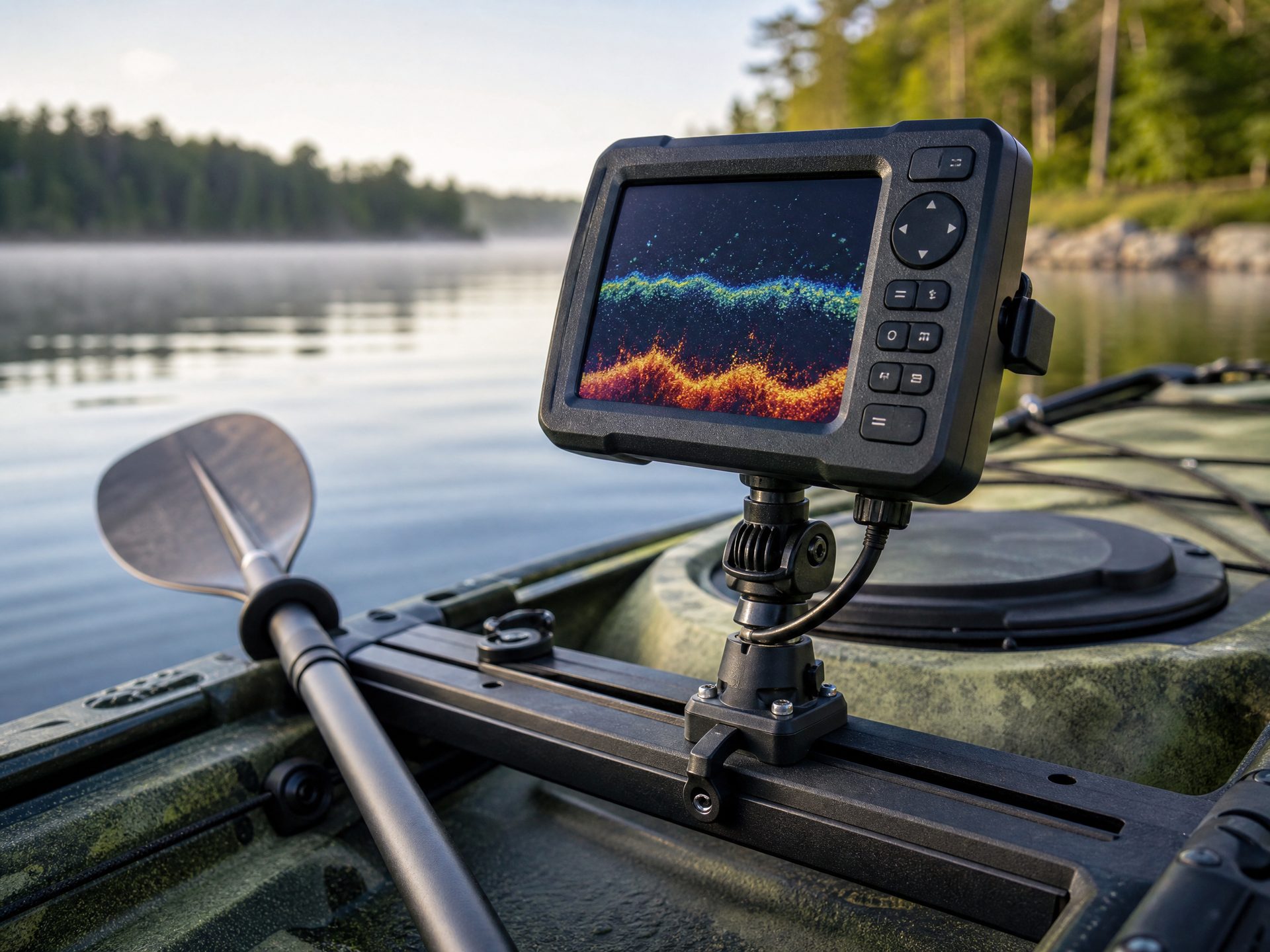
Quick answer: On a kayak, a 4–5 inch sonar/GPS combo you can read in full sun is the sweet spot — big enough to show depth and structure, small enough to mount and power easily. Choose a plain 4 inch unit to start, step up to a 5–7 inch mapping combo for serious structure fishing, and add down or side imaging only if you fish complex bottom. Pair any of them with a light LiFePO4 battery, not a heavy lead-acid brick.
The myth that sells the most fish finders is that side-scan and down-imaging are what put fish in the boat from a kayak. They are brilliant on the right water, but on a small hull the screen you can actually read in glare — showing depth, bottom hardness and bait on plain 2D sonar — does the vast majority of the work. Readability and power draw matter more than the feature list, and a modest unit set up well beats a flagship you cannot see or keep charged.
A kayak is a demanding place for electronics: limited deck space, no dashboard, salt spray, and a battery you have to carry. That is why the best kayak fish finder is rarely the biggest one. Garmin, Lowrance, Humminbird and Deeper all make units that suit the kayak brief, and the right choice comes down to a screen you can mount, the sonar you genuinely need, and a battery light enough not to eat your payload.
Quick Picks
- Best all-round: a 4–5 inch sonar/GPS combo you can read in sun.
- Best budget: a plain 4 inch 2D sonar unit.
- Best for structure fishing: a 5–7 inch mapping combo with down imaging.
- Best portable: a castable or clamp-on sonar for scouting and hire boats.
- Best power upgrade: a small 12 V LiFePO4 battery and a sealed box.

How to Choose a Kayak Fish Finder
Start with the screen, because on a kayak you will read it in bright glare with wet hands. A 4–5 inch display is the practical sweet spot: large enough to show sonar and a map, small enough to mount without crowding the deck or draining the battery. Look for a high-contrast, sunlight-readable screen, and resist a 7 inch unit unless you genuinely have the deck space and the power to feed it. A screen you cannot read is worth nothing, however good the sonar behind it.
Then sort the transducer and how it mounts. Kayaks use a scupper-hole mount, an over-the-side arm, or a transducer shot through the hull on a foam bed — each is a different fiddle, so check what suits your boat before you buy. Keep the transducer clear of the pedal drive and prop turbulence, and run the cable where it will not snag a line. A tidy install is the difference between clean, readable sonar and a screen full of noise and interference.
Finally, power and navigation. A LiFePO4 battery weighs roughly a third of an equivalent lead-acid one and holds its voltage steadier, which matters when every kilo counts on a kayak; a small 7–10 Ah pack runs most units all day. Built-in GPS lets you mark productive water, drop a waypoint on a snag or a drop-off, and find it again next trip — often more useful day to day than any imaging mode.
The Kayak Fish Finders
Check today’s prices on Amazon →
The entry 4 inch 2D sonar
Most kayak anglers should start here, and plenty never need more. A compact 4 inch unit like a Garmin Striker 4 or a Lowrance Hook shows depth, bottom hardness and bait on clean 2D sonar, with basic GPS on some models to mark spots. It sips power, mounts anywhere, and costs little, so it teaches you to read water without a big outlay. The screen is small and there is no fancy imaging, but for finding depth, structure and fish it does the core job honestly. Compare kayak fish finder on Amazon
The 5 to 7 inch sonar and GPS combo
When you fish structure seriously and want mapping, a larger sonar/GPS combo pulls its weight. Units like a Garmin Striker Vivid or Echomap, a Lowrance Hook Reveal, or a Humminbird Helix give you a bigger, clearer screen, proper chartplotting, and often down imaging in one head unit. You see more detail and navigate with confidence, at the cost of more deck space and a battery that works a little harder. This is the sweet spot for anglers who have outgrown a 4 inch screen. Check the latest fish finder GPS combo on Amazon
The down and side imaging unit
On complex bottom, imaging genuinely changes what you see. Garmin ClearVu and SideVu, or Humminbird MEGA imaging, render timber, rock and drop-offs in almost photographic detail, so you can pick apart structure a 2D trace only hints at. Over flat, featureless mud it is wasted, and it draws more power and asks more of your transducer mount. Buy it if you fish reefy, snaggy, structure-rich water and want to know exactly what is under the hull rather than guess. Browse side imaging fish finder on Amazon
The castable or portable sonar
Not every trip justifies a permanent install. A castable sonar like a Deeper PRO+ or a Garmin Striker Cast clips to your line or clamps on, then pairs to your phone to show depth and fish where you cast it. It is perfect for hire boats, bank scouting, or a kayak you do not want to drill, and it packs into a pocket. It will never match a mounted unit for continuous, hands-free sonar, but as a scout and a no-install option it is genuinely handy. Shop castable fish finder on Amazon
The LiFePO4 battery and transducer mount
The upgrade that makes every fish finder work is the power and mounting behind it. A 12 V LiFePO4 battery around 7–10 Ah, in a sealed box, runs a typical unit all day at roughly a third of the weight of lead-acid, while a proper scupper or over-the-side transducer mount gives you clean sonar instead of noise. Sort these two out and a modest fish finder outperforms an expensive one wired up badly. It is the least glamorous purchase and often the most worthwhile. See kayak fish finder battery and mount options on Amazon

Comparison
| Unit type | Screen | Sonar | Best for | Power draw |
|---|---|---|---|---|
| Entry 2D sonar | 4 in | 2D, some GPS | Starting out | Low |
| Sonar/GPS combo | 5–7 in | 2D, mapping, down imaging | Structure fishing | Moderate |
| Imaging unit | 5–7 in | Down and side imaging | Complex bottom | Higher |
| Castable sonar | Your phone | 2D via app | Scouting, no install | Self-contained |
| Battery and mount | — | Powers any unit | Making it all work | Runs all day |
Frequently Asked Questions
What size fish finder is best for a kayak?
A 4–5 inch screen is the practical sweet spot: readable in sun, easy to mount, and light on the battery. Step up to 7 inch only if you have the deck space and power and genuinely want the extra map and imaging real estate, because bigger screens crowd a small deck and draw more current.
Do I need down or side imaging?
Not to start. Standard 2D sonar shows depth, bottom and bait, which covers most kayak fishing well. Imaging earns its place if you fish complex structure and want to see it in detail, but it adds cost, power draw and mounting fuss you may not need on simpler water.
What battery should I run?
A small 12 V LiFePO4 pack around 7–10 Ah. It weighs roughly a third of a lead-acid battery, holds voltage steadier through the day, and runs most units from dawn to dusk. Keep it in a sealed box away from spray and it will last many seasons.
Is a fish finder waterproof enough for a kayak?
Most units carry an IPX7 rating, meaning they handle rain and brief splashes, but the connectors and battery still need protecting. Mount the head unit where it will not sit in water, keep the battery in a dry box, and rinse everything with fresh water after saltwater trips.
The Bottom Line
The best kayak fish finder is the one you can read in the sun, mount cleanly and keep powered all day — which for the money is a 4–5 inch sonar/GPS combo, not a flagship. Start simple, add imaging only if your water demands it, and put a light LiFePO4 battery behind whatever you choose. A tidy install and a screen you can actually see will teach you more about the bottom than the longest spec sheet ever could.
For more on setting up your boat, see our guides to the best fishing kayaks, the best electric trolling motors, and the best kayak anchors and trolleys.