
This page contains affiliate links. Far Cornel may earn a commission if you buy through them, at no extra cost to you.
See the top-rated gear on Amazon →
Quick answer: A 12V pump shower fed with water you have warmed is the best value: steady pressure, simple, cheap to run. A solar shower bag is the budget backup, a pressurised tank gives pressure without power, a gas hot water system delivers endless instant heat for longer stays, and a rechargeable pump shower is the neatest self-contained option.
Washing off a day’s dust and sweat is the difference between crawling into your sleeping bag feeling human and feeling like you slept in a car park. A camp shower does not need to be complicated, and the fanciest system is rarely the right one. The right choice comes down to how you heat the water, power the flow, and how much space and money you give it.
The options run from a bag you hang in the sun to a gas unit that pipes out hot water on demand, each suited to a different trip. This guide covers the main types, the features that make a shower a pleasure or a chore, and the habits that keep you clean without wrecking the campsite.
Quick Picks
- Best overall: a 12V pump shower you feed with water warmed on the stove.
- Best budget: a solar shower bag heated by the sun.
- Best pressure without power: a pump-up pressurised tank.
- Best hot water: a portable gas hot water system for long stays.
- Best self-contained: a rechargeable battery pump shower with no cable to run.

How to Choose a Camp Shower
Start with water discipline, because off-grid you are always working from a finite tank. The feature that saves the most water is a shower head with a trigger or on-off switch at the handle, so you can wet down, stop while you lather, and turn it on to rinse. A flow around 2 to 4 litres a minute balances a comfortable wash against stretching your supply.
Then decide how you will power and heat it, which is really the choice between the types. A 12V or rechargeable pump needs electricity but gives steady pressure and lets you mix your own warm water; a solar bag needs only sun and patience; a pressurised tank trades power for a pump-up beforehand; a gas unit gives instant hot water but means carrying a bottle. Be honest about which fits your setup, since the best system on paper is useless if you cannot run it where you camp.
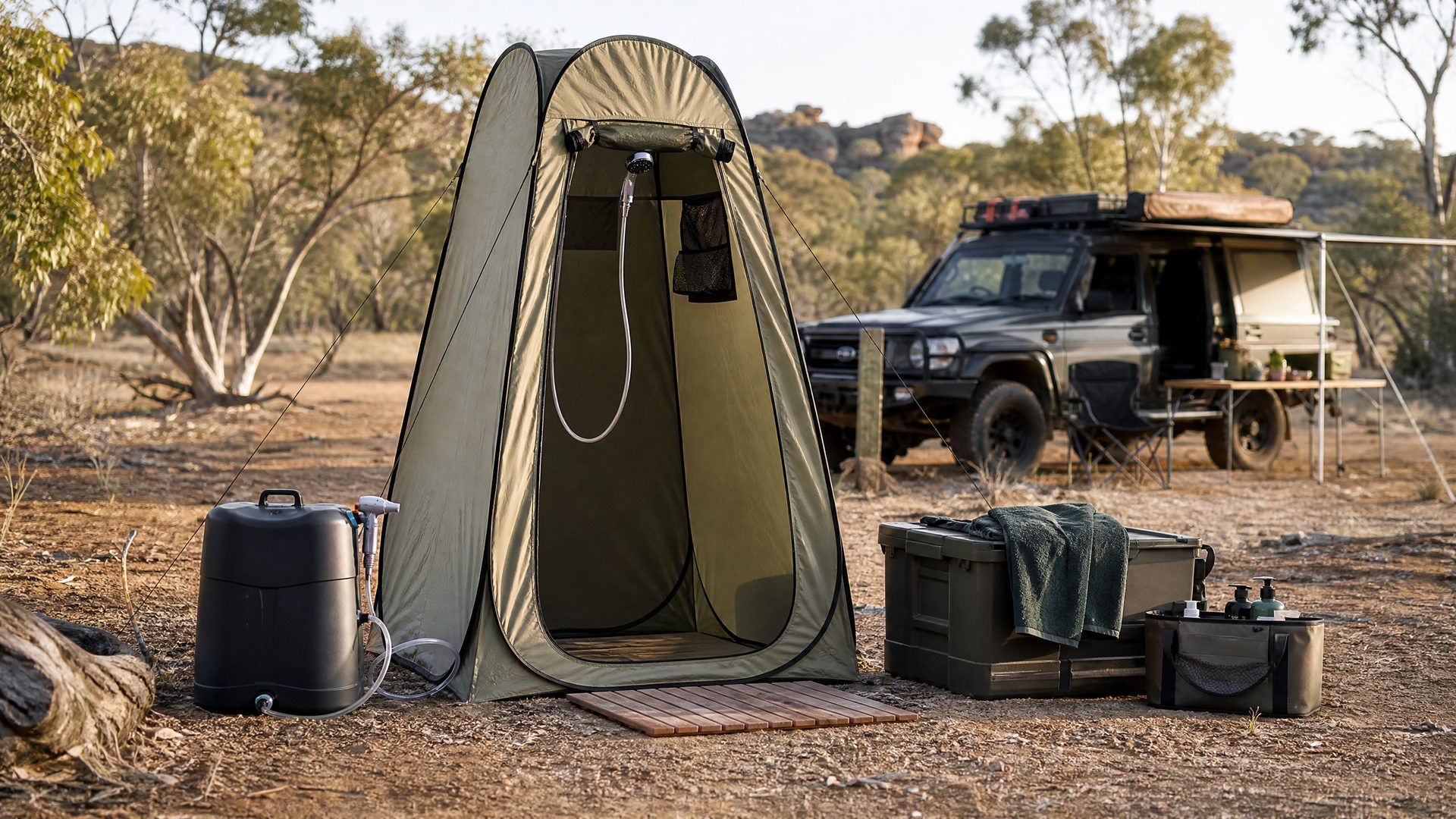
Finally, weigh portability, storage and build. Solar bags and small pumps pack into nothing, while gas systems and pressurised tanks want dedicated space. Look for hard-wearing PVC on bags, brass fittings on hoses, and a pump that will not choke on grit. Then plan for privacy and drainage: a pop-up shower tent makes it usable, and washing at least 50 metres from any water source with biodegradable soap keeps the site clean.
The honest question a camp shower answers is not “how do I get water” — it is “how do I get warm water, and how much.” A solar bag is the cheapest hot water going, but it needs three or four hours of real sun to warm up and holds about one short shower; a 12V or battery pump gives lovely pressure but no heat, so you are heating water on the stove first; and a gas continuous-flow unit is the only setup that runs genuinely endless hot water, at the cost of a gas bottle, a flat setup and proper ventilation. Whichever you pick, a “navy shower” — wet down, tap off, soap up, rinse — turns ten litres into several washes and is the single habit that makes off-grid washing actually work.
The Camp Showers
Check today’s prices on Amazon →
The 12V pump shower
This is the one I would point most campers to first. A small submersible pump drops into a bucket or jerry can, runs off a 12V socket or a battery box, and pushes a steady stream through the shower head. What makes it shine is that you control the temperature: heat a pot on the stove, mix it into the bucket to the warmth you like, and drop the pump in. It is cheap, reliable and endlessly flexible. See what a 12V pump shower costs.
The solar shower bag
The humble solar bag is the cheapest, simplest shower there is: fill it, lay it in the sun for a few hours, hang it from a branch or the roof rack, and let gravity do the rest. It packs to nothing and makes a perfect backup or a minimalist’s only shower. The limits are obvious: it relies on sunshine, the pressure is gentle, and hoisting a full bag up high can be a wrestle. As a cheap standby or for warm-weather trips, it is hard to fault. Compare the solar shower bags for cheap hot water.
The pressurised tank shower
A pressurised tank gives real pressure without needing power when you shower. You pump it up by hand or with a compressor beforehand, and some tanks are dark-coloured to soak up warmth from the sun. Mounted to a rack or stored in the back, it is durable and convenient for a permanent setup. The downsides are bulk and weight, and a roof-mounted tank raises your centre of gravity, so it suits a considered touring build more than a light weekend kit. Look at the pump-up pressurised tank showers.
The portable gas hot water system
For the closest thing to a home shower, a portable gas hot water system heats water on demand as it flows through the unit, so you get instant, endless hot water with good pressure and adjustable temperature. It connects to a gas bottle and a water source, the luxury choice for families and long stays. The cost is exactly that: the most expensive, bulkiest option, and it means carrying a bottle and setting up hoses and a pump. Buy it if regular hot showers are worth the space and outlay. Price up a gas continuous-flow unit for endless hot water.
The rechargeable battery pump shower
A rechargeable pump shower is the tidiest self-contained option: the pump, battery and shower head are one unit you charge over USB, then drop into any bucket. There is no cable to run and no 12V socket needed, which makes it brilliant for tent campers and anyone without a battery setup. Runtime and pressure are modest next to a wired 12V pump, so it suits quick, water-wise showers. As a grab-and-go in a small bag, it is genuinely handy. Check the rechargeable battery pump showers.
Comparison
| Shower type | Heating | Power needed | Best for |
|---|---|---|---|
| 12V pump shower | Warm your own water | 12V socket or battery | Value all-rounder |
| Solar shower bag | Sun | None | Budget and backup |
| Pressurised tank | Sun or ambient | None during use | Permanent touring builds |
| Portable gas system | Gas, on demand | Gas bottle, small pump | Families and long stays |
| Rechargeable pump | Warm your own water | USB charge | Tent campers, no vehicle socket |
Frequently Asked Questions
What types of camp shower are there?
The main types are solar bags warmed by the sun, 12V or rechargeable pumps that draw from a bucket, pressurised tanks you pump up beforehand, and gas units that heat water on demand. As a rule, the more convenience and hot water you want, the more you pay and set up.
How much water does a camp shower use?
A quick, water-wise wash can use only a few litres, but it is easy to run a tank dry if the water runs the whole time. A shower head you can pause while you lather is the biggest water saver.
Do I need a privacy tent?
At most sites, yes: a pop-up privacy tent is what makes a shower genuinely usable, and it doubles as a toilet or change room. It also blocks wind, which turns a warm shower cold fast.
How do I get hot water without a gas system?
Heat a pot or kettle on your camp stove or fire, mix it into a bucket of cold water to a comfortable temperature, then use a 12V or rechargeable pump to shower from it. This gives warm water far cheaper than a gas heater, which is why the pump-and-bucket method is so popular.
The Bottom Line
A camp shower is a small investment that lifts an off-grid trip out of the grubby-and-gritty category, but the right one depends on your setup, not the price tag. For the average setup, a 12V pump shower fed with water warmed on the stove does almost everything a fancy system does for far less; a solar bag is a great cheap backup, a pressurised tank suits a permanent build, and a gas unit earns its space on long family stays. Add a privacy tent, shower well away from any water source, stay water-wise, and you will feel human every night.
Related guides
Compare your options on Amazon →
