
This page contains affiliate links. Far Cornel may earn a commission if you buy through them, at no extra cost to you.
See the top-rated gear on Amazon →
Quick answer: Buy for the metal, not the badge. A flanged cast-iron oven around 9 quarts (about 8.5 litres) is the do-everything choice — a Lodge for a dependable default, a Camp Chef when baking is the point. Cooking for two? Drop to 4.5 quarts. Counting every kilo on a touring rig? Spun steel (Wildtrak) or hard-anodised aluminium (GSI) roughly halves the weight. Skip enamelled pots for open-fire work.
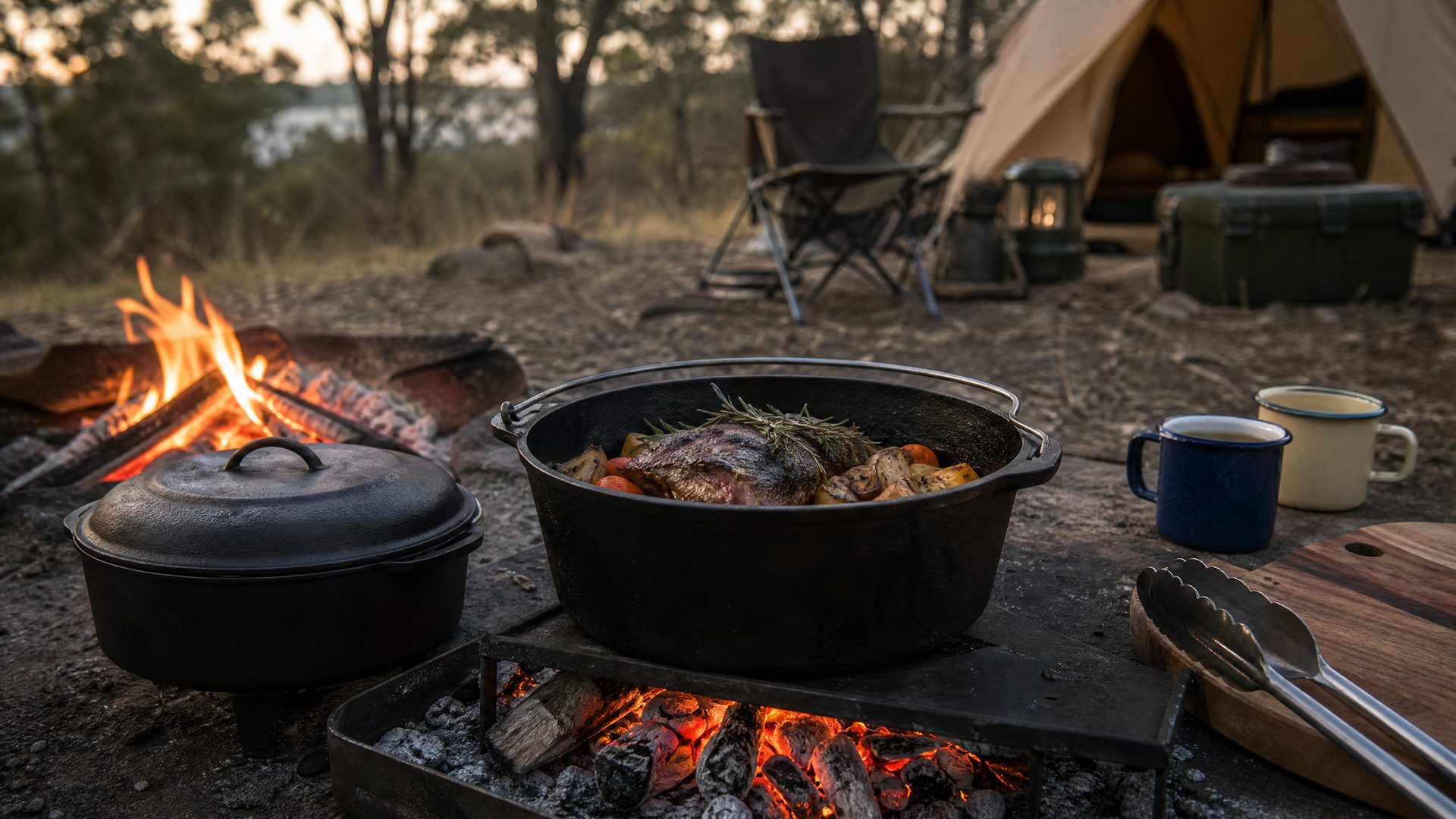
Pull a golden loaf out of a black iron pot at a fireside — no oven, no gas, no power anywhere near it — and someone always asks how you did it. The answer is boring and brilliant at once: thermal mass. A thick-walled pot swallows the fierce, uneven heat of a fire and hands it back low and even, so a stew ticks over for hours and a roast cooks through instead of charring on one side and staying raw on the other.
That is the whole case for a camp oven, and also the trap. The marketing wants you choosing between brands; the real decision is simpler and comes down to three things — the metal, the size you actually cook for, and whether the lid is built to hold coals. Get those right and a cheaper pot used well will outcook a premium one used badly. Here is how each metal behaves, which pot suits which trip, and the coal maths that turns “cook on a fire” into real temperature control.
Quick Picks
- Best all-round cast iron: Lodge Camp Dutch Oven — deep, legged, properly flanged and usable almost out of the box.
- Best for serious baking: Camp Chef Deluxe Dutch Oven — the flat, tight lid doubles as a griddle and holds a full load of coals.
- Best value first oven: Coleman cast iron camp oven — the honest, no-frills pot to learn coal management on.
- Best for weight-limited touring: Wildtrak spun steel camp oven — about half the weight of cast iron and near impossible to crack.
- Best ultralight option: GSI Outdoors hard-anodised Dutch oven — aluminium, so it heats fast and packs light.

How to Choose a Camp Oven
Start with the metal; it changes how the oven cooks more than any logo does. Cast iron is thick — usually 4 to 6 mm in the wall — and that mass is the point: it soaks up heat and radiates it back evenly, which is exactly what slow stews and risen bread need. The price is weight (a large oven with its lid can run past 9 kg) and brittleness, since a sharp knock on rock can crack it. Spun steel flips the trade: far lighter, effectively unbreakable, quick to heat — but it sheds heat just as fast, so you tend the coals more often. Hard-anodised aluminium goes lighter again and heats almost instantly, at the cost of the deep, forgiving thermal mass that makes long bakes easy.
Then look at the lid, because it is doing two jobs. A flat, flanged lid with a raised rim holds a full load of coals on top without them rolling off into the fire, which is what lets you bake — heat from above browns the top while the base cooks gently. A domed or loose lid cannot hold coals properly, and an enamelled kitchen Dutch oven has no rim for them at all, which is why it belongs on the stove at home rather than over a fire. A loop handle on the lid and a sturdy wire bail on the pot are the difference between easy lifting and a burnt knuckle.
Temperature is really just coal counting. The rule that works in the field: take the oven’s diameter in inches and use that many coals for a moderate heat — a 12-inch oven, 12 coals — then split them for the job. Baking bread or a cake, put about two-thirds on the lid and one-third underneath so the top colours without the base scorching. Flip that for a stew or a boil — most of the heat underneath, a few on top. Roasting sits between the two, coals ringed evenly top and bottom. On a cold or windy day add a coal every 20 minutes or so to hold the heat, and lift the lid as little as you can; every peek costs you roughly ten minutes of recovery.
Whatever you buy in iron or steel needs seasoning to stay non-stick and rust-free. A factory-seasoned Lodge is usable from the first cook, but bake on a couple of extra thin oil layers before the first trip and the surface only improves from there. Aluminium skips all of that — it will not rust — but it also never builds the slick, dark patina that makes a well-used iron oven a pleasure to cook in.
The Ovens Worth Buying
Check today’s prices on Amazon →
Lodge Camp Dutch Oven
The default recommendation, and for good reason. Lodge has been pouring cast iron long enough to have the basics dialled: a deep pot, three stubby legs, a flanged lid with a loop handle, and factory seasoning that is usable from the first cook. The 10-inch (4-quart) suits a couple; the 12-inch (6-quart) is the one most groups should buy. It is heavy and the casting is a shade rougher than boutique brands, but it will outlast you. Day-one upgrade: add a longer lid lifter so checking on it stops being a reach over the coals. Check the latest Lodge Camp Dutch Oven on Amazon
Camp Chef Deluxe Dutch Oven
If baking is the reason you are buying, this is the pick. The lid sits flat and tight, holding a full load of coals without them rolling into the fire, and it flips over to work as a griddle for eggs or flatbread. Camp Chef puts a lid lifter in the box, which the others make you buy separately, and the seasoning is even over a thick wall. The trade-off is price — a clear premium over a plain pot — but for regular bread and roasts it earns it. Don’t buy this if you only ever make one-pot stews; the baking strengths go to waste. Browse Camp Chef Deluxe Dutch Oven on Amazon
Coleman Cast Iron Camp Oven
The sensible first oven. Coleman is not chasing the artisan crowd, so the casting is plain and the seasoning basic, but the fundamentals are right: real flange, real legs, a solid bail, at a price that does not sting if camp cooking turns out not to be for you. Give it two extra rounds of seasoning and it punches above its cost. Don’t expect a mirror-smooth interior or a lifetime warranty; do expect years of honest stews while you learn coal placement. Shop Coleman Cast Iron Camp Oven on Amazon
Wildtrak Spun Steel Camp Oven
When every kilogram on the rig counts, spun steel changes the maths. A Wildtrak weighs roughly half its cast iron equivalent and shrugs off the knocks that would crack iron — drop it and you get a dent, not a write-off. It heats fast, handy for boiling and frying, but sheds heat just as fast, so you watch the coals and rotate more often when baking. Think of it as the touring specialist: lighter, tougher, a little more hands-on. See Wildtrak Spun Steel Camp Oven options on Amazon
GSI Outdoors Hard-Anodised Dutch Oven
The lightest way to keep the format. GSI’s hard-anodised aluminium oven strips the weight down further again, with a machined base that sits flat and a lid still cut to hold coals. Aluminium heats almost instantly and cleans up easily, so it suits smaller groups and shorter trips where hauling 10 kg of iron is overkill. You give up the deep thermal mass, so it is less forgiving for long, low bakes — but for a fast roast or dinner for two, it pulls its weight by having almost none. Find the right GSI Outdoors Dutch Oven on Amazon

Comparison
| Oven | Material | Handy capacity | Weight feel | Best for |
|---|---|---|---|---|
| Lodge Camp Dutch Oven | Cast iron | 4–6 qt (3.8–5.7 L) | Heavy | All-round groups |
| Camp Chef Deluxe | Cast iron | 6–8 qt (5.7–7.6 L) | Heavy | Baking and roasting |
| Coleman Camp Oven | Cast iron | 4–6 qt (3.8–5.7 L) | Heavy | First oven on a budget |
| Wildtrak Spun Steel | Spun steel | 9 qt (8.5 L) | Light | Weight-limited touring |
| GSI Hard-Anodised | Aluminium | Small–medium | Very light | Fast cooks, small groups |
Frequently Asked Questions
What size camp oven should I buy?
Match it to your usual group, not your biggest-ever trip. A 4.5-quart (about 4.2 litre) oven cooks for two or three; 9-quart (about 8.5 litre) is the sweet spot for four to six; go bigger only if you regularly feed a crowd, since oversizing wastes coals and dries out small meals.
Heat beads or hardwood coals — does it matter?
Both cook, but they behave differently. Heat beads (compressed charcoal briquettes) burn at a steady, predictable heat for an hour or more, which is why they suit baking, where you set a temperature and leave it alone. Coals raked from a hardwood fire burn hotter and less evenly and need topping up more often, so they suit stews and boils you are already watching. If you are learning, start with heat beads — the even burn is what makes counting coals actually mean something.
Can I just use my enamelled kitchen Dutch oven over the fire?
Not really, and this is where a lot of money gets wasted. Enamel chips and crazes under direct flame, the lids are domed rather than flanged so they will not hold coals, and most have no legs. A purpose-built camp oven with a raised-rim lid is the tool for open-fire cooking; keep the enamel for the stove at home.
How do I keep it from rusting between trips?
Clean it with hot water and a brush or chainmail scrubber — no harsh detergent, which strips the seasoning — then dry it fully over low heat. While it is still warm, wipe a thin film of cooking oil over the whole surface, inside and out. Store it with the lid propped slightly open so air moves through, and drop a scrunched piece of paper inside to catch any damp.
The Bottom Line
Buy for how you cook, not for the biggest or cheapest pot on the shelf. Feeding a group over a fire, a flanged cast-iron oven near 9 quarts is the one you will still be using in twenty years — a Lodge for the safe default, a Camp Chef if baking is the whole point — and the money is better spent on a proper lid and a long lid-lifter than on enamel that chips over coals. If weight rules your packing, spun steel or aluminium keeps the format for half the heft, as long as you accept tending the coals a little more. Season it, feed it, keep it dry, and it turns into the one piece of camp kit that has people wandering over to your fire at dinnertime.