
This page contains affiliate links. Far Cornel may earn a commission if you buy through them, at no extra cost to you.
See the top-rated gear on Amazon →
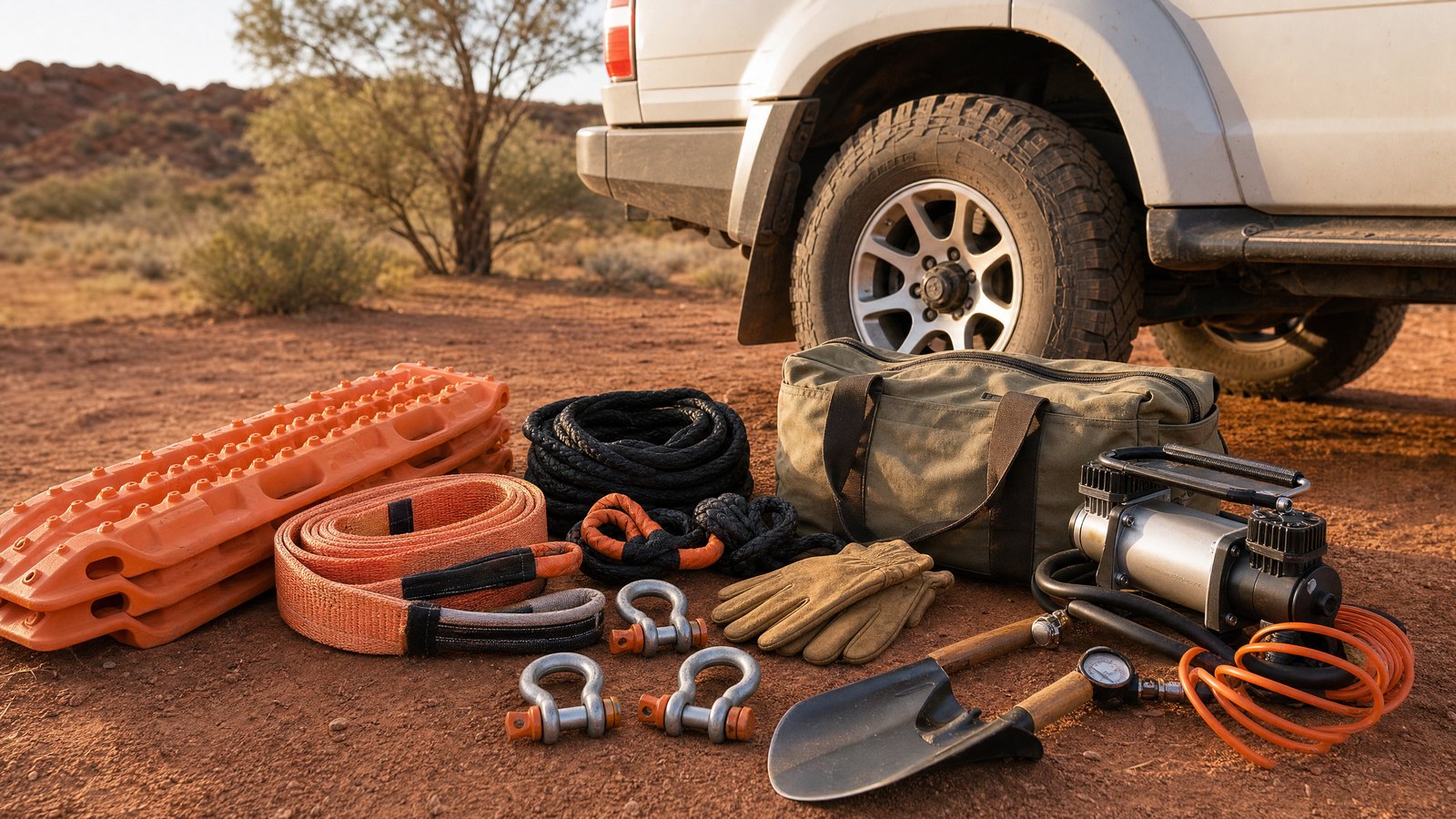
Quick answer: A first off-road recovery gear list only needs six things that earn their space: a tyre deflator and a 12V compressor, a long-handled shovel, a pair of recovery boards, gloves, and two rated soft shackles with a kinetic rope for vehicle-to-vehicle pulls. Lowering pressures and sliding boards under the tyres solves most stuck-vehicle situations on its own. A winch is not on the beginner list; it comes later, once the tracks you drive regularly earn it.
The most expensive way to get unstuck is to buy the winch first. Plenty of new drivers do exactly that, then sink to the axles in soft sand where a thirty-dollar deflator and a set of boards would have walked them straight out. Getting bogged is part of leaving sealed roads, but the fix is almost never the biggest thing on the shelf. Soft sand, sticky mud and rutted clay each trap a vehicle differently, and a beginner can handle nearly all of them with a small, well-chosen kit and a little technique.
Recovery is genuinely dangerous. The forces in pulling a two- or three-tonne vehicle free are enormous, and a snapped strap or a failed anchor point becomes a projectile. So treat buying the gear as step one of two: the second step is learning to use it, checking every rated point, and keeping people well clear of a loaded line. This checklist sticks to what belongs in a first kit, and to using it without hurting anyone.
Quick Picks
- Best first buy: a tyre deflator and a 12V compressor, because pressure prevents most bogs.
- Best self-recovery pair: a set of recovery boards, backed by a proper shovel.
- Best connector: two rated soft shackles instead of steel bow shackles.
- Best vehicle-to-vehicle tool: a kinetic recovery rope sized to your loaded weight.
- Best held-off purchase: a winch, until the tracks genuinely demand one.

How to Choose a First Recovery Kit
Match every load-bearing item to your vehicle’s loaded weight and its rated strength, and treat those ratings as non-negotiable. The number that matters on a kinetic rope or a strap is minimum breaking strength, and the widely taught guide is to choose one rated roughly two to three times your vehicle’s fully loaded weight, then keep well within it. Cheap, unrated gear bought to save money is exactly what you do not want holding a shock load.
Buy in the order that removes risk. A deflator and compressor come first because dropping pressures, often to somewhere around 18 psi in soft sand, lengthens the tyre’s footprint and prevents a huge share of bogs for no ongoing cost. Boards and a shovel come next as self-recovery you can do alone. A rope and shackles come after that, for when a second vehicle is around. The winch is last, and most beginners on sand and mild tracks do not need one for a long time. And when you are actually stuck, the order matters as much as the kit: stop before you spin the wheels, because spinning only digs you deeper; clear the sand or mud from in front of the tyres; drop your pressures; then try boards before you ever put a rope under tension. A pull is the last resort, not the first, because it is the one step that can hurt someone.
Brands matter here more than in most gear. Recovery boards from ARB or Maxtrax use UV-stabilised nylon that grips and springs back; soft shackles and ropes from names like Saber or Bushranger publish honest ratings you can trust. The bargain copies are the ones that glaze, melt or let go.
The Recovery Gear, In Buying Order
Check today’s prices on Amazon →
A tyre deflator and 12V compressor
This unglamorous pair prevents more bogs than anything else you can buy. A dedicated deflator takes several tyres down quickly to a known figure instead of you guessing with a valve key, and a 12V compressor airs them back up before you hit sealed roads again. Buy a compressor with a genuine duty cycle so it can do all four large tyres without overheating and cutting out, and check the airflow rating rather than just the headline maximum pressure. Do not buy this if you truly never leave the sealed surface, but for anyone airing down for sand or tracks it is the first thing in the kit. Shop tyre deflator on Amazon
Recovery boards
Boards are the most valuable self-recovery item for a beginner because they get you out without a second vehicle or a line under tension. Slid under the driven wheels after you have dropped pressures, a good pair floats the vehicle up and forward out of sand, mud or snow. Look for stiff, UV-stable nylon roughly a metre long, secure mounting so they are not rattling loose on the roof, and honest reviews rather than the cheapest listing. Skip the bargain look-alikes: they glaze under a spinning tyre and can snap when you load them. See recovery boards options on Amazon
A proper long-handled shovel
Before boards or a rope can do their job, you usually have to clear sand or mud from around the tyres and out from under the chassis. A long-handled shovel with a strong steel or composite blade moves real volume without wrecking your back, which a tiny folding trowel cannot. The compact folders pack smaller, but bogged to the axles you will wish you had the full-size tool. It doubles as a fire and general camp shovel too, so it rarely sits idle. Find the right recovery shovel on Amazon
Rated soft shackles
For joining a strap to a recovery point, soft shackles have largely replaced steel bow shackles, and for good reason. Made from synthetic rope, they are far lighter, they float, and if a point lets go they will not fly back as a lump of steel. Check the minimum breaking strength and keep it comfortably above your vehicle’s loaded weight, not merely equal to it, and inspect them for cuts or heat glazing before every use. Buy two so you can rig properly. They are cheap insurance against the most dangerous part of a recovery. Price up a soft shackles on Amazon
A kinetic recovery rope
When a second vehicle is around, a kinetic rope is the tool that does the pull. It stretches, storing energy from the moving vehicle and releasing it smoothly into the stuck one, which is gentler on both than a stiff tow strap that dumps a violent shock load. Match its rating to your vehicle, roughly two to three times the loaded weight, and never rig it to a tow ball or a factory tie-down eye. Do not buy this if you always travel solo, because it needs a second vehicle to work; a winch or boards suit lone travel better. See current kinetic recovery rope prices on Amazon

Comparison
| Gear | Job it does | What to check | Watch-out |
|---|---|---|---|
| Deflator + compressor | Prevents most bogs | Duty cycle, airflow rating | Cheap units overheat on big tyres |
| Recovery boards | Self-recovery, no second car | UV-stable nylon, secure mounts | Bargain copies snap or glaze |
| Long-handled shovel | Clears the wheels first | Blade strength, handle length | Folders are slow when axle-deep |
| Soft shackles | Connects strap to point safely | MBS above loaded weight | Never use a tow ball as a point |
| Kinetic rope | Vehicle-to-vehicle pull | Rating 2-3x loaded weight | Needs a second vehicle; rig it right |
Frequently Asked Questions
Do I need a winch to get started?
No. Most early recoveries come down to lower tyre pressures, boards, a shovel, and a kinetic rope with a second vehicle. A winch is heavy, needs a rated bar and upgraded wiring, and earns its place only once you regularly drive terrain those simpler tools cannot beat. Get the basics and the skills first; add a winch when the tracks genuinely demand it.
Can I use a normal tow strap for a recovery?
Not for a dynamic snatch. A flat tow strap barely stretches, so using it to yank a stuck vehicle dumps a huge shock load onto both cars and their attachment points, which is how things bend, tear off and fly. Use a kinetic rope or a proper snatch strap that is built to stretch, and connect it only to rated recovery points.
Do I really need rated recovery points?
Yes. The factory tie-down loops under most vehicles only hold the car still on a transport truck; they are not built for snatch loads and can rip off and become projectiles. Fit rated points designed for recovery before you attempt any dynamic pull, and never improvise with a tow ball, a bumper or a suspension arm.
How many recovery boards should I start with?
A pair covers most mild bogs. Very soft sand or a deeply buried vehicle can need extra digging and repositioning, but two good boards, a shovel and lower pressures handle the vast majority of first-timer situations. If you routinely travel solo in soft conditions, a second pair is a sensible add rather than a starting requirement.
The Bottom Line
Build the first kit around self-reliance and safety, not gadgets. Start with a deflator, a compressor and a shovel, because simply adjusting tyre pressure prevents a surprising number of recoveries. Add a pair of boards for self-recovery, then two rated soft shackles and a kinetic rope for when you travel with another vehicle. Learn to use each one safely, fit rated recovery points, and keep bystanders well back from any loaded line. Hold off on the winch until boards, deflation and a snatch genuinely cannot get you out.
These guides go deeper on the core items: compare the best traction boards, match a kinetic recovery rope to your loaded weight, and get airing down right with a fast tyre deflator kit.