
This page contains affiliate links. Far Cornel may earn a commission if you buy through them, at no extra cost to you.
See the top-rated gear on Amazon →
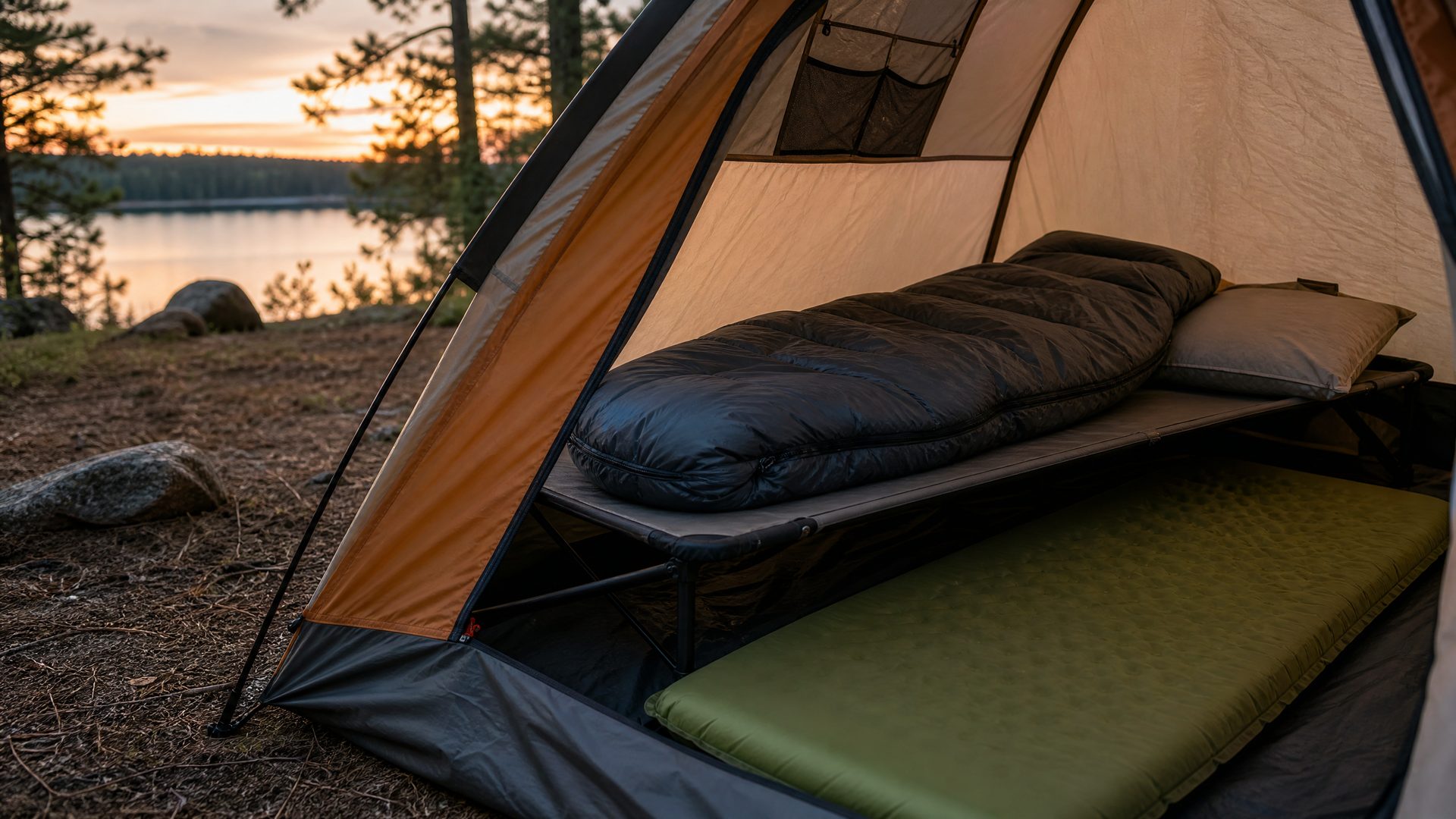
Quick answer: Build from the ground up. The winning combination is a bag rated a little colder than you expect, over an insulated mat of R-value 3 or higher, with a packable pillow. Add a cot for car-camping comfort and a liner to stretch the bag’s range. The mat, not the bag, is where a cold night is usually won or lost.
Sleep is the thing campers skimp on and regret first. You buy a good bag, crawl in on a cold night, and still wake at 3am with a chilled back and no idea why. Nine times out of ten it is not the bag. It is what is underneath you. A sleep system is the bag, the mat, a pillow and sometimes a cot working together, and warmth comes from the combination rather than any single piece.
Get the pieces matched to the season and you sleep the way you do at home; get one wrong and the rest cannot rescue it. This guide walks the components in the order that matters and flags the mistakes that leave people cold, sore or staring at the tent roof.
Quick Picks
- Best top insulation: a bag or quilt rated a step colder than your expected low.
- Best value in warmth: an insulated mat of R-value 3.0 or higher.
- Best small comfort: a compressible or hybrid camp pillow.
- Best for car camping: a sturdy cot or stretcher, used with a mat on top.
- Best cheap upgrade: a liner to add warmth, comfort and easy cleaning.

How to Choose a Sleep System
Start with the mat, because it decides whether you are warm and it is the part most people underspend on. Lie down and your weight crushes the bag’s insulation flat beneath you, so it stops trapping heat where you press. The mat’s R-value measures how well it blocks cold rising from the ground: below 2 is warm-weather only, 2 to 4 covers most three-season camping, and 4 or higher suits genuinely cold nights. You can also stack two mats and add their R-values, a cheap way to upgrade without replacing everything.
Then the bag. Treat the temperature rating as a rough guide, not a promise: most quote a comfort figure and a lower limit, and if you sleep cold or the air is damp you will feel colder than the number. Down gives the best warmth for its weight and packs tiny, but it is dearer and near useless once wet unless treated; synthetic is bulkier yet holds some warmth when damp and costs less. Shape is a warmth-versus-room call: a mummy traps less dead air and weighs less, a rectangular bag feels roomier but leaves more cold space to heat.
Round it out with the comfort pieces. A packable pillow is a small spend that fixes neck ache and saves bunching up a jumper. A cot lifts you off stones and damp and is kinder on older backs, but air moves freely underneath, so in the cold you still want a mat on top of it, not instead.
The Components
Check today’s prices on Amazon →
Sleeping bag or quilt
This is your top layer of warmth and the piece most people buy first. A bag wraps all the way round and suits colder or restless sleepers; a quilt drops the crushed underside and full zip to save weight, which suits milder nights and people who shift about. Brands like Sea to Summit and Exped make both well. Buy for a low a little below what you expect, since it is easy to vent a warm bag and impossible to add warmth you did not bring. Price up a camping sleeping bag on Amazon
Insulated sleeping mat
If you upgrade only one thing, make it this. An insulated mat is what stops the cold ground draining your heat all night. Closed-cell foam is cheap, tough and puncture-proof but bulky and only mildly warm; self-inflating mats mix foam and air for a comfortable middle ground; air pads are the lightest and most packable, and the warm ones use internal insulation or reflective layers, at the risk of a puncture. Match the R-value to the season and you fix most cold-night complaints. See current insulated sleeping mat prices on Amazon
Camp pillow
A good pillow punches above its size for sleep quality. Inflatable pillows pack down to nothing but can feel firm; compressible foam pillows feel closest to home but take more space; hybrids split the difference with an inflatable core under a foam top. A real pillow beats a stuff sack of clothes, and it is the cheapest comfort upgrade you can buy. Compare camp pillow on Amazon
Cot or stretcher
A cot lifts you off the ground and away from stones and damp, and many find it far kinder on the back and easier to climb out of. The catch is warmth and bulk: air flows freely beneath it, so keep a mat on top in cool weather, and accept that it is heavy and packs large. It earns its place at car and base camps, and loses its appeal the moment you carry gear any real distance. Check the latest camping cot on Amazon
Sleeping bag liner
The most overlooked piece here. A liner adds a few degrees of warmth for very little weight, keeps the inside of the bag clean so you wash it far less, and doubles as a light sheet on warm nights. Silk and merino cost more but pack tiny and feel lovely; a fleece liner adds the most warmth for the money. It is the cheapest way to stretch one bag across more of the year. Browse sleeping bag liner on Amazon
Comparison
| Component | Job it does | Key number | Don’t skimp because |
|---|---|---|---|
| Sleeping bag or quilt | Traps the heat you make | Comfort and limit rating | You can vent warmth, not add it |
| Insulated mat | Blocks cold from the ground | R-value | This is where cold nights are lost |
| Camp pillow | Neck support and posture | Packed size | Cheapest comfort in the kit |
| Cot or stretcher | Lifts you off the ground | Weight capacity | Needs a mat on top for warmth |
| Liner | Adds warmth and hygiene | Material and weight | Stretches one bag across seasons |
Frequently Asked Questions
Do I really need a mat if my bag is warm?
Yes, and it is the part people most often skip. Your weight flattens the insulation under you, so the bag alone cannot keep the ground’s chill out. The mat does that job, and skipping it is the quickest route to a cold night no matter how good the bag is.
Should I get a bag or a quilt?
A bag wraps fully round and suits colder nights and people who like feeling enclosed. A quilt saves weight and bulk and suits milder conditions and sleepers who roll about. Both still rely on a good mat underneath, so the choice is about warmth and preference.
What R-value do I actually need?
For warm nights, under 2 is fine. For three-season camping, aim for 2 to 4. For cold trips, look for 4 or higher, or stack a foam mat under an air pad and add their values. The colder and harder the ground, the more the R-value matters.
Can I just use an air mattress?
A plain air mattress insulates poorly, because the open air inside it circulates and can leave you colder than the bare ground. If you want that raised-bed feel, lay a foam mat or a rated air pad on top of the mattress to add the insulation it lacks.
The Bottom Line
Match the system to how you camp. On a budget, a decent bag over a thick foam or basic self-inflating mat does the job. Family and car campers should lean into comfort: a roomy bag, a high R-value mat, a soft pillow and a cot if there is room. For cold nights, spend on a good bag and a mat rated 4 or higher. Whatever you buy, put the money into the mat first, because that is the piece that decides whether you sleep warm.
For the next pieces of the puzzle, see our guides to down sleeping bags, self-inflating sleeping mats, and the camping gazebo and canopy guide.
Compare your options on Amazon →
