
This page contains affiliate links. Far Cornel may earn a commission if you buy through them, at no extra cost to you.
See the top-rated gear on Amazon →
Quick answer: From reasonably clean sources, a hollow-fibre filter — a squeeze unit for one person, a gravity system for a group — is the sweet spot: fast, low-effort and effective against bacteria and protozoa. Add a pump filter for murky or shallow water, step up to a purifier where viruses are a real risk, and always carry purification tablets as a light backup for when a filter clogs or cracks.
A filter’s most dangerous trick is false confidence. Push cloudy water through it, watch it run clear, and it is easy to believe the job is done, when the filter may have removed nothing that could actually make you ill. Clean water is the one thing you cannot improvise once the taps run out, so it pays to know exactly what each tool stops and what it lets straight through.
The good news is that matching the tool to the source is simple once you know the categories. This guide covers the main types, what each one removes, and how to choose without carrying a filtration lab on your back.
Quick Picks
- Best for one person: a hollow-fibre squeeze or straw filter.
- Best for groups and base camp: a gravity filter.
- Best for murky or shallow water: a pump filter.
- Best for virus risk: a purifier.
- Best backup: purification tablets or drops.

How to Choose a Water Filter
Start with what could be in the water. Most sources carry some mix of sediment, bacteria and protozoa such as Giardia and Cryptosporidium; some also carry viruses, farm runoff, chemicals or heavy metals. Public-health guidance is blunt on two points: clear water can still be unsafe, and water fouled with chemicals or toxins cannot be fixed by filtering or boiling alone. If a source might carry fuel, pesticide or algal toxins, find a different source rather than trusting any camp filter.
Then learn the one distinction that matters: a filter is not a purifier. A standard hollow-fibre filter uses tiny pores, often 0.1 to 0.2 microns, to physically strain out bacteria and protozoa, but most do nothing about viruses. Where human-waste contamination is likely, treat filtering and disinfecting as two separate steps and use a purifier or a filter plus a chemical treatment.
Finally, think about volume and taste. A squeeze or straw filter suits a solo hiker; a gravity or pump system processes litres quickly for a group. A carbon element adsorbs chemicals and improves taste but does not kill microbes, so it works alongside a hollow-fibre element rather than instead of one.
The Water Treatment Options
Check today’s prices on Amazon →
Hollow-fibre squeeze or straw filter
The default for one person. A hollow-fibre squeeze or straw filter strains water through pores around 0.1 to 0.2 microns, catching bacteria and protozoa, and it is light, cheap and near foolproof. Names like Sawyer and LifeStraw dominate here. Backflush it regularly and it can last thousands of litres, but silty water clogs it faster, and it never removes viruses or dissolved salt. compare squeeze filters and how fast they actually flow
Gravity filter
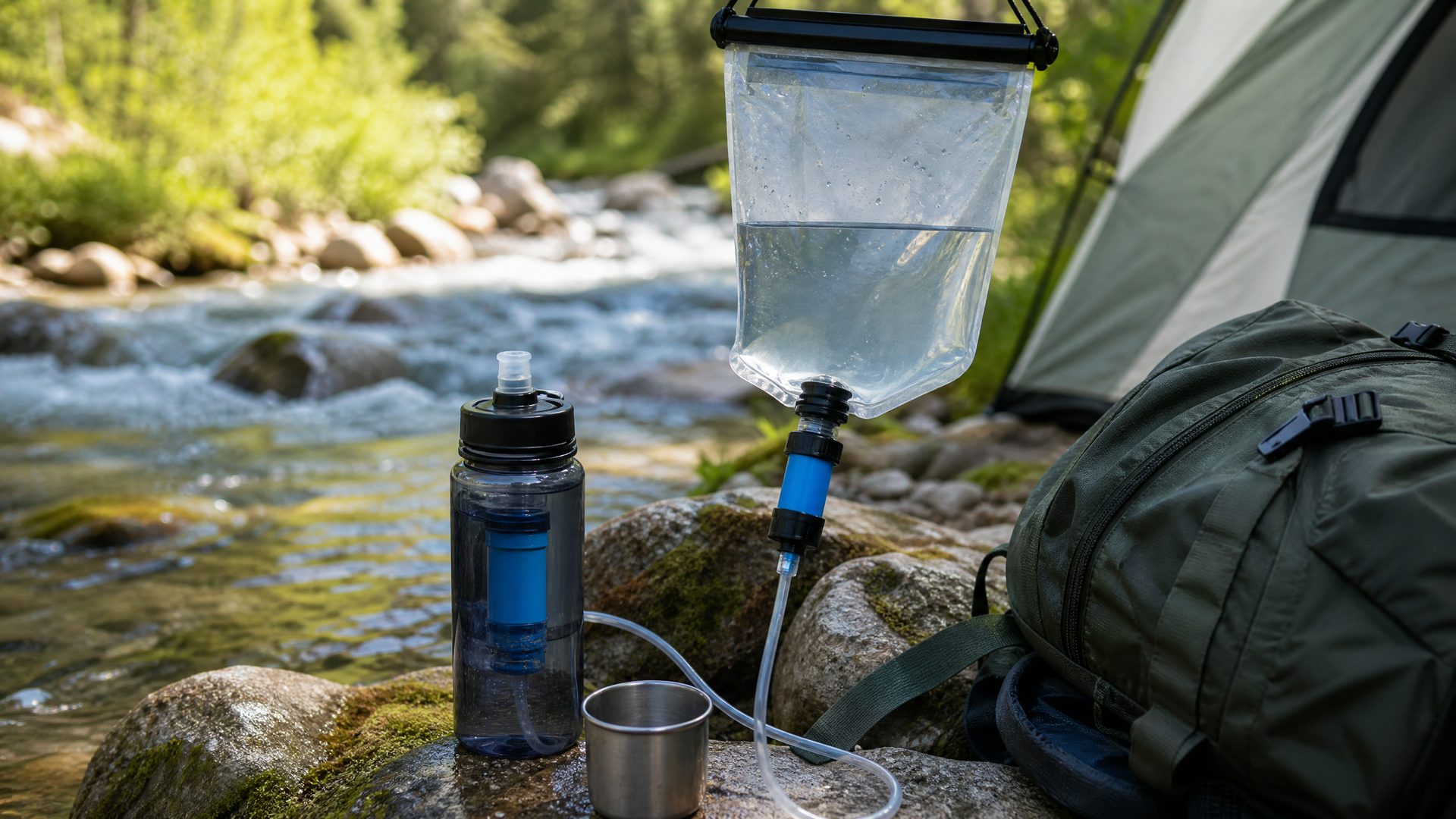
The easy option for groups and base camps. Fill a dirty bag, hang it, and gravity does the work while you set up camp, filling clean containers with no pumping or squeezing. Platypus and Katadyn make popular versions. It is the least effort per litre of any system, which is exactly why it wins for families, though the bags take some care to keep the dirty and clean sides strictly apart. see gravity systems sized to fill a group’s bottles
Pump filter
The tool for awkward sources. A pump filter lets you draw from a shallow puddle, a seep or a tricky bank that a squeeze filter cannot reach, and you control the flow by hand. MSR and Katadyn are the known names. It is heavier and slower than gravity and has more moving parts to maintain, but for genuinely marginal water nothing else gives you the same reach and control. look at pump filters built for shallow, awkward sources
Purifier
The step up when viruses are a real risk, such as water that may carry human-waste contamination. A purifier removes or deactivates viruses as well as bacteria and protozoa, using a finer element, an ultraviolet pen or a chemical stage. Grayl and Katadyn make trusted units. The trade-off is a slower flow, higher cost and more weight, so most campers carry one only when the source genuinely warrants it. check purifiers that shut viruses down too
Purification tablets or drops
The backup that weighs nothing and never clogs. Chlorine-dioxide tablets or drops kill bacteria, protozoa and viruses given time, which makes them a fail-safe for when a filter cracks or freezes. They can take up to four hours against Cryptosporidium and leave a faint chemical taste, and they do not clear sediment, so pre-filter cloudy water through a cloth first. Every kit should carry a strip. keep a strip of purification tablets in the kit
Two failures no filter warns you about: a clogging element and a freeze. As a hollow-fibre cartridge blocks up, the flow slows to a trickle long before it stops working — backflush it in the field to bring the flow back, and dry it fully before storage so it does not grow mould of its own. And never let one freeze with water still inside; the ice splits the microscopic fibres, and it will then pour perfectly clear water that no longer filters a thing. That is the false-confidence trap wearing a different hat: clear is not the same as safe.
Comparison
| Type | Stops | Does not stop | Best for |
|---|---|---|---|
| Squeeze/straw filter | Bacteria, protozoa, sediment | Viruses, chemicals, salt | One person, light trips |
| Gravity filter | Bacteria, protozoa, sediment | Viruses, chemicals, salt | Groups and base camp |
| Pump filter | Bacteria, protozoa, sediment | Viruses, salt | Shallow or murky sources |
| Purifier | Viruses, bacteria, protozoa | Salt, most chemicals | Human-waste risk |
| Tablets/drops | Viruses, bacteria, protozoa | Sediment, chemicals, salt | Backup and ultralight |
Frequently Asked Questions
Do I need a filter, or is boiling enough?
Boiling kills microbes but does nothing for sediment, chemicals or taste, and it burns fuel and time. A filter is faster and clears cloudiness but does not touch viruses or dissolved chemicals. When the water is genuinely doubtful, the two work well together: filter to clear it, then boil or treat to be sure.
What do camping water filters actually remove?
Most hollow-fibre filters remove bacteria, protozoa and sediment down to around 0.1 to 0.2 microns. What they do not remove is viruses or dissolved salt, and a plain filter will not deal with chemical pollution. For viruses you need a purifier or a chemical treatment on top of filtering.
Squeeze, pump or gravity, which should I get?
Squeeze and straw filters are light and personal; pumps let you draw from shallow or awkward sources; gravity systems fill containers for a whole group with almost no effort. Match the type to how you camp, and many tourers carry a squeeze filter for the day and a gravity system for camp.
Can a filter make seawater drinkable?
No. Ordinary filters and purifiers do nothing about dissolved salt, and removing it needs desalination by distillation or reverse osmosis, a slower and quite different process. Treat seawater as undrinkable in the field unless you carry gear built specifically for it.
The Bottom Line
From reasonably clean water, a hollow-fibre filter earns its keep: a squeeze unit for one person, a gravity system for a group, both fast and effective against bacteria and protozoa. Reach for a pump when the source is shallow or murky, and step up to a purifier when viruses are a genuine risk rather than a maybe. Whatever you carry, keep a strip of purification tablets in the kit as a light, fail-safe backup, and never let a filter convince you that clear water is automatically safe.
For more on kitting out for off-grid trips, see our guides to camp shower systems, offline navigation for touring, and camping sleep systems.
Compare your options on Amazon →
