
This page contains affiliate links. Far Cornel may earn a commission if you buy through them, at no extra cost to you.
See the top-rated gear on Amazon →
Quick answer: For touring, a quality UV-stabilised stretch mesh net, sized with some stretch to spare, is the one to own: it throws over a mixed load and clips down in seconds. Rhino-Rack and Front Runner make good ones. Add a fine-mesh net for small gear, a barrier net to keep the load out of the cabin, and always strap heavy items rather than trusting the net.
Anyone who has watched a bag tumble across a tray or heard gear crash around the boot on a rough track knows why a cargo net earns its place. A net is the simplest way to keep loose loads where you put them, stretching over bags, recovery gear and camping kit so nothing bounces out or slides forward under braking. It will not replace rated straps for a heavy item, but for containing the soft, awkward gear that fills a touring vehicle, nothing is quicker to throw over.
Nets come in more forms than most people expect, from a general stretch mesh that conforms over an uneven load to a vertical barrier that stops cargo flying into the cabin, and using the wrong one is where people come unstuck. Hook quality and resistance to sun separate a net that lasts years from one that perishes in a season. Be honest, too: a net contains light, loose gear, but heavy items still need rated straps.
Quick Picks
- Best overall: a heavy-duty stretch mesh net sized to your load area.
- Best budget: a simple bungee net for occasional trips.
- Best for roof racks: a large net with plenty of anchor hooks.
- Best for small items: a fine-mesh net that traps loose gear.
- Best barrier: a net that separates the load area from the cabin.

How to Choose a Cargo Net
Start by matching the type and size to what you carry and where. A general stretch mesh net suits a tray or boot full of soft, loose gear; a roof-rack net is shaped and hooked for a basket; a fine-mesh net stops small items slipping through; and a barrier net separates the cargo area from the people up front. Size matters: a net stretched near its limit turns thin, with gaps that let gear escape, while an oversized one sags. Choose one that covers your area with stretch in reserve.
Then look hard at the hooks and the material, because that is what fails. The hooks take all the load, so strong steel or moulded hooks with a positive catch beat flimsy plastic ones that snap on a rough track, and rubber-coated hooks spare your paint. The netting should be UV-stabilised, since cheap elastic perishes after a season in the sun. The classic mistake is trusting a stretch net to restrain a heavy item that needs a rated strap, so keep straps for the heavy gear and the net for containment.
Be honest about what a net is for. It is brilliant for containment, but it is not a load-rated restraint. Anything heavy should be held by rated straps, with the net as a secondary layer. Load-restraint rules vary and change, so check your current local regulations for how loads must be secured.
The Cargo Nets Worth Considering
Check today’s prices on Amazon →
All-Round Stretch Mesh Net
The one most tourers should own. A heavy-duty elasticated mesh net stretches over a rack, tub or trailer, hooks to the anchor points and holds a mixed load snugly, and Rhino-Rack and Front Runner build hard-wearing versions with decent hooks. Sized right, it handles the widest range of trips and is the net you will reach for first. Don’t buy one so small you stretch it flat; leave some give in reserve. See current stretch mesh cargo nets prices on Amazon.
Budget Bungee Net
For occasional loads or a spare to keep in the vehicle, a simple bungee cargo net does the basics for very little. It will not have premium hooks, but for holding a few bags on a short run it is hard to argue with the price, and Kings and Oxford do cheap, cheerful ones. Keep it for light containment, and don’t ask it to hold anything that matters. Look over the current budget cargo nets options on Amazon.
Roof-Rack Cargo Net
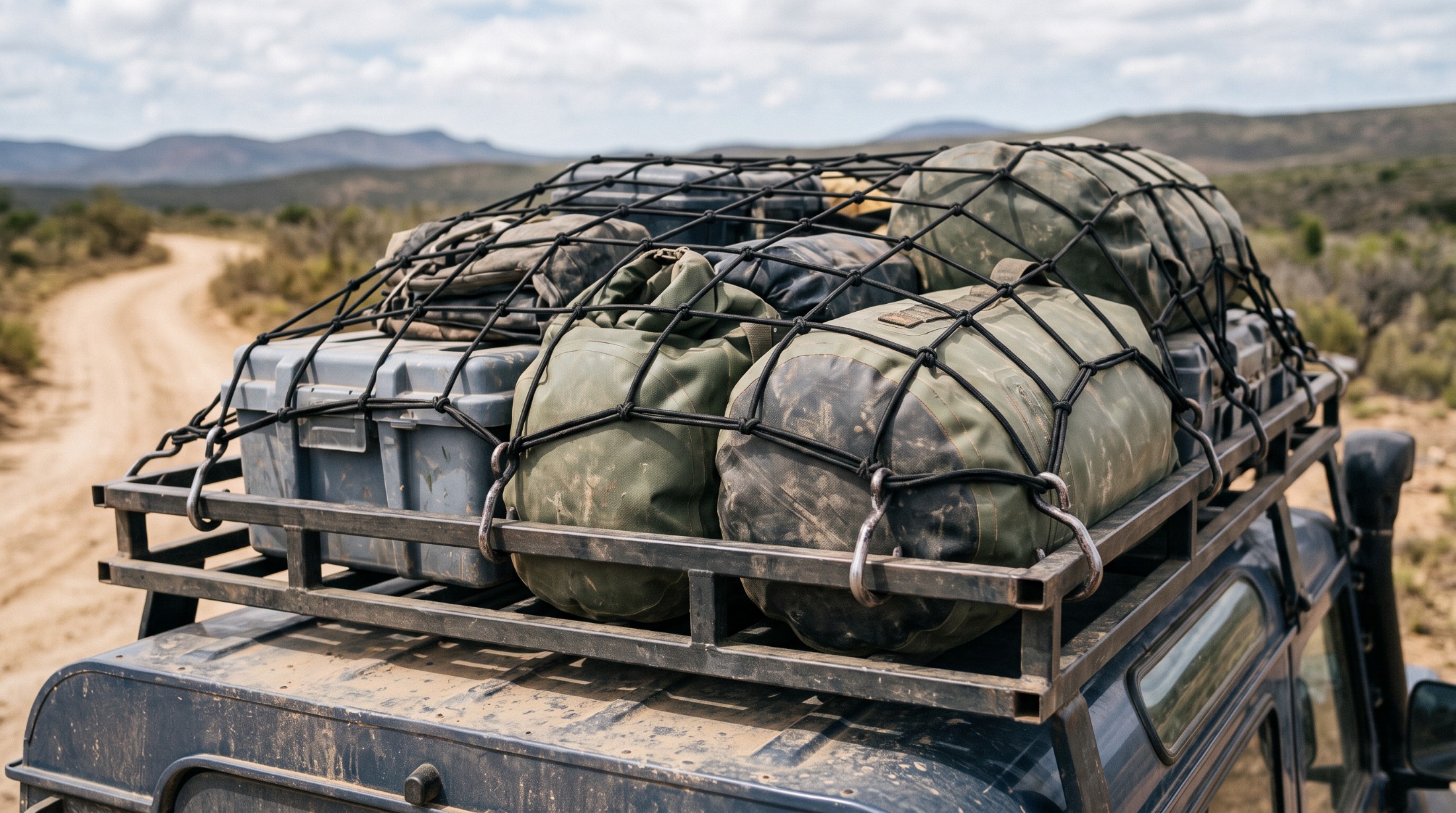
Roof loads take the most punishment, so a large net with strong, closely spaced anchor hooks earns the spend. It pins bags and tubs to the basket and stops wind and corrugations working them loose, and Rhino-Rack and Front Runner size theirs to common rack footprints. Make sure it reaches your rack’s fixing points with tension to spare. Don’t trust a light bungee net up top, where a failure sends gear onto the road. Check current roof-rack cargo nets stock on Amazon.
Fine-Mesh Net for Small Items
If your load is lots of little things, bottles, tools, dry bags, cookware, a fine-mesh net keeps them contained instead of letting them slip through wide gaps. It is the difference between arriving with your gear where you left it and hunting for it under the seats. Pair it with a stretch net over the top, and it earns its keep on any trip with loose odds and ends. Shop fine-mesh cargo nets choices on Amazon.
Cargo Barrier Net
A barrier net stretches across the vehicle behind the seats, separating the load area from the cabin so gear cannot come forward under braking. It is a simple safety upgrade for wagons and pickups, and a sensible choice if you travel with a dog or a heavily loaded rear. It is not a full steel cargo barrier, so treat it as restraint for light gear, not a crash-rated bulkhead. See the newest cargo barrier nets listings on Amazon.
Comparison
| Type | Best for | Fit | Hooks | Watch-out |
|---|---|---|---|---|
| Stretch mesh net | General touring loads | Rack, tub or trailer | Steel or moulded | Size with reserve |
| Budget bungee net | Occasional or spare | Small to medium | Basic plastic | Light duty only |
| Roof-rack net | Roof-mounted gear | Full roof rack | Strong, close-spaced | Must reach fixings |
| Fine-mesh net | Lots of small items | Tub, boot or trailer | Varies | Not for big items |
| Barrier net | Load out of cabin | Behind the seats | Anchored ends | Not a steel barrier |

Frequently Asked Questions
What size cargo net do I need?
Measure the area you need to cover, then pick a net that reaches it with a bit of stretch to spare rather than one pulled to its limit. An over-stretched net thins out and opens gaps, while an oversized one sags. Many nets list a relaxed and a stretched size, so buy to sit between the two.
Does a cargo net meet load-restraint rules?
Often not on its own. A stretch net contains and steadies loose, lighter gear, but load-restraint standards require heavy or hard items to be secured so they cannot shift under braking, which usually means rated straps. Treat a net as containment for light loose gear, not as the primary restraint for anything heavy.
Cargo net or ratchet straps?
They do different jobs, so usually both. Ratchet or cam straps lock down heavy, hard items so they cannot move, while a cargo net contains the loose, lighter gear that would otherwise slide or blow out. Strap the heavy things first, then net the rest. A fridge or full water container needs strapping; sleeping bags, chairs and a bedroll are what a net is for.
Will a net damage my gear or paint?
It can if you are careless. Bare metal hooks scratch paint, so use rubber-coated hooks or clip to proper anchor points, and avoid over-tightening onto soft gear, where the mesh can press in. Used sensibly, a good net protects more than it harms.
The Bottom Line
A cargo net is one of the cheapest upgrades that makes a real difference on rough tracks. A heavy-duty stretch mesh net sized to your load area is the right pick, with a fine-mesh option for lots of small gear and a barrier net to keep the load out of the cabin. Just remember the golden rule: rated straps for heavy items, a net for containment.
Pair it with a set of ratchet straps and tie-downs, a solid roof rack platform, and some rugged storage boxes to keep the whole load organised.