
This page contains affiliate links. Far Cornel may earn a commission if you buy through them, at no extra cost to you.
See the top-rated gear on Amazon →
Quick answer: The best tie-down kit is a small mix, not one type. A rated ratchet set from Rhino-Rack, ARB or Ancra handles heavy, must-not-move loads; a pair of cam buckle straps like Rollercam secures kayaks and fragile gear without crushing them; ROK Straps and soft loops protect finishes; and a few bungees plus a cargo net tame the loose light stuff.
Nothing focuses the mind like watching a kayak lift off the roof in the mirror, or hearing a bike shift in the tray on a corrugated back road. A load that moves is a load that can be lost or turned into a hazard for whoever is behind you, and the humble tie-down is the cheap bit of kit standing between a tidy trip and an expensive one. Straps cost little, but the wrong type or an underrated set gives a false sense of security.
Tie-downs come in a handful of forms, and each has a job it does well and jobs it does badly. Ratchet straps deliver serious tension, cam buckles cinch gently and fast, retractables tidy themselves away, soft loops protect paint, and bungees and a net stop light items shifting. Read the ratings right and match the type to the load, and you rarely go wrong.
Quick Picks
- Best overall: a rated ratchet set — for heavy, must-not-move loads.
- Best for fragile gear: cam buckle straps — cinch tight without crushing.
- Best for convenience: retractable tie-downs — never tangle or trail loose ends.
- Best for paint and alloy: soft loops and ROK Straps — protect finished surfaces.
- Best for odd loads: a bungee and cargo net kit — for scattered light items.

How to Choose Ratchet Straps and Tie-Downs
Learn to read the rating, because the big number is not the useful one. Straps quote a break strength and a working load limit, and only the working load limit matters for securing a load — it is usually about a third of the break figure. Add up the working load limits of the straps actually holding a load, keep the total comfortably above the weight, and spread it across several anchor points. If a strap prints no working load limit at all, put it back on the shelf.
Then match the strap to the load, not just the weight. A ratchet gives huge, lever-driven tension for heavy items that must not budge, while a cam buckle tensions only as hard as you can pull — which is exactly what a kayak or canoe needs, because you physically cannot crush it. Reach for the ratchet on a bike or a stack of crates; reach for the cam strap on anything hollow, moulded or precious.
Small details save your paint and your straps. Coated or flat hooks and soft loops let you anchor to bars and rails without chewing the finish, and a corner protector under any webbing that crosses a sharp edge stops it chafing through on a long, vibrating drive. Keep webbing out of grit, dry it before storage, and retire anything cut, frayed or sun-chalked, because worn webbing loses strength long before it looks failed.
The Tie-Down Straps
Check today’s prices on Amazon →
Ratchet Straps
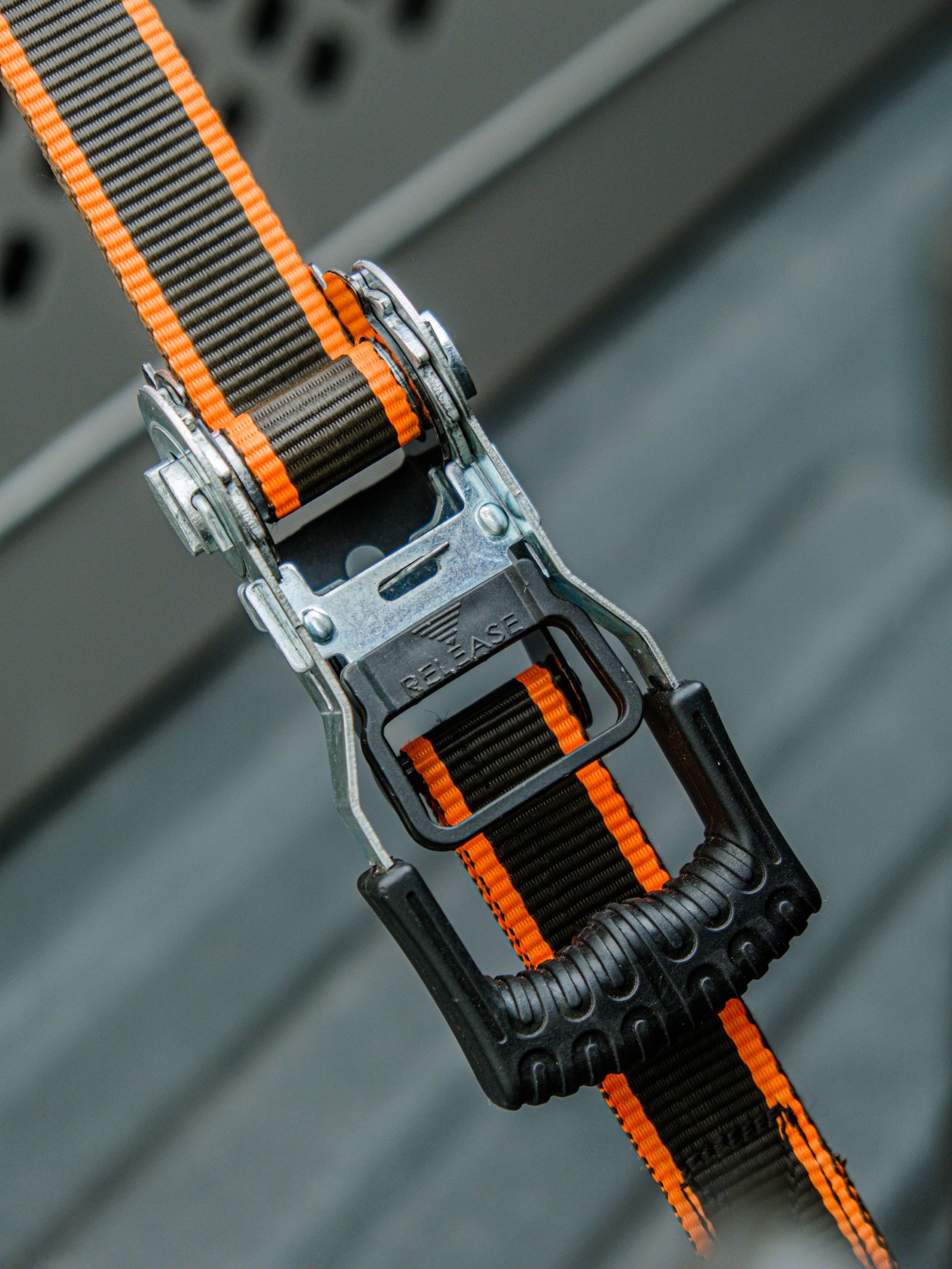
The workhorse for heavy, must-not-move loads: bikes, mowers, stacked crates. The ratchet multiplies your effort into serious, repeatable tension and holds it without slipping, and a rated set from Rhino-Rack, ARB or Ancra will outlast a dozen no-name specials. The trade-offs are real — slow to release, prone to jamming with grit or a twisted strap, and easy to over-tighten. Don’t use them to compress anything you could crush. Buy rated, keep them clean, and they are the backbone of any kit. Check the latest ratchet straps range on Amazon.
Cam Buckle Straps
A cam buckle tensions only as hard as you pull, which sounds like a weakness and is the whole point. You cannot over-tension and dent a kayak, a canoe or a piece of furniture, and release is instant, so they beat a ratchet for light, everyday loads. Premium versions like Rollercam add a roller that cinches tighter and holds better than a plain cam. The limit is outright holding power, so step up to ratchets once a load is genuinely heavy. Run your eye over the cam buckle straps range on Amazon.
Retractable Tie-Downs
Retractables wind back into a housing like a seatbelt, so there is no long tail flapping in the wind or knotting in a drawer. That tidiness makes them a pleasure for repeat jobs, the same tubs, boards or crates every trip. Capacity is modest and you cannot easily swap the webbing, so treat them as a neat answer for lighter, recurring loads rather than heavy hauling. Don’t buy them as your only straps. Find the right retractable tie-down straps on Amazon.
Soft Loops and ROK Straps
Soft loops are short fabric slings that wrap a handlebar, roll bar or alloy rack, giving your hook something to grab without chewing the finish; riders anchor bikes at the triple clamp with them. ROK Straps take the idea further with adjustable, part-elastic straps that are brilliant for odd or awkward loads. Both are add-ons rather than complete tie-downs, so pair them with cam or ratchet straps and check they are rated to match. Compare today’s soft loop tie-down straps prices on Amazon.
Bungee Cords and Cargo Net
Bungees and a cargo net have one honest job: stopping light items rattling or lifting, a tarp, a pack, loose bits in the tray. They are quick and forgiving, and a net from Rhino-Rack or similar is worth having. But they stretch, so never trust them to secure anything that would hurt someone if it broke free, and keep your face clear when hooking one, because a hook that lets go under tension recoils hard. Look over the current cargo net and bungee cords options on Amazon.

Comparison
| Type | Holding power | Speed | Surface-friendly | Best for |
|---|---|---|---|---|
| Ratchet straps | High | Slower | With soft loops | Heavy loads |
| Cam buckle straps | Light to medium | Fast | Yes | Crushable gear |
| Retractable tie-downs | Light to medium | Fast | Yes | Tidy, repeat loads |
| Soft loops and ROK | Varies | Medium | Excellent | Delicate finishes |
| Bungee and net | Low | Very fast | Yes | Loose light items |
Frequently Asked Questions
What strength straps do I actually need?
Work from the working load limit, not the eye-catching break strength, which is usually about three times higher. Add up the working load limits of the straps holding the load, keep the total well above the weight, and spread it across several anchor points rather than one.
Ratchet strap or cam buckle?
A ratchet uses a lever to build far more tension and lock it in, for heavy loads that must not move. A cam buckle tensions only as hard as you pull, so it is faster and cannot crush fragile gear, but it holds less. Most kits need both.
How do I stop straps damaging my gear or vehicle?
Use coated or flat hooks and soft loops to spare paint and alloy, and slip a corner protector under any webbing that crosses a sharp edge. With a ratchet, stop tightening once the load is firm rather than crushing it.
When should I replace a strap?
Retire it once the webbing is cut, frayed or chalky and sun-faded, or when a hook is bent or the ratchet no longer holds cleanly. Worn webbing loses strength long before it looks fully failed.
What is the difference between lashing capacity and breaking strength?
Lashing capacity is the working load the whole assembly — webbing, stitching, hooks, ratchet — is rated to restrain in service. Breaking strength is the laboratory failure point, roughly double. Buy and compare on LC; a strap advertised only by breaking strength is telling you the flattering half of the story.
Why do my straps hum at speed, and does it matter?
Flat webbing in airflow flutters like a reed, and that flutter is both the noise and a wear mechanism. Put a couple of full twists in the exposed run when you fit the strap and the hum disappears, with no meaningful loss of strength. Tie off loose tails for the same reason.
The Bottom Line
The best tie-down kit is a small mix rather than one type. A rated ratchet set from Rhino-Rack, ARB or Ancra covers heavy loads, a couple of cam straps handle boats and fragile gear without crushing them, and a few bungees deal with the light stuff that only rattles. Buy on working load limit, protect any sharp edges with corner protectors, and check every strap before a serious trip so your load stays exactly where you put it.
Keep the rest of your load organised and secure with our guides to 4×4 storage boxes and gear crates, roof rack platforms, and recovery track mounting brackets.