
This page contains affiliate links. Far Cornel may earn a commission if you buy through them, at no extra cost to you.
See the top-rated gear on Amazon →
Quick answer: Buy for where the box lives and how hard it will be used. The Front Runner Wolf Pack Pro is the all-round touring pick that stacks and straps onto a roof platform, the Decked D-Box handles heavy tools, the RUX 70L is the premium big-capacity box, a sealed Pelican-style case protects electronics from dust and water, and a value crate like an Oztrail or Boab covers food and clothing. Measure the space first, and look for strong, flat, latching lids.
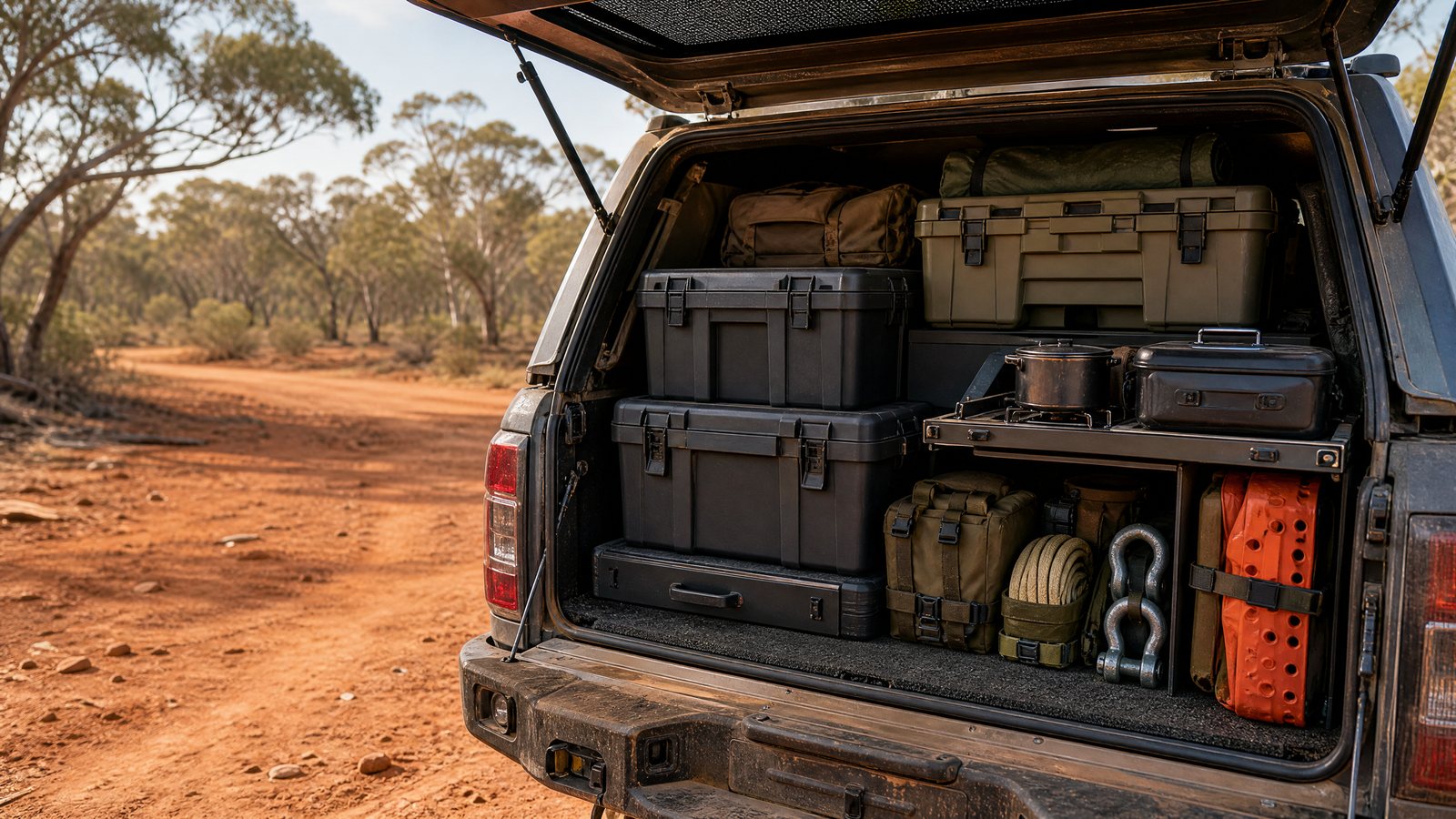
The difference between a load you dread unpacking and a camp where you can find things in seconds usually comes down to boxes. The right rugged crate keeps recovery gear, the camp kitchen, tools and food contained, dust-sealed and stackable, whether it is strapped to a roof platform, slotted into a canopy, or wedged behind the back seat. Cheap household tubs crack and pop their lids on corrugations; a proper storage box is built to take the abuse and the weight piled on top of it.
So the choice is less about the badge and more about three things: the material, how well it seals, and how it fits the space you actually have. A sealed box keeps fine dust off your food and electronics on a corrugated track; a flat, load-bearing lid lets you stack a second box on top without crushing what is inside; and a size that matches your canopy or drawer means nothing slides around on a corner. Get those right and the boxes quietly do their job for years.
Quick Picks
- Best overall rugged crate: the Front Runner Wolf Pack Pro.
- Best heavy-duty stackable: the Decked D-Box.
- Best premium modular box: the RUX 70L.
- Best dust-and-water sealed case: a Pelican-style Trail Case.
- Best value general crate: an Oztrail or Boab Heavy-Duty Crate.

How to Choose a Storage Box
Think first about where the box will live, because that drives the dimensions more than anything. Roof platforms favour boxes with mounting points or flat lids you can strap and stack; canopies and drawers reward boxes sized to the cavity so nothing slides on a corner; cabin storage wants something that fits the footwell or the seat base. Measure the space before you buy, because a box that is 20 mm too tall for the drawer is useless no matter how good it otherwise is.
Then look at the lid and the seal, which are what separate a touring box from a laundry tub. You want a reinforced, latching lid rated to take weight and a design that interlocks or sits securely when stacked, so you can pile a second box or a tub of firewood on top without crushing the gear below. A gasket-sealed lid is the other half of the story: on dusty tracks fine dust finds every gap, and only a proper seal keeps it out of your food and electronics, which is exactly what a loose-fitting tub never manages.
Match capacity to the job — roughly 30 to 50 litres for recovery gear, tools and the kitchen, small hard cases for electronics and valuables, and 60 to 70 litres for bulky bedding and clothing — and be honest about material. Aluminium seals and locks best and dents rather than cracks, but it costs more, weighs more and gets hot in the sun; plastic is lighter, cheaper and insulates a touch better but grows brittle over years. The myth to drop is that a box is stored once it is simply in the vehicle: an untied box is a projectile in a hard stop, so strap every one to a rated anchor point, no exceptions.
The Storage Boxes
Check today’s prices on Amazon →
Front Runner Wolf Pack Pro
The touring benchmark. A tough, weather-resistant box with a secure latching lid that is flat and strong enough to stack and strap, sized to sit neatly on roof platforms and in canopies alongside the brand’s wider system. Grab handles make loading easy and it shrugs off the corrugations that pop the lids on lesser tubs. If you want a rugged, stackable box that integrates with a roof-rack setup and looks after itself for years, this is the one to build a set around. See current Front Runner Wolf Pack Pro prices on Amazon.
Decked D-Box
The heavy-duty workhorse. Built from thick, impact-resistant material with a reinforced lid you can stand on, the D-Box is made to take serious abuse and weight on top, and it stacks securely for an organised load. It is heavier and less about looks than about survival, which is exactly the point. For anyone hauling tools and heavy gear who wants a box that will not flinch when a jerry can or a second loaded crate lands on it, this is the pick. Browse the current Decked D-Box listings on Amazon.
RUX 70L
The premium modular option. A large, well-engineered box with a structured-but-flexible body, a secure lid, internal organisation and tie-down points, designed to be carried, stacked and lashed easily. The 70-litre capacity makes it ideal for bedding, clothing and bulky kit that would otherwise need two smaller crates. It costs more than a plain tub, but if you want one big, genuinely organised box that carries well and stows tidily, it earns the premium. Compare today’s RUX 70L prices on Amazon.
Pelican-style Trail Case
The seal-it-tight choice. A hard case with a gasketed, fully latching lid keeps dust and water completely out, which makes it the box for cameras, drones, electronics, documents and anything that cannot get wet or dusty. Foam or divider inserts protect fragile gear from the constant vibration of a corrugated track. It is not the box for bulky bedding, but for the small handful of valuables you genuinely need to protect, nothing else comes close. Buy the size to suit the kit, not the cupboard. See how the Pelican-style trail case options stack up on Amazon.
Oztrail or Boab Heavy-Duty Crate
The value all-rounder. A robust general-purpose crate with a latching lid and a stackable design at a friendly price — not as bombproof or as sealed as the premium boxes, but plenty for kitchen kit, food and clothing on regular trips. This is where you save sensibly: buy a couple of these for the hardy, bulky gear that does not mind a little dust, and put the money you saved toward a sealed case for the valuables. A smart way to fill out a set without spending big. Run your eye over the heavy duty storage crate range on Amazon.

Comparison
| Box | Capacity | Seal | Stack strength | Best for |
|---|---|---|---|---|
| Front Runner Wolf Pack Pro | ~40 L | Weather-resistant | High | Roof / canopy systems |
| Decked D-Box | ~45 L | Resistant | Very high | Heavy gear / tools |
| RUX 70L | 70 L | Resistant | High | Bulky kit, one big box |
| Pelican-style Trail Case | Varies | Fully sealed | Medium | Electronics / valuables |
| Oztrail / Boab crate | ~30–60 L | Basic | Medium | Value / general use |
Frequently Asked Questions
Aluminium or plastic storage boxes?
Aluminium seals dust and water out best, locks, and dents rather than cracks, but it costs more, weighs more empty and gets hot in the sun. Plastic is lighter, cheaper and insulates a little better, but less secure and slowly brittle over years. The best set is often plastic tubs for bulky, hardy gear and sealed boxes for tools and valuables.
How do I keep dust out of my gear?
A gasket-sealed lid with firm latches is the whole answer — on corrugated tracks fine dust finds every gap in a loose-fitting tub. A purpose-sealed box does it best and keeps doing it; a cheap crate can be improved a little with aftermarket seals, but if your travel is mostly dusty back roads, treat sealing as the single feature that matters most.
What size boxes should I buy?
Match capacity to the job: around 30 to 50 litres for recovery gear, tools and the camp kitchen, small hard cases for electronics and first aid, and 60 to 70 litres for bedding and clothing. Then check you can actually lift each box when it is full, because a crate packed with tools gets heavy fast.
Do I really need to strap the boxes down?
Always. An unsecured box becomes a dangerous projectile in a hard stop or a rollover, no matter how neatly it is packed. Use the vehicle’s anchor points and rated straps on every load. It is the one place in a storage setup you should never cut a corner, since it is a safety issue rather than a convenience.
The Bottom Line
Buy for where the box lives and how hard it will be used. The Front Runner Wolf Pack Pro is the all-round touring pick, the Decked D-Box is the one for heavy gear, the RUX 70L is the premium big-capacity box, and a sealed Pelican-style case is essential for anything electronic. Round out the set with a couple of value crates like an Oztrail or Boab for food and clothing, measure your space before you buy, and look for strong, flat, latching lids so you can stack a loaded rig with confidence — then strap every box down.
To finish organising your build, see our guides to the best collapsible storage crates for lighter gear, the best vehicle-mounted water tanks, and the best ratchet straps and tie-down kits for locking every box down.