
This page contains affiliate links. Far Cornel may earn a commission if you buy through them, at no extra cost to you.
See the top-rated gear on Amazon →
Quick answer: The best home for touring water is a low-mounted tank. An under-tray or under-body poly or steel tank from the likes of Boab or Brown Davis keeps the weight low and central where it belongs. Upright tanks suit wagons with no tray, a roof tube gives a warm evening wash, and a bladder folds away when empty. Plan around 4 to 5 litres per person per day, and remember every litre is a kilogram of payload.
Water is the heaviest, most awkward thing you carry, and a mounted tank turns a boot full of sloshing bottles into a fixed supply you draw from with a tap or pump. It frees up cargo space, stops jerry cans becoming missiles on a corrugated track, and puts the weight where it does least harm to handling.
There is no single best tank, only the one that suits your vehicle and how far you travel between refills. The types differ mainly in where they mount and what that does to weight, capacity and access. A tank slung low under the body behaves nothing like one on the roof, so match the shape and position to your rig rather than chasing the biggest litre figure.
Quick Picks
- Best overall: a low under-tray or under-body tank from Boab or Brown Davis.
- Best for wagons: an upright tank strapped hard against the cargo barrier.
- Best for a warm wash: a small roof-mounted shower tube.
- Best for tight builds: a heavy-duty folding water bladder.
- Best upgrade: a 12-volt pump and tap kit for pressured water.

How to Choose a Water Tank
Work out your water need first. A common planning figure is 4 to 5 litres per person per day for drinking and cooking, more if you wash or shower. Multiply that by your longest stretch between reliable refills, add a margin, and you have your capacity. Then face the payload maths: water weighs a kilogram a litre, so a full 80-litre tank is 80 kg counted against everything else.
Where that weight sits matters more than the number of litres, which is the myth this guide exists to bust: a big roof tank is not a clever place for your main supply. Water up high raises your centre of gravity and hurts handling exactly where you least want surprises. Keep the bulk of your drinking water low and central, and reserve any roof tank for a small wash supply. On anything over about 40 litres, insist on internal baffles so the water cannot surge and shift the balance mid-corner.
Finally, choose the material and plan how you will keep it clean. Food-grade, BPA-free poly is light, cheap and rust-proof; aluminium or stainless is tougher and takes custom shapes but weighs and costs more. Whatever you pick, use a drinking-water hose, keep the tank sealed and shaded, and flush and sanitise it before big trips. A tank you cannot easily drain and dry will eventually taste of it.
The Water Tanks
Check today’s prices on Amazon →
Under-tray and under-body tank
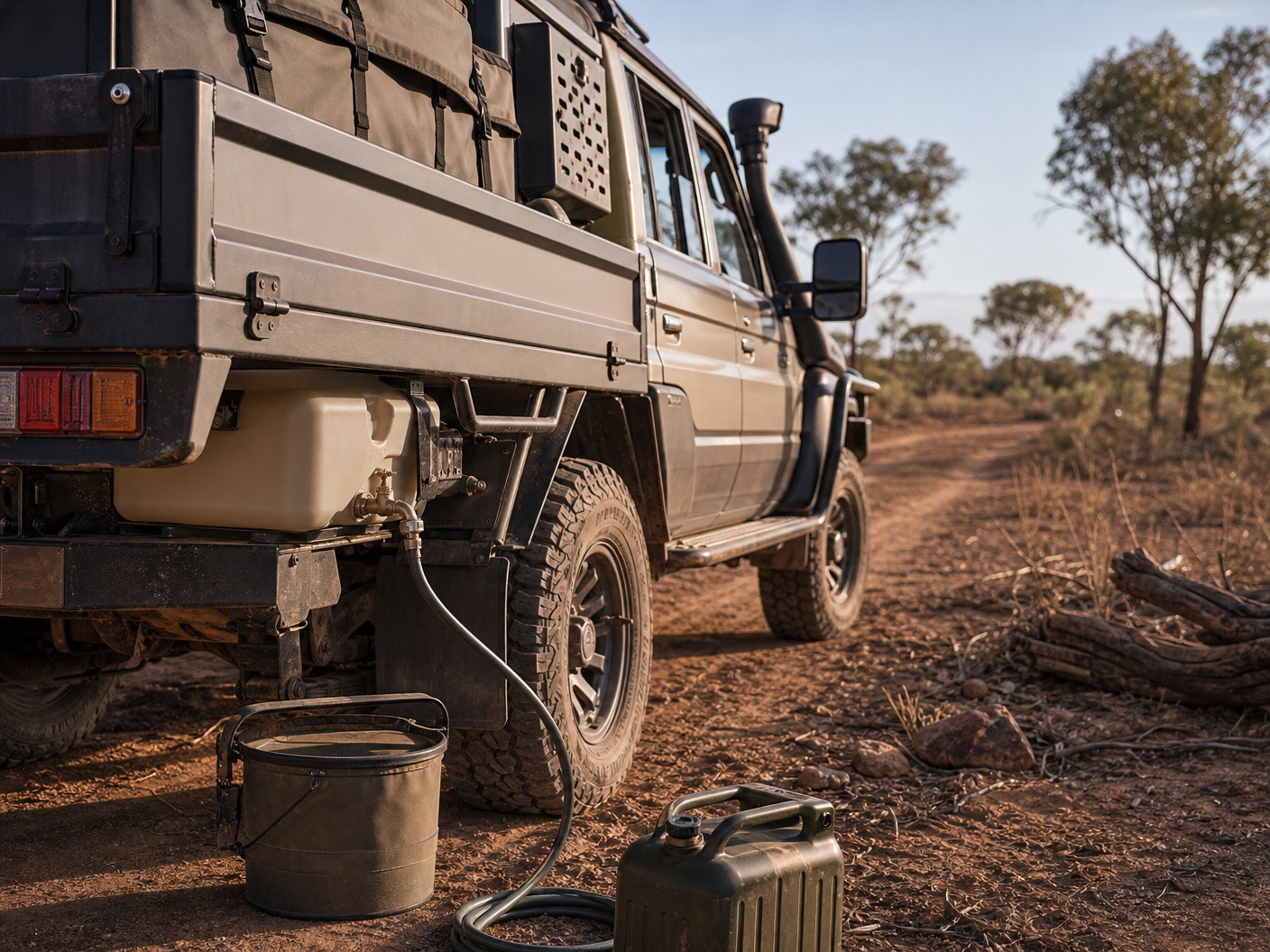
This is the ideal home for water and the one I would fit first. Bolted beneath a dual-cab tray or into a chassis gap, a poly tank from Boab or a steel one from Brown Davis puts 40 to 90 litres down low and central, barely touching your cargo space or centre of gravity. The trade-offs are a vehicle-specific fit, exposure to stone chips, and the need for a strong cradle, since a full tank pounds hard on corrugations. Get the mount right and you forget it is there. compare under-tray tanks that sit low and central
Upright and cargo-barrier tank
For a wagon with no tray to work under, an upright tank that sits flush against the cargo barrier is the practical answer. It is far easier to fit and remove than an under-body tank, which suits people who only carry a big water load on longer trips. The cost is cargo space and a higher weight point, so keep it low and strap it down hard. Look for a baffled version, since an unbaffled slab of water shoves the back of the vehicle around. look at upright tanks for a tray-less wagon
Roof-mounted shower tube
A roof tube, usually PVC or aluminium, sits on the rack and uses the sun to warm water for an evening rinse, which is a genuine luxury after a dusty day. It frees up interior space and keeps a wash supply separate from your drinking water. Just be honest about the weight up high: keep these small and treat them as a bonus, not your main tank. Black tubes heat fastest but can scald on a hot day. Don’t run your primary supply here. see roof tanks that warm a wash by evening
Folding water bladder
When there is no room for a permanent tank, a heavy-duty bladder is the flexible option. It drops into a footwell or on top of a drawer system, moulds to odd spaces, and folds flat when empty so it is not eating room on the way home. Choose reinforced, puncture-resistant material and a proper cap and tap, and rinse it before first use to clear the initial taste. It is less durable and harder to clean than a hard tank, but for occasional extra litres nothing packs smaller. check a folding bladder for flexible capacity
12-volt pump and tap kit
A tank is only as good as how you get water out of it, and a 12-volt pump turns a gravity dribble into a proper pressured flow for a sink, a rinse hose or a shower. A compact diaphragm pump plumbed in with quick-connect fittings and an inline filter is a straightforward upgrade that draws little current and switches on with the tap. Fit a strainer to protect it and you have running water at camp. Skip it and you are back to tipping a jerry can. price up a 12-volt pump for pressure at the tap

A few things separate a tank you trust from a science experiment. Buy food-grade poly and fit a breather, or the tank glugs and airlocks as it drains and the water takes on a plastic tang. Baffles matter on anything past about 40 litres — an unbaffled slab of water surges on braking and works the whole mount loose. Bolt the cradle to the chassis, not to thin tray sheet, and re-check those bolts after the first stretch of corrugations. And sanitise it: a mild cleaning solution flushed through once a season, then well rinsed, keeps the inside from turning into a biology lesson.
Comparison
| Tank type | Mount position | Typical capacity | Watch-out |
|---|---|---|---|
| Under-tray / under-body | Low and central, outside | 40 to 90 L | Custom fit, stone chips, needs a strong cradle |
| Upright / cargo-barrier | Inside, against the barrier | 20 to 60 L | Uses cargo space, weight sits higher |
| Roof shower tube | On the roof rack | 10 to 30 L | Weight up high, wash supply only |
| Folding bladder | Footwell or drawer top | 15 to 40 L | Puncture risk, harder to clean |
Frequently Asked Questions
How much water should I carry?
Plan around 4 to 5 litres per person per day for drinking and cooking, more if you shower. Work out your longest stretch between refills, add a margin, and size the tank to that. Remember every litre is a kilogram, so a large tank quietly eats your payload.
Where should the tank mount?
Low and central is the right home for the bulk of your water, under the tray or against the cargo barrier, because it protects your handling and payload. A roof tank is handy for a warm wash but lifts weight up high where it hurts stability most, so keep those small and reserve the low mounts for drinking supply.
Poly or metal tank?
Food-grade poly is light, rust-proof and affordable, and it suits most touring builds. Aluminium or stainless is tougher and can be made to custom shapes for an under-tray fit, but it weighs more and costs more. A quality baffled poly tank is the sensible default; metal earns its place on a hard-core custom tray.
How do I keep the water clean?
Use a food-grade tank and a dedicated drinking-water hose, keep the tank sealed and shaded, and flush and sanitise it now and then, especially before a big trip or after it has sat unused. A quick first flush after refilling, plus a proper filter or purification tablets for questionable sources, keeps what comes out of the tap safe.
The Bottom Line
Fit your water where it does the least harm to the vehicle and the most good to your trip: low and central, in a baffled, food-grade tank sized to your longest run between refills. An under-tray or under-body tank from Boab or Brown Davis is the sensible core, with an upright tank for wagons, a small roof tube for a warm wash, and a bladder for extra litres. Add a 12-volt pump for real running water, keep it clean, and count every litre against your payload.
For the rest of your water setup, see our guides to caravan water hose and filtration kits and portable water filters.
For the rest of a self-sufficient water setup, see our guides to camp shower systems, portable water filters, and water hose and filtration kits.