
This page contains affiliate links. Far Cornel may earn a commission if you buy through them, at no extra cost to you.
See the top-rated gear on Amazon →
Quick answer: The best tyre pressure gauge for touring is one accurate reference gauge with a built-in deflator, so you can air down and read in a single motion; the ARB E-Z Deflator is the classic. A rugged analogue or clear digital both work, a pencil gauge makes a cheap backup, and a dual-head suits big tyres and trailers. Buy for low-pressure accuracy, not a high maximum.
Tyre pressure touches safety, handling, comfort, fuel use and tyre life all at once, and it is invisible until it goes wrong. Off the blacktop it matters even more, because letting pressure down for sand or rocks and pumping it back up for the highway is part of everyday driving. None of that works without a gauge you can trust, and the readouts on compressors and dashboards are often the least reliable numbers in the vehicle.
A good gauge is a cheap, simple tool that quietly earns its keep on every trip. The choice comes down to how it reads, how rugged it is, and whether it also lets you bleed air down, since a touring gauge often doubles as a deflator. Here is the key point: the gauge built into a compressor is usually badly placed and loosely calibrated, and a dash monitor can drift several units out, so a dedicated gauge gives you one number to trust.
Quick Picks
- Best overall: a quality digital gauge with a clear backlit readout.
- Best no-battery option: a rugged analogue dial gauge.
- Best budget backup: a simple pencil gauge for the glovebox.
- Best with a compressor: an inflator-style gauge with a hose and bleed valve.
- Best for heavy rigs: a high-range dual-head gauge for big tyres and duals.

How to Choose a Tyre Pressure Gauge
Start with accuracy, and just as important, the range you actually use. A touring gauge has to be reliable both at the low pressures you run in sand and at the higher pressures a loaded vehicle needs on the highway, and here is the catch: many cheap gauges are least accurate down at the soft end, exactly where it matters for airing down. Look for one that reads clearly across that span with fine resolution at the bottom. Being trustworthy at low pressure beats a high maximum you will rarely reach.
Then match the type to how you drive. A rugged analogue dial needs no batteries, survives being dropped and reads easily with gloves on, though a knock can shift its calibration; a glycerine-filled version damps the needle on corrugations. A digital is precise and backlit, at the cost of a battery and possible drift. For touring, a gauge with a built-in deflator and bleed valve is a genuine upgrade, letting you drop pressure and read it in one motion, and the ARB E-Z Deflator and Staun set the pattern. Buy one accurate reference gauge, and keep a cheap pencil as backup.
The Tyre Pressure Gauges
Check today’s prices on Amazon →
Digital Tyre Gauge
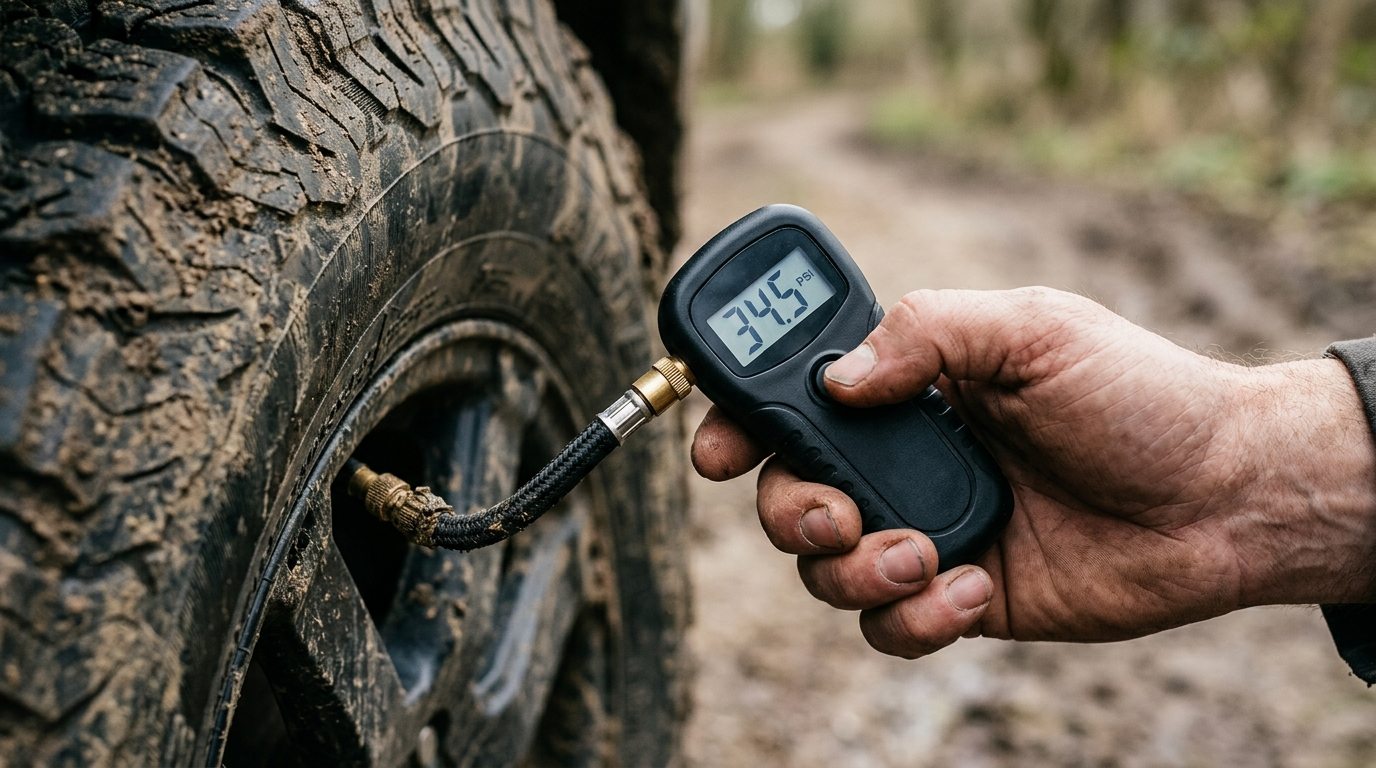
The easiest pick if you want a number, not a needle. Press it on the valve, read an exact number off a backlit screen, and there is no dial to misread in poor light. The best ones hold the reading, switch units and feel solid rather than toy-like; JACO and AstroAI make well-regarded ones. The only real downside is the battery, so choose one that takes a common cell and check it before a big trip. For repeatable airing down and up, the clear digital number is hard to beat. See the newest digital tyre pressure gauge listings on Amazon.
Analogue Dial Gauge
If you want something that never runs flat and shrugs off abuse, a quality analogue dial is the tourer’s classic. A good one uses a large, clearly marked face and a protective rubber boot, and will happily live in the door pocket for years; a glycerine-filled dial holds steady on corrugations. Many hold the reading until you press a bleed button, handy on hard-to-reach valves. You give up the exact number, but for rugged, battery-free reliability it just keeps working. See how the dial tyre pressure gauge options stack up on Amazon.
Pencil Gauge
The humble pencil gauge is cheap, tiny and almost indestructible, which makes it the perfect backup; Milton has made the classic for generations. No battery, it fits the smallest gap and gives a quick reading off a sliding scale. It is not as precise or as easy to read as a good digital or dial, so it is not the one for careful airing down. But as the spare that lives in the glovebox for the day your main gauge fails, it earns its tiny cost. Browse the current pencil tyre gauge listings on Amazon.
Inflator Gauge with Hose
If you run a portable compressor, an inflator-style gauge with a flexible hose changes the game. It connects between the compressor and the tyre so you inflate, check and bleed in one motion, watching the gauge the whole time; the ARB E-Z Deflator is the touring benchmark. The hose reaches valves without crouching, and the bleed trigger fine-tunes down to target. It is bulkier than a pocket gauge, but with a compressor it is the fastest way to set pressures. Check current tyre inflator gauge with hose stock on Amazon.
Heavy-Duty Dual-Head Gauge
Larger vehicles, off-road trailers and dual-wheel setups suit a heavy-duty gauge with a higher range and a dual-head chuck; Milton is the name most people know here. The dual head seats onto inner and outer valves on twin wheels, and the higher range and sturdier internals handle the pressures big tyres run. It is more gauge than a light wagon needs, but for heavier rigs and trailers it reads confidently where a pocket gauge runs out of range. Check the latest heavy-duty tyre pressure gauge range on Amazon.

Comparison
| Gauge type | Best for | Key strength | Deflator | Trade-off |
|---|---|---|---|---|
| Digital | Most tourers | Exact, easy-to-read number | Some models | Needs a battery |
| Analogue dial | Rugged everyday use | No battery, tough | Bleed button | Read to nearest mark |
| Pencil | Glovebox backup | Cheap and tiny | No | Least precise |
| Inflator with hose | Compressor users | Inflate, check and bleed in one | Yes | Bulkier to store |
| Heavy-duty dual-head | Big tyres and duals | High range, dual-valve chuck | Usually | Overkill for light rigs |
Frequently Asked Questions
Do I really need a separate gauge if I have a compressor or TPMS?
Yes. The gauge on a compressor is often poorly placed and loosely calibrated, and a dash tyre-monitoring system can drift several units out and lags behind real changes. A dedicated, accurate gauge gives you one reliable reading to set and check pressures against.
How accurate does a tyre gauge need to be?
For touring, within about one to two units of true pressure is plenty, and consistency matters more than perfection. Because you set pressures by feel over time, using the same trusted gauge every time beats chasing laboratory accuracy from a device you never check.
Digital or analogue, which should I get?
Both work well, so it comes down to preference. A rugged analogue dial needs no batteries and shrugs off knocks, while a digital gives a precise, easy-to-read number with a backlight but depends on a battery. Many tourers keep a tough analogue as the primary and a digital for fine readings.
Can one gauge handle both aired-down and highway pressures?
Yes, provided its range and resolution suit both ends. A good touring gauge reads clearly from the low pressures you run in sand up to firm highway settings, with fine detail at the bottom. Check it is accurate at low pressure, where a poor gauge lets you down.
The Bottom Line
The best tyre pressure gauge is an accurate one you trust across your whole range, from a soft sand setting to a loaded highway pressure, and use every time. Don’t rely on the compressor’s built-in dial or the dashboard monitor; a dedicated gauge, checked against a known reference, gives you the one honest number you need. For touring, a rugged analogue or quality digital with a built-in deflator is the sweet spot. Keep a cheap backup in the glovebox, and correct pressures stop being guesswork.
Pair your gauge with the rest of a proper tyre kit: see our guides to the best tyre deflator kits, the best tyre pressure monitoring systems, and the best portable air compressors.