
This page contains affiliate links. Far Cornel may earn a commission if you buy through them, at no extra cost to you.
Roll through the camp wagon range →
Quick answer: Most campers should buy a folding wagon in the 100–120 litre range with wide rubber wheels — it moves a family’s gear from boot to site in one trip and collapses into a slab the size of a gym bag. If your trips involve dry sand, spend more on a balloon-wheel beach cart instead. And skip the category entirely if you park beside your tent: your boot already does this job.
Stand at the car park end of a walk-in campground on a Saturday morning and count the trips. Six is about standard: the cooler first, then the tent, then two armloads of bedding, then the food box, then the bag of things that fell out of the food box. The family two bays over stacks everything into a fabric wagon, makes one trip at a stroll, and has the kettle on before the six-trip crew has located the tent poles.
Here is what the packaging will not tell you: a camp wagon is a wheel decision with a bag attached. The tubs are near-identical across the market — polyester over a folding steel frame, much the same seams. The wheels are where the products genuinely differ, and they decide whether the thing glides over grass, gravel and sand or digs in and fights you the whole way there. Match the wheels to your ground and the rest is detail.
Quick Picks
- Best all-rounder: a 100–120 litre folding wagon on chunky rubber wheels — one-trip capacity for a family of four across grass, gravel and firm tracks.
- Best for soft sand: a balloon-wheel beach cart — wide, low-pressure wheels ride on top of dry sand where standard wheels slice in and stall.
- Best for rough ground: a steel-mesh utility cart on large pneumatic wheels — firewood, water containers and long stays at a base camp.
- Best for small boots: a compact 60–80 litre wagon at around seven kilograms — half the bulk, and it still saves you four trips.
- Best for slopes and crowds: a push-handle convertible wagon — pushing gives you a control over momentum that a pull strap never will.

How to Choose a Camp Wagon or Beach Cart
Start with the worst ground you will cross, because the wheels are the entire purchase. A narrow, hard wheel concentrates the whole load onto a thin contact strip — efficient on concrete, hopeless on dry sand, where it slices straight down and anchors you mid-stride; a wide, soft wheel spreads the load and stays up on top. Four-wheel-drivers let air out of their tyres before a sand track for exactly this reason, and a wagon obeys the same physics at a hundredth of the weight. Beach regulars should treat roughly 12 centimetres of wheel width as the starting line; grass-and-gravel campers are better served by standard 7–8 centimetre rubber wheels, which roll easier on firm ground and fold into a smaller package.
Now the number on the box. A wagon advertising a 150 kilogram capacity is quoting what its axles support while parked on a flat, hard floor — it says nothing about the pulling effort once ground softens, which climbs sharply as the wheels sink. A realistic family load of cooler, tent, bedding and food rarely clears 60 kilograms, and the tub’s seams will wave a white flag long before a sound frame bends. Buy on wheel spec, folded size and weld quality; file the capacity figure under marketing wallpaper. Remember, too, that the wagon itself weighs 9–12 kilograms — you will lift it over the boot lip far more often than you will ever test its rating.
Two quieter specs decide whether the wagon survives ownership. Measure your boot before you buy — a full-size wagon folds to roughly 80 by 50 by 25 centimetres, a real bite out of a hatchback. And if the beach features in your plans, look hard at the metal: plated steel and zinc fasteners pit quickly once salt works into the folding joints, so a fresh-water rinse and a proper dry-out after every sandy trip is part of ownership, not an optional extra. Removable, machine-washable tub fabric is the sleeper feature nobody advertises loudly enough.
The Wagons and Carts
Haul up today’s wagon and cart prices →
The all-round folding wagon
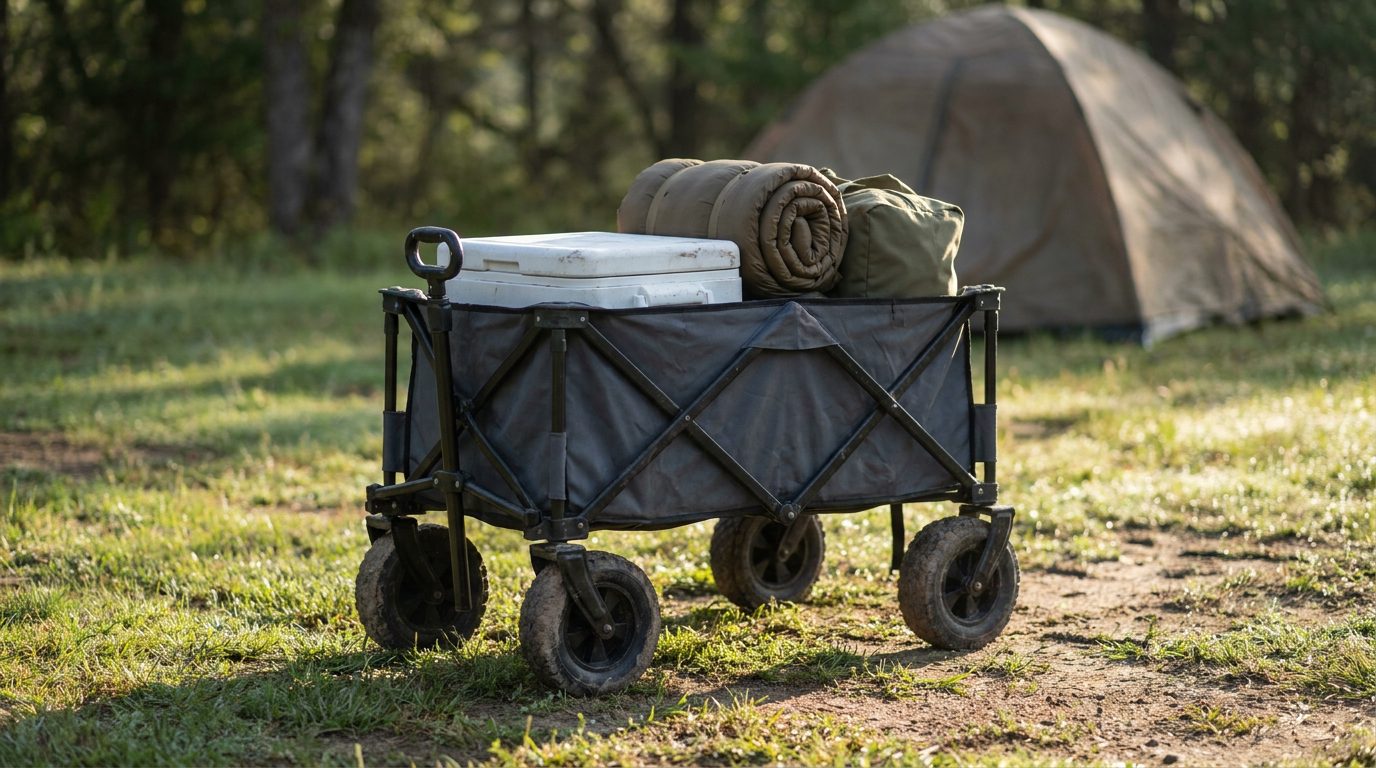
The default buy, and for most campers the right one. A 100–120 litre tub on 7–8 centimetre rubber wheels carries a family’s kit across grass, gravel paths and packed dirt, opens in seconds, and folds one-handed into a slab that stands upright in a garage corner. Mac Sports and Coleman set the template most of the market now copies: swivelling front wheels, a telescoping pull handle, a tub that lifts out for cleaning.
The detail that separates the good ones is a lock on those front swivel wheels. Swivelling makes a wagon lovely to steer on hard ground and twitchy on rough ground; a lock gives you both. Check for it first — then check that the handle stows away, because a dangling handle is the part that trips someone at every second campsite. Wheel through the current folding wagon range and check tyre width before anything else
The balloon-wheel beach cart
Dry, soft sand defeats ordinary wagons: the wheels knife in, the tub becomes a plough, and the handle starts pulling back at you. Balloon-wheel carts answer with fat, low-pressure wheels 12–15 centimetres wide that stay up on the surface a standard wheel cuts straight through. OZtrail’s beach carts are the familiar shape, and several makers sell balloon-wheel versions of their standard wagons.
The honest trade-offs: balloon wheels add real bulk to the folded package, they squirm a little on cambered hard paths, and the soft tyres want an occasional top-up of air. Buy this cart because sand is your routine rather than your exception — and pull it with the handle held low and long, which stops the front wheels burying on the softest stretch above the high-tide line. Put the balloon-wheel beach carts side by side and judge them on wheel width alone
The steel-mesh utility cart
For base camps, firewood runs and water hauling, the garden-style mesh cart out-muscles every fabric wagon. A welded steel bed on large pneumatic wheels takes loads the soft tubs cannot — a full 20 litre water container in each corner, say — and the open mesh lets mud and bark fall through instead of pooling. Fold-flat versions exist, though most trade a little rigidity for the trick.
The compromise is heft: 15–20 kilograms of cart before anything goes in it, and even folded it wants a trailer, a roof basket or a very empty boot. This is the cart for the campsite you return to every season, not the one you shuttle in a hatchback. Run down the steel-mesh cart listings with an eye on wheel diameter and axle build
The compact lightweight wagon
A 60–80 litre wagon at around seven kilograms suits the campers a full-size wagon quietly punishes: hatchback owners, solo travellers, anyone whose site is a short walk on decent ground. It gives up one-trip capacity for a family — call it one trip for a couple — and in exchange folds small enough to live in the car permanently, which is how these end up pulling weekend shifts at markets and picnics between trips.
Check the wheels closely at this end of the market. The cheapest compacts run narrow, hard plastic wheels that rattle over gravel and give up the moment ground softens; rubber tread, even on a small wheel, is the difference between a small wagon and a small mistake. Skim the compact wagon options with your boot measurements written down first
The push-handle convertible wagon
Pulling a loaded wagon downhill is a quiet exercise in hoping it stays behind you, because almost no camp wagon has brakes. Push-handle convertibles put a rigid, height-adjustable bar behind the tub so you can push it like a trolley instead, and the control you gain on slopes, ramps and crowded paths is immediate: the load sits in front of you, at arm’s length, always visible.
Some versions add moulded lid-tables and cup holders; treat those as bonuses, never as reasons to buy. And a firm word on the obvious temptation: a wagon has no restraints, no brakes and no crash structure, so haul the gear, not the children — whatever the pictures on the packaging suggest. Study the push-handle wagons for one that locks rigid in both directions
Comparison
| Wagon type | Ground it handles | Real-world load | Folded bulk | Made for |
|---|---|---|---|---|
| All-round folding wagon | Grass, gravel, packed dirt | A family of four’s camp kit | Golf-bag slab | Most campers, most trips |
| Balloon-wheel beach cart | Dry and wet sand | Day loads: cooler, shade, rods | Bulky — the wheels dominate | Regular beach days |
| Steel-mesh utility cart | Rough tracks, muddy ground | Firewood and full water containers | Large even when folded | Seasonal base camps |
| Compact lightweight wagon | Grass, paths, firm ground | A couple’s weekend kit | Smallest — lives in the car | Hatchbacks and solo campers |
| Push-handle convertible | Slopes, ramps, busy paths | A family kit, under control | Slab plus the handlebar | Undulating sites and crowds |

Frequently Asked Questions
Can kids ride in a folding camp wagon?
The makers say no, and for once the legal caution matches the engineering. A camp wagon has no restraints, no brakes and a high centre of gravity once something sits above the axles, and its capacity rating describes what the frame bears — not what stays safe in motion. Wagons built for carrying children are a separate product class with harnesses and braked wheels; if that is the real job, buy one of those.
Why does my wagon bog on soft sand?
Wheel width, almost every time. A narrow wheel under load presses down harder per square centimetre than a wide one, so it cuts through the dry top layer instead of riding it — and once the front wheels bury, pulling harder only ploughs them deeper. Fixes, in order: cross where the sand is damp and firm, drop the handle low and pull with a long lean, shift the heavy items over the rear axle. If sand is an every-trip thing, the real fix is balloon wheels.
Do beach carts rust?
The frames are usually powder-coated or plated steel, and the coating survives until sand scratches it inside the folding joints — then salt does what salt does. After a beach day: rinse with fresh water, open the fold to drain, and let it dry before it goes back in its storage bag, because a wet cart zipped into a bag is a corrosion experiment. A silicone spray on the axles and pivots twice a season keeps the fold smooth.
Is a kayak cart the same thing?
No. A kayak cart is a cradle for a hull — two wheels and a frame shaped to strap one boat on top — and it carries nothing else. A camp wagon is general cargo. Plenty of paddlers genuinely need both; neither substitutes for the other.
The Bottom Line
Buy the 100–120 litre all-round folding wagon unless your ground argues otherwise: balloon wheels if sand is routine, steel mesh if the load is firewood and water at a seasonal base camp, compact if the boot is small, push-handle if your sites roll up and down. Whichever you pick, judge it on the wheels first, the folded size second and the tub last — and treat the capacity number as the least interesting line on the box. One trip from car to camp instead of six is the whole promise, and the right wheels are what keep it.
Working out the rest of the kit? Our family camping setup guide covers the buying order for the big pieces, the camping coolers guide sorts out the box your wagon will carry most often, and the camp kitchen tables guide takes over once everything reaches the site.