
This page contains affiliate links. Far Cornel may earn a commission if you buy through them, at no extra cost to you.
Paddle through the kayak crate range on Amazon →
Quick answer: Buy a lidded, hard-sided crate with two or three rod tubes angled clear of your paddle stroke, and measure the tankwell with the seat where you actually fish before you order it. That is the pick for anyone who launches through waves or fishes open water. A milk crate with a bolt-on rod-holder kit is the honest budget answer for calm water. Skip the category if your rear well is a moulded hatch or already holds a battery box.
Every purpose-built kayak crate is priced for about four seconds of your trip: the ones between the hull rolling and the hull coming back up. For the other eight hours a milk crate does the job so well that the branded versions look like a tax on gullibility. It holds four trays and three rods, it drains instantly, and it cost less than the lure on your leader. Then a wake catches you side-on during a re-entry, the crate goes under, and everything that was not lidded, clipped or leashed leaves in the order it was packed. That is the moment the lid, the latches and the strap points justify their price.
The second way to get this wrong never touches the water: buying on litres, the way you would buy a cooler, and unboxing a crate to find the tankwell four centimetres too narrow or the seat reclining straight into its front wall. Tankwells vary between hulls far more than crates do, frame seats eat into them when they recline, and a battery box or a fish bag may already own part of the space. So measure the well with the seat where you fish, allow for the straps, and only then shop by footprint, height, lid and rod tubes, in that order.
Quick Picks
- Best overall: the lidded hard crate — a moulded box with a latching lid, built-in rod tubes and strap points; it beats an open crate the first time you go over.
- Best budget: a milk crate plus a bolt-on rod-holder kit — most of the function for a fraction of the money, provided you add a bungee net.
- Best for shallow tankwells: a half-height, low-profile crate that clears a reclined seat back and keeps the weight low.
- Best for home storage: a soft-sided crate bag that folds flat between trips, at the cost of drainage and sag.
- Best when a crate is the wrong shape: a seat-back tackle bag for sit-inside hulls and moulded-hatch sterns with no tankwell to fill.

How to Choose a Kayak Fishing Crate
Footprint first, height second, capacity last. Measure the well at its narrowest point at the height the crate will sit, because tankwells taper and a crate that fits at deck level can jam a hand’s width up. Then measure from the deck to the underside of the seat back with the seat reclined the way you fish; a taller crate either forces the seat upright or rides on top of it. Note where the scupper holes and pad-eyes sit, because they are your strap points, and check that a rear hatch still opens with the crate in place. Volume comes last and matters least: four small trays on edge plus a pliers pouch is a full day’s kit.
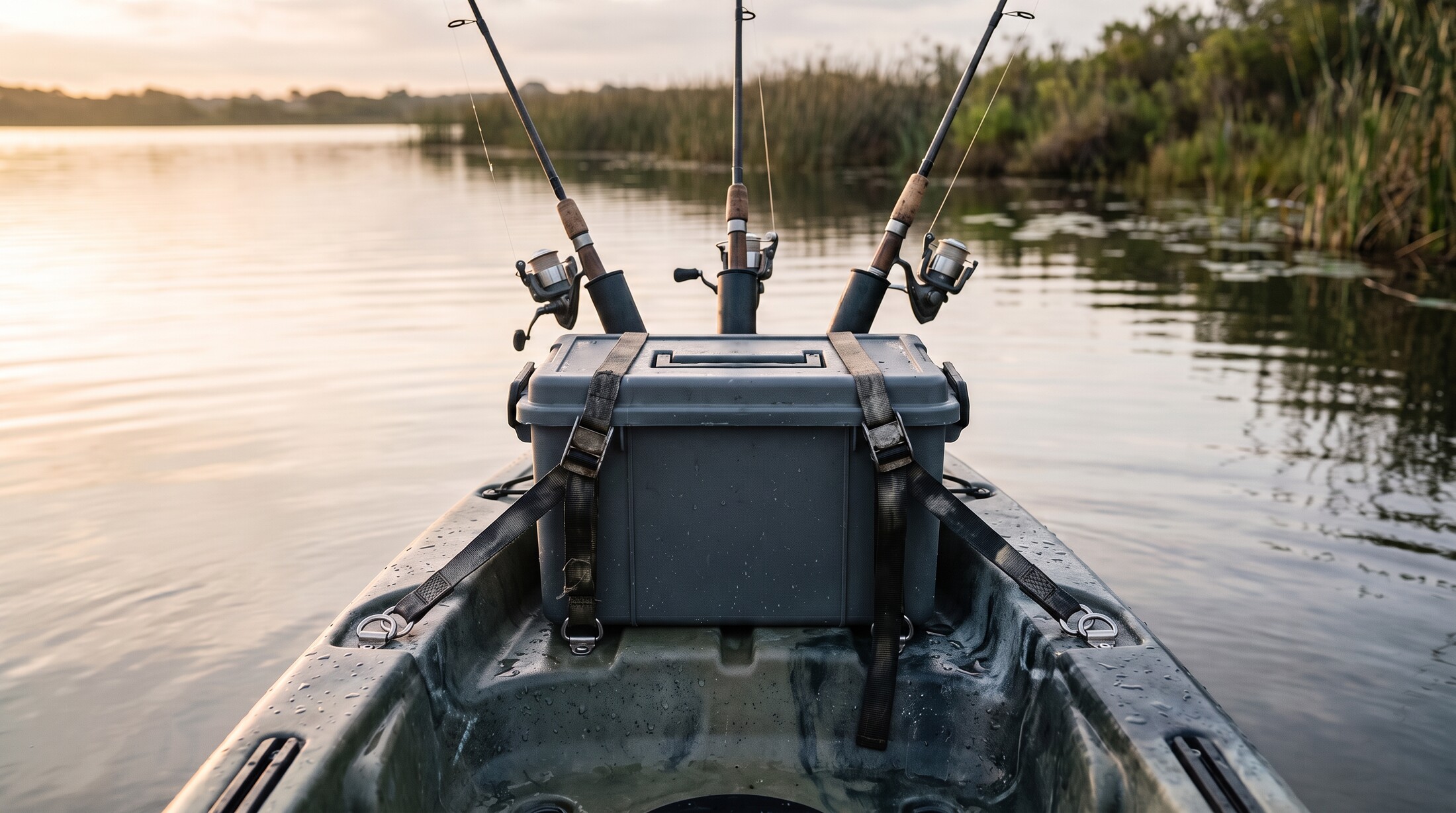
A lid is not about rain. It is about wave wash, rollovers and the rod tip of the person you are drifting next to; an open crate loses gear to all three. Latches beat a bungee-held lid because a bungee stretches exactly when the crate is upside down. Rod tubes want an angle that leans the rods aft and outboard, so a full paddle stroke never clips one, and enough grip that a butt does not lift out on the first bump. Two tubes is plenty; four looks impressive on a jetty and turns a drift into a fence. Mounting is where everyone skimps. Cam straps through pad-eyes or a gear track hold a crate through a re-entry; bungee cords hold it until one.
Now think about where the mass ends up. A full crate behind the seat trims the kayak stern-down, which lifts the bow, gives the wind more to push on and makes a straight line harder to hold. Pack the heavy items — spare spools, a dry box of leaders, any battery — low and against the wall nearest the seat, with the light bulk at the back. On material, moulded plastic wins for salt: it drains, it rinses, and it does not sag half-loaded.
The Crates
Round up the crates that fit your tankwell →
The lidded hard crate
If the hull might roll where you fish — and once the wind gets up it might roll almost anywhere — this is the crate. A moulded box with a latching lid, strap slots in the walls, and rod tubes built into the corners rather than bolted on. YakAttack, Hobie and Wilderness Systems all make purpose-built crates, and the design logic they share is the point: strap slots that take cam straps down to the pad-eyes, tubes angled out of the stroke, and on the best of them a lid that doubles as a rigging surface.
The trade-off is money and bulk; it is the heaviest option empty and the one that least enjoys a small boot. Test the latch with wet hands: one you cannot open one-handed while holding a rod is one you will leave open. Hunt through the lidded crates moulded to your tankwell’s footprint
The milk crate conversion
The original kayak crate and still the right answer for calm water and short sessions. A standard square dairy crate runs roughly 33 centimetres a side, a great many sit-on-top wells are moulded to take exactly that footprint, and a bolt-on kit adds two or three rod tubes for the price of a packet of jig heads. Everything drains through the sides, and a rock-stoved one is replaced without grief.
Its weakness is the same feature: open on top and on every side, so wave wash goes straight in and a rollover empties it in one motion. Stretch a bungee net across the top, leash anything you cannot afford to lose, and do not launch it through surf. Spend the money on the kit; the crate is the cheap part. Rummage through the bolt-on rod holder kits and build the crate yourself
The soft-sided crate bag
A fabric box with stiffened panels, a zip or roll-top lid and sewn-in rod tubes, and the option to fold flat between trips. If your kayak lives on the roof of a small car and your gear lives in a wardrobe, this is the one that stops the crate being the biggest object you own, and it is the lightest to lift in and out of the well.
The downsides are real: fabric sags half-loaded and trays lean, the base holds water instead of draining it, and salt goes for the zip first. Look for drain grommets in the floor, corrosion-resistant zips, and stiffening that reaches the full height of each panel; a soft crate stiffened only in the lid is a bag with ambitions. Thumb through the soft crate bags if home storage is the real constraint
The low-profile crate
Half the height of a standard crate, and the answer for tandems with a shallow rear well, hulls with a rear hatch that needs to open, and any kayak whose frame seat reclines into the space a full crate would take. Keeping the mass lower also settles the hull, which you notice most when you stand to sight-cast. Rod tubes are usually two and shorter, so the rods lean further; fine for spinning rods, awkward for anything with a long grip.
You give up tray count — two or three on edge instead of four — and often the lid, because the low walls leave less to latch to. Pair it with a dry bag for the overflow and treat it as the tackle you use every hour, not the tackle you own. Scout the low-profile crates if a reclined seat eats your tankwell
The seat-back tackle bag
Not a crate, and the right buy for kayaks that never had a tankwell to fill: sit-insides and hulls with a moulded rear hatch. The bag straps to the seat frame or the rear deck loops, holds two or three small trays and a pliers sleeve, and keeps everything within a half-turn of the seat; some are insulated, doubling as a bait cooler.
Their limit is rods. A seat-back bag holds none, so it pairs with flush-mount or rail-mounted holders rather than replacing them, and its capacity is a morning’s fishing, not a week’s. If you find yourself strapping a second bag to the first, the fix is a hull with a tankwell, not a third bag. Leaf through the seat-back bags if your hull has no tankwell
Comparison
| Crate style | Well it suits | Rod tubes | If the hull rolls | Pick it for |
|---|---|---|---|---|
| Lidded hard crate | Standard sit-on-top well, measured first | 2–4, built in | Stays shut, stays strapped | Open water, surf launches, everyday use |
| Milk crate conversion | Any well moulded around a 33 cm square | 2–3, bolt-on | Empties unless netted and leashed | Calm water, short sessions, tight budgets |
| Soft crate bag | Standard wells; folds flat at home | 2–3, sewn in | Zip holds; base holds water | Small cars, wardrobe storage, light kits |
| Low-profile crate | Shallow wells, hatch-adjacent wells | 2, shorter | Less mass, less to lose | Reclined seats, tandems, stand-up casting |
| Seat-back tackle bag | No tankwell at all | None | Stays on the seat | Sit-insides, hatch-only sterns, minimal kits |

Frequently Asked Questions
Will a standard milk crate fit my kayak’s tankwell?
Often — many sit-on-top wells are moulded around that 33-centimetre square — but measure the narrowest point of the well at crate height and the gap under a reclined seat before you trust it. A crate that only fits on the diagonal does not fit.
Do I need a lid on a kayak crate?
You need one the first time the hull rolls, and nobody plans that day. On calm water with short drifts, an open crate and a bungee net cover most of the risk. Once you launch through waves, fish open water, or carry anything you would hate to lose — a spool of fluorocarbon, good pliers, a phone in a dry pouch — the lid pays for itself in one incident.
How do I stop the crate sliding around or tipping out?
Cam straps, not bungee, through the pad-eyes or a gear track, pulled tight enough that the crate does not shift when you shove it sideways with a fist. Bungee stretches under load, and a rollover is load; keep it for the lid and the net. If your well has scupper holes and no pad-eyes, a pair of scupper-hole anchors is a cheap, drill-free fix.
Can I keep my fish finder battery in the crate?
Yes, in a sealed battery box, low against the wall nearest the seat, with a cable run that never crosses your lap. It is the heaviest single item most anglers carry, so it sets the crate’s centre of gravity, and it belongs out of the drainage path so it is not standing in a puddle all day.
The Bottom Line
Measure the well, then buy the lidded hard crate unless you have a reason not to: a milk crate and a rod-holder kit if the water is calm and the budget is tight, a low-profile crate if a reclined seat owns the space, a soft bag if the crate has to live in a wardrobe, and a seat-back bag if the hull has no well at all. Whatever you choose, strap it with cam straps and leash the things you love. A crate is not really tackle storage. It is the difference between a rollover that costs you ten minutes and one that costs you the tackle box.
Building the rest of the rig? Our fishing kayaks guide explains which hulls have a tankwell worth filling, the fishing tackle boxes guide covers the trays that go inside the crate, and the kayak carts guide gets the loaded boat from the car to the water without a second trip.