
This page contains affiliate links. Far Cornel may earn a commission if you buy through them, at no extra cost to you.
Suss out the current seat cover range →
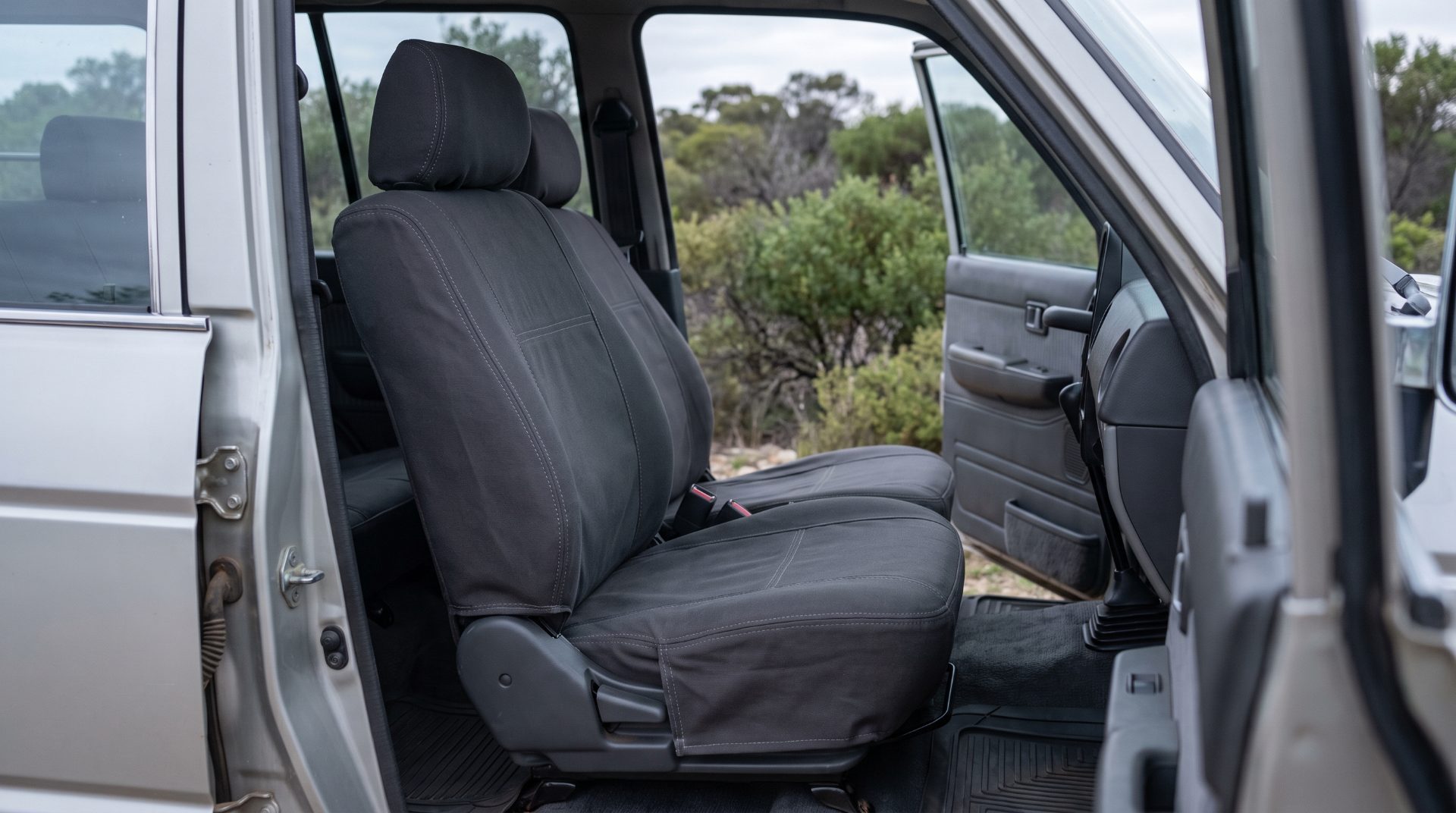
Quick answer: For a vehicle that sees dirt roads and wet gear, a tailored heavy-canvas set is the pick — it sits tight enough to keep grit off the trim and shrugs off a soaked jacket. Neoprene suits anyone who climbs in wet. Universal slip-ons are fine on a second vehicle but fit loosely. Skip any cover you cannot confirm carries a tear-away airbag seam.
Take a cheap universal cover off a seat after a season of dirt-road work and the trim underneath is often in worse shape than the seat in the vehicle that never wore one. That is not bad luck. A loose cover behaves like a pocket: dust funnels past the edges, settles along the seams, and every slide across the seat grinds it into the fabric the cover was bought to protect.
Which is the argument for buying on fit before fabric. Almost every listing sells you canvas weight and water resistance, and both matter, but a 500gsm cover sitting proud of the bolster protects less than a snug polyester one. Sort the fit class first, settle the airbag question second, and the fabric becomes a preference about heat and drying time.
Quick Picks
- Best all-round: a tailored heavy-canvas set, cut to your seat shape and heavy enough to live with tools, dogs and wet boots.
- Best for wet work: neoprene, which stretches into a close fit, sheds water and wipes down in seconds.
- Best on a budget: a universal slip-on set, provided you accept a loose fit on a low-use seat.
- Best for long stretches behind the wheel: sheepskin or a wool blend, which regulates heat better than any synthetic.
- Best for the back seat: a full-width bench protector covering base and backrest in one piece.

How to Choose 4×4 Seat Covers
There are three fit classes, and the gap between them is wider than the gap in price. Tailored covers are patterned for one seat shape, with openings already in the right places for the belt stalk, the armrest, the map pocket and the recline lever; they take longer to fit and they stay where you put them. Semi-tailored covers are patterned to a body style rather than a specific seat, so they fit most of the seat well and one part of it badly. Universal covers are an approximate seat shape held on with elastic and hooks. On a seat that only ever carries a passenger, that is fine. On a seat taking wet, sandy, heavy loads every weekend, it slides, bunches behind your lower back and lets grit underneath.
Then settle the airbag question, because it is the detail that turns a cheap cover into a bad idea. Most modern front seats carry a side airbag in the outer bolster, and it deploys through a tear seam built into the factory trim. Anything covering that bolster has to give way at the same instant. Purpose-made covers use a breakaway seam — a deliberately weak line of stitching, usually marked on the cover itself — over the airbag zone. A generic cover stitched normally across the bolster is a restraint, not a protector. If a listing does not state airbag compatibility, read that as a no rather than an oversight.
Fabric comes third. Canvas is sold by weight, and roughly 400–600gsm is the sensible band for a working vehicle. Neoprene is wetsuit rubber laminated between two fabric faces: it stretches into a closer fit and water sits on top rather than soaking in. Polyester and cotton blends are lighter and dry fast but abrade sooner at the bolster. Whatever you land on, check the hardware and the cutouts first. Straps should be webbing with buckles rather than elastic loops, and the pattern needs openings for everything your seat actually does: fold-flat bases, under-seat drawers, heater switches and child restraint anchors.
The Seat Covers
Glance over the canvas and neoprene sets →
Tailored canvas sets
This is the default for a vehicle that works for a living. The appeal is not the cloth on its own — it is that a tailored cover has nowhere to move. The belt slot lands where the belt is, the map pocket is cut out rather than sealed over, the base tucks under and buckles, and dust has no gap to fall through. Makers built around this approach, Black Duck and MSA 4X4 among them, will normally ask for your seat configuration before they sell you anything, which is a good sign rather than an inconvenience.
Budget an hour for a front pair the first time, and expect stiff, slightly noisy canvas for the first month. Take the heaviest weight your seat shape allows: the failure point is almost never the panel, it is the seam at the front edge of the base where you drag yourself in and out a few thousand times a year. Have a look through the tailored canvas sets cut to your seat shape
Neoprene covers
Neoprene stretches, so a semi-tailored neoprene cover often sits closer to the seat than a semi-tailored canvas one, and water beads on the face instead of soaking through. Tip a drink over and you wipe it off. That makes it the obvious answer if you are regularly getting in soaked or straight out of the water.
The trade-off is heat, and it is a real one. Neoprene insulates both ways: it holds warmth against your back and takes its time giving it up, which is why better sets run a perforated panel down the middle. Thickness matters too — 2mm feels closer to ordinary fabric, 3mm lasts noticeably longer where your hip scrubs the bolster. Measure up the neoprene covers against your own seat width
Universal slip-on sets
Worth being straight about what these are: a shaped bag with elastic and a few hooks, sized to fit a range of seats approximately rather than any seat precisely. On a seat that carries a passenger and nothing else that is genuinely enough, at a fraction of the price of a tailored set.
What it will not do is stay taut under load, keep grit out of the seams, or reliably clear an airbag — and a universal set that bunches at the lumbar will annoy you every drive. If you buy one, take the version with a proper strap and buckle underneath rather than elastic alone, and re-tension it every few weeks. Pick through the universal slip-on sets at the cheaper end
Sheepskin and wool covers
Wool does something no synthetic manages: it moves moisture away from your back and evens out temperature, so the seat feels neither clammy in the heat nor freezing at dawn. On long stretches behind the wheel that is the difference between arriving stiff and arriving comfortable.
Wool and mud do not get along, so treat this as a driver-seat choice rather than a whole-vehicle one. Most sheepskin products are inserts sitting on top of the seat rather than covers enclosing it, which makes the attachment method the thing that decides whether it stays put or ends up in the footwell at the first hard turn. Check over the sheepskin inserts and how they actually attach
Rear bench protectors
The back seat has a different problem from the front. It is not being worn out by one person getting in and out — it is carrying dogs, kids, wet gear and the occasional load that should have gone in the boot. A one-piece protector covering base and backrest handles that better than two cushion covers, and hammock-style versions clipping to both sets of headrests stop anything sliding into the footwell.
Measure the bench first, because bench widths vary far more than front seats do. Then check two things: whether the cover still lets the split-fold work, and whether it leaves the child restraint anchors reachable. A protector that has to come off every time you fold the seat will not stay on the seat for long. Filter the rear bench protectors by the width of your seat
Comparison
| Cover type | What it handles best | Heat on a long drive | Fitting time | Skip it if |
|---|---|---|---|---|
| Tailored canvas | Grit, tools, dogs, daily abuse | Warm at first, breathes once broken in | Around an hour per pair | You want it on in five minutes |
| Neoprene | Water, mud, anything dripping | Runs hot and stays hot | 20–30 minutes per pair | You already sweat through the seat |
| Universal slip-on | Light wear on a low-use seat | Neutral, thin fabric | Ten minutes | The seat has a side airbag |
| Sheepskin or wool | Comfort and temperature on long days | The best of the group by a distance | Ten minutes, but check the straps | Muddy gear rides in that seat |
| Bench protector | Dogs, kids, wet loads across the back | Depends on the fabric chosen | Under 15 minutes | You need the split-fold daily |

Frequently Asked Questions
Will a seat cover stop a side airbag from deploying?
A cover stitched normally across the outer bolster can, yes — that bolster is where the bag comes through, and it has to tear open in milliseconds. Covers made for airbag-equipped seats use a breakaway seam over that zone: a deliberately weak line of stitching that lets the bag through. If the listing does not say so, assume it was not built for it.
Do I have to take the headrests off to fit them?
For most tailored and semi-tailored sets, yes — the headrests get their own covers and the backrest cover slides down over the top of the seat. Universal sets usually pull on around the headrest instead. Some headrests fold rather than lift out, which rules out a lot of sets, so check before you order.
Can I wash them?
Canvas: cold, gentle, never hot or tumble dried — heat shrinks the panels enough that they no longer fit and strips whatever water repellency the fabric had. Neoprene: hose it, wipe it, hang it in the shade, keep it out of a machine entirely. Wool: cold wool cycle at most, dried flat.
Universal or tailored — is the price difference worth it?
It depends on how complicated the seat is and how hard it works. A plain rear bench carrying nothing heavier than shopping is well served by a universal cover. A front seat with a side airbag, an armrest, a fold-flat base and a weekly load of wet gear is not, and the cheap cover fails at all four points at once.
The Bottom Line
Buy the fit, then the fabric. A tailored canvas set is the one to spend on for a front seat that works hard, because a cover that cannot move is the only kind that keeps grit off the trim underneath — and confirm the airbag seam before anything else goes in the basket. Neoprene if you climb in wet, wool if the drives are long, and a one-piece protector across the back bench for the rest.
More from the touring gear guides: our rundown of 4WD drawer systems covers keeping the load area sorted, cargo nets deals with the gear that would otherwise end up on the back seat, and storage boxes and gear crates handles the rest of it.