
This page contains affiliate links. Far Cornel may earn a commission if you buy through them, at no extra cost to you.
See the current 270-degree awnings on Amazon →
Quick answer: A 270-degree awning wraps shade around two sides of the vehicle and deploys in a minute or two, which is brilliant if you move camp often. A freestanding frame sets up fastest; a pole-supported one is lighter and cheaper. The real limits are weight and wind, not shade area, so check your roof-load rating first. If you sit in one spot for long stays, a cheaper gazebo or a straight awning may serve you better.
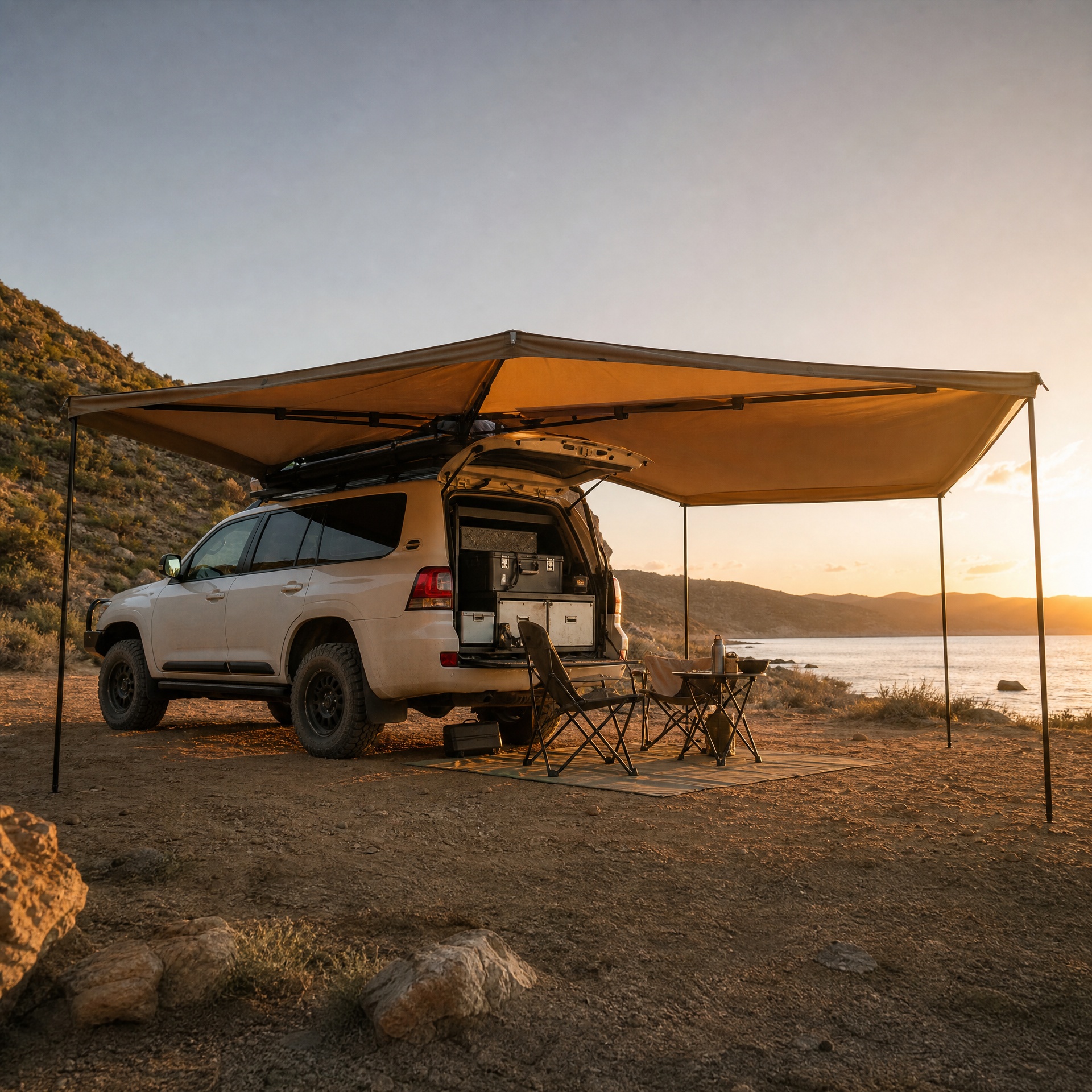
Pull up, walk a bag around the vehicle, peg it out, and you have a shaded outdoor room before the kettle boils — that is the pitch for a 270-degree awning, and it is a good one. A straight pull-out awning only gives you a strip of shade down one side; a 270 swings right around the side and rear, throwing a continuous covered area over where you cook, sit and open the back of the rig. For anyone living out of a vehicle across changing weather, that speed and coverage genuinely earns its keep.
But the shade area is not the number that should decide your buy. A 270 is a heavy item mounted high on the roof rack, so the constraints that matter are payload and wind. It raises the centre of gravity, eats into what you can carry, and turns into a large sail the moment a gust comes through. Get the weight and wind plan right and it earns its place; ignore them and it just overloads a roof.
Quick Picks
- Best for frequent moves: a freestanding 270 awning that swings out in a minute.
- Best value and weight: a pole-supported 270 awning for settled camps.
- Best living upgrade: an awning wall or room kit to enclose the space.
- Best comfort add: an LED awning light for hands-free cooking after dark.
- Best cheap insurance: heavy-duty pegs and guy ropes for windy sites.

How to Choose a 270 Awning
Start with weight and your roof, not the shade area. Add the awning’s mass to your rack, drawers, roof-top tent and any other roof load, and check it all sits inside the rack’s and the vehicle’s roof-load ratings. A typical 270 weighs around fifteen to twenty-five kilograms, riding high where it hurts handling most, so confirm those numbers before you drill the brackets. Mount it on the side you camp from, with strong brackets that will not work loose on corrugations.
Then judge the canvas, because it is doing the real work. Look for poly-cotton ripstop around 280 to 320gsm, with fully tape-sealed seams so it does not leak and a good UV rating so the sun does not degrade it early. Brands like ARB, Darche and Bushranger publish these figures; a rack maker like Rhino-Rack tells you what its bars carry. Cheap canvas and vague listings are the warning signs.
Finally, plan for wind from the outset, because it is what wrecks awnings. Every leg needs a peg and the whole thing needs guying out properly, not left on its arms. Buy one sized to your wheelbase, and take it down when the weather turns rather than trusting it to ride out a squall.
The Awnings and What Completes Them
Compare freestanding and pole-supported awnings on Amazon →
A freestanding 270 awning
If you stop often and briefly, a freestanding 270 is worth its weight and cost. The frame supports itself, so it swings out and locks in a minute or two with no legs to peg before it stands up, which matters when you pull in late or in poor weather. You still peg and guy it for wind, but it stands and shades almost immediately. The trade-off is honest: it is heavier and dearer than a pole-supported design, so it leans hardest on your roof-load budget. Price up a freestanding 270-degree awning
A pole-supported 270 awning
If you set up once and stay, or you are watching weight and budget, a pole-supported 270 does the same job of shading two sides for less. It is lighter on the roof and kinder on the wallet, at the cost of legs and guy ropes that take longer to set and put poles in your working space. Do not buy this if you move camp several times a day and hate fiddling with legs. But for settled camps it is the sensible, cheaper way to the same coverage. See what pole-supported 270s are selling for
Awning walls or a room kit
The bare awning gives overhead shade and shelter from light rain, and for many trips that is plenty. Add walls or a full room, though, and it becomes an enclosed space you can use as a camp kitchen, a change room or an annexe bedroom, blocking wind and low sun. Most awnings offer matching wall kits, so buy the awning first and add walls later once you know you want the extra shelter. This is the upgrade that turns a shade patch into a genuine living area for cooler or wetter touring. Compare the wall and room-kit options
An LED awning light
A strip of LED lighting along the awning arms transforms how usable the space is after dark. Instead of balancing a head torch while you cook, you get even, hands-free light over the whole kitchen and table. Choose a warm-toned strip to keep insects and glare down, ideally one that runs off your existing 12V or power-station setup. It is a small, cheap add you will use every night, which is more than most touring gadgets manage. Check the current LED awning lights
Heavy-duty pegs and guy ropes
The awning is the expensive bit, but pegs and guy ropes are what keep it attached in a blow. Bin the flimsy pins in the bag and carry proper heavy-duty pegs for sand and hard ground, plus strong guy ropes with quick tensioners. Guying every leg is not optional on an exposed site: it is the difference between an awning that shrugs off a gust and one that folds or tears. Cheap to buy, and the best insurance for a costly awning. Browse heavy-duty pegs and guy ropes

Comparison
| Option | Setup | Coverage | Best for |
|---|---|---|---|
| Freestanding 270 | A minute or two, no legs first | Two sides | Frequent, brief stops |
| Pole-supported 270 | Slower, legs and ropes | Two sides | Settled camps, tighter budget |
| Walls / room kit | Adds to pitch | Encloses the space | Wind, low sun, sleeping |
| LED awning light | Fixed to the arms | Lights the area | Cooking after dark |
| Pegs and guy ropes | Part of every pitch | Holds it down | Windy and soft sites |
Frequently Asked Questions
Is a 270 awning worth it over a straight awning?
Often yes, if you use the shade. A 270 wraps two sides of the vehicle and deploys fast, especially freestanding, giving far more usable shade than a straight awning for the same stop. The trade is more weight, cost and roof load. If you mostly want a small patch of shade occasionally, a straight awning is cheaper and lighter; for living out of the vehicle, the 270 earns its keep.
Which side should it mount?
The side you actually camp from, which is usually the side away from the road when you pull up, so camp opens onto quiet space rather than traffic. Think about the usual wind direction and where the sun sits through the afternoon too. Because a 270 only shades one side of the vehicle, choosing the right side before you drill the brackets matters more than it first seems.
How does it handle wind?
Only as well as you pitch it. An awning is a large sail, and left un-guyed in a gust it can bend the frame, tear the canvas and even damage the vehicle it is bolted to. Peg and guy every leg properly rather than trusting the arms alone, and take it down if the weather turns. Treat wind as the main risk and the awning lasts for years.
Do I need walls for it?
Not to start. The bare awning gives overhead shade and shelter from light rain, which is enough for many trips. Walls or a full room turn it into an enclosed space for a kitchen, a change room or an annexe bedroom, and block wind and low sun. Buy the awning first, then add walls later if you find you want the extra shelter.
The Bottom Line
A 270-degree awning is one of the more useful things you can bolt to a touring vehicle, but only if the weight fits your roof and you commit to pegging it properly. Choose a freestanding frame if you move camp often and want shade up fast, or a pole-supported one if you stay put and want the coverage for less. Check the roof-load numbers first, mount it on your camp side, back it with proper pegs and guy ropes, and dry the canvas before it goes away. Skip it if you camp in one spot for long stays or your roof load is already tight, where a gazebo does the job for less.
More touring guides: pair the awning with the right roof rack platform to mount it on, close in the sides with awning walls and room kits, or get off the ground with our rooftop tents guide.