
This page contains affiliate links. Far Cornel may earn a commission if you buy through them, at no extra cost to you.
See the top-rated gear on Amazon →
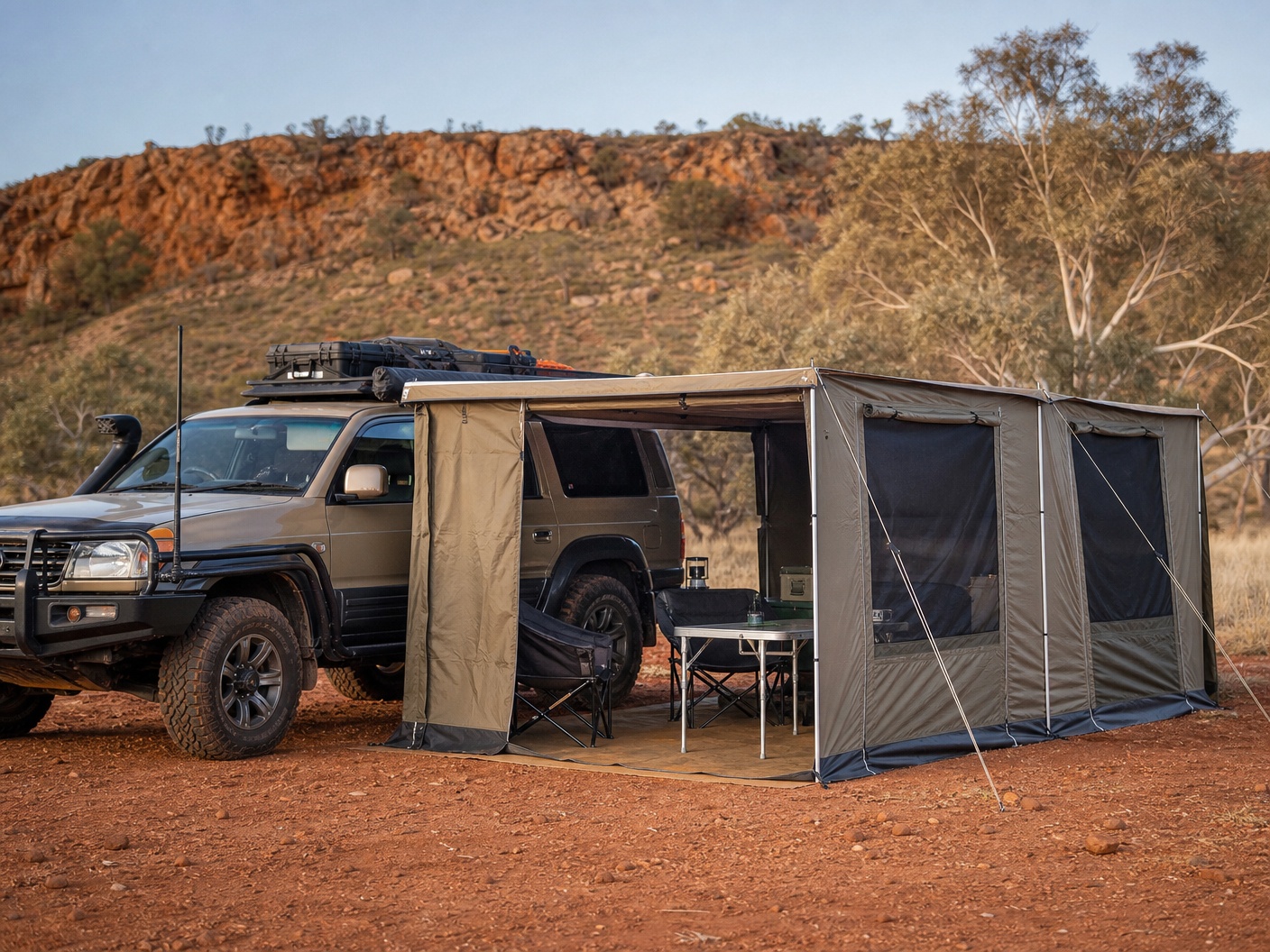
Quick answer: For long stays and rough weather, a full room kit with a sewn-in floor turns your awning into a proper enclosed space. For flexibility, buy individual wall panels and add them as conditions demand. Mesh walls are the pick for bugs and airflow, a change-room adds privacy for a toilet or shower, and a brand-matched set is the safest way to guarantee a proper seal.
An awning gives you shade and a dry patch to stand under, and for a lot of trips that is plenty. Walls are what you add when the wind swings around, the sun drops below the awning roof and blasts in sideways, the bugs arrive at dusk, or you want to get changed without performing for the whole campsite. They turn an open lean-to into a room.
The mistake is treating walls as a magic upgrade that makes any awning bombproof. They do not — and understanding what they can and cannot do is the whole game. Makers like ARB, Rhino-Rack, Darche and 23Zero build wall and room kits matched to their own awnings, and the right choice depends on how long you camp in one spot, the weather you get, and how much setup time you will tolerate.
Quick Picks
- Best overall: a full room kit with a sewn-in floor for long stays.
- Best for flexibility: individual wall panels you add as the weather turns.
- Best for airflow and bugs: mesh insect walls that keep the breeze and lose the flies.
- Best for privacy: a change-room kit for a toilet or a shower.
- Best guaranteed fit: a brand-matched wall set for your existing awning.

How to Choose Awning Walls and Room Kits
Compatibility comes first, and it is where most money gets wasted. Walls and room kits are generally cut to fit a specific awning — a particular brand, length and mounting style — and a kit even slightly off will not seal along the roof line, which defeats the point. Measure your awning, note its make and model, and buy walls designed for it rather than a generic kit you hope will fit. A brand-matched set costs a little more and removes the single most common and most infuriating mistake.
Then look at fabric and airflow, and get honest about wind. Heavier poly-cotton ripstop around 300gsm sheds sun and light rain well; lighter polyester packs smaller and dries faster. Either way you want mesh panels or zippered vents, because a sealed room with no airflow becomes a condensation trap overnight. Here is the myth to bust: walls do not make an awning stormproof. The arms and fabric are the weak link, and walls only add sail area pulling on them — in a genuine blow you take the awning down, walls or not. Whatever you buy, sort your anchoring with quality pegs, guy ropes and tie-downs, and pitch it once at home so you are not learning the sequence in fading light.
The Awning Walls and Room Kits
Check today’s prices on Amazon →
Full room kit with a sewn-in floor
For base camps and long stays, a full room kit is the comfort upgrade. It encloses the awning on all sides, usually with a sewn-in floor that seals out dust, draughts and crawling insects, giving you a genuine second room to cook, sit out a wet afternoon or set up a stretcher. It is the warmest and most weatherproof option by a distance. The trade-offs are real: it is the heaviest, bulkiest and slowest kit to pitch, so it rewards people who park up for days. Price up a full awning room kit on Amazon
Individual wall panels
If you want shelter without committing to a full room every time, individual wall panels are the flexible choice. You add a single wall on the windward side, close in two sides for more shelter, or leave it open on a mild evening — you carry only what you need and pitch only what the weather demands. This modular approach suits tourers who move around and face changeable conditions, and it spreads the cost since you can build the set up over time. Check that panels attach securely and can be stormed down in a hurry. See current individual awning wall panels prices on Amazon
Mesh insect walls
Sometimes the enemy is not the weather but the flies and mosquitoes at dusk. Mesh insect walls hang like solid walls but trade fabric for fine screen, so the breeze still moves through while the bugs stay out — exactly what you want on a warm, still evening. They are light, pack down small, and turn the space under the awning into a bug-free zone. They do nothing for wind or rain, so most people run them alongside a set of solid walls rather than instead of them. Compare mesh insect walls on Amazon
Change-room kit
A change-room is a small, tall enclosure that clips to the awning to give a private cubicle for getting changed, rinsing off under a portable shower or screening a camp toilet. For families, groups or anyone camping where there are no facilities, that privacy is worth a surprising amount, and a dedicated change-room does it far better than draping a towel over an awning arm. It is niche rather than everyday, but when you want it, nothing else really substitutes. Check the latest awning change room on Amazon
Brand-matched wall set for a 270-degree awning
If you run a wraparound 270-degree awning, buy the wall set designed specifically for it. These larger awnings cover a big arc, and only a purpose-cut kit will follow that curve and seal along the whole length; a generic set simply will not fit. A matched kit from the awning’s own maker turns that broad shaded arc into a large, well-sealed room. It costs more than a generic wall, but on a 270 it is the only version that actually works. Browse 270-degree awning wall set on Amazon

Comparison
| Type | Weather protection | Setup time | Best for |
|---|---|---|---|
| Full room with floor | Highest | Slow | Long stays in one spot |
| Individual wall panels | Adjustable | Quick per panel | Changeable conditions |
| Mesh insect walls | Bugs only | Quick | Warm, buggy evenings |
| Change-room kit | Privacy | Quick | Toilet or shower screening |
| 270-degree wall set | High, large area | Moderate | Wraparound awnings |
Frequently Asked Questions
Do I really need awning walls?
Not for a quick shady lunch stop, but they make a big difference on longer stays. Walls turn an open awning into a sheltered room against wind, driving sun, rain and insects, and add privacy. The trade-off is weight and setup time, so add them if you camp in one spot or face changeable weather.
Will any walls fit my awning?
No, and assuming they will is the classic mistake. Walls are usually cut for a specific awning brand, length and mount, so a mismatched kit will not seal along the roof line. Measure your awning and note its make and model, then buy walls designed for it.
Can I leave the awning and walls up in strong wind?
No. Walls do not make an awning stormproof; if anything they add sail area for the wind to push on, and the arms and fabric are the weak point. Anchor everything well with pegs and guy ropes, and in a genuine blow take the awning down rather than trust the walls.
Full room or just a couple of walls?
Match it to how long you stay put. A full room with a floor suits a week in one spot and cold or wet weather, but it is slow to pitch for a single night. One or two wall panels are lighter and quicker and cover most needs on the move.
The Bottom Line
Walls turn an awning from a sunshade into a livable room, but only if you buy the right kind and set expectations honestly. A full room kit is the pick for long stays and rough weather, individual panels suit tourers who move around, and mesh walls handle the bugs. Always buy for your specific awning so it seals, anchor it properly, and remember the golden rule: when the wind really gets up, the walls come down with the awning.
For the awning itself, see our guide to the 270-degree awnings.