
This page contains affiliate links. Far Cornel may earn a commission if you buy through them, at no extra cost to you.
See the top-rated gear on Amazon →
Quick answer: The best all-round tackle box is a soft bag built around removable 3700 utility trays — light to carry, easy to expand and quick to reload. Choose a cantilever hard box for a fixed kit, a gasket-sealed case for kayak and surf, slim stowaway trays for travelling light, and a rugged crate only when your fishing starts at the boat or the vehicle.
Tackle multiplies. A handful of hooks and two lures becomes a drawer of tangled leaders, rusting trebles and soft plastics welded to the bottom of a bag. A tackle box is just the system that keeps all that sorted and to hand, so you spend the session fishing instead of untangling. The right one depends far more on how you fish than on how much gear you have quietly hoarded.
Storage comes in a few shapes: rigid cantilever boxes that fan their trays open, soft bags built around utility trays, sealed cases for wet work, the slim trays themselves, and heavy crates for the boat. Bank, kayak, boat and charter anglers each pull in a different direction on size and waterproofing. Here is how to weigh that, then five setups worth comparing.
Quick Picks
- Best overall: a soft tackle bag built around removable 3700 trays.
- Best for a fixed kit: a cantilever hard box that fans open.
- Best for wet decks: a gasket-sealed waterproof case.
- Best for travelling light: slim stowaway utility trays.
- Best for a big collection: a rugged crate or station.

How to Choose a Tackle Box
Decide on a tray system before you fall for a box. Almost all modern trays follow the 3600 and 3700 sizing standard, so anything built around those is easy to expand and refill for years. Count the trays you actually fish in a session rather than the ones you own: two or three loaded trays cover most trips, and a bag that holds four leaves room to grow without becoming dead weight.
Then be honest about how wet your fishing gets. A water-resistant box shrugs off spray, but only a gasket-sealed case with latching clasps keeps trebles dry in a kayak footwell or a swamped dinghy, and one-piece moulded latches are the parts that last longest. If you store soft plastics, check the trays are rated worm-proof, or the baits react with the plastic and fog the tray.
Finally, match the carry to the walk. Bank and kayak anglers want a slim bag or a single tray that rides on a shoulder or under a seat, while a boat angler can run a full crate and never think about weight. The classic mistake is buying one huge box, filling it, then leaving it in the car because it is too heavy to bother with. Spend on the bag and trays you carry every trip, and save on the hard box that lives in the shed.
The Tackle Boxes
Check today’s prices on Amazon →
Cantilever hard box
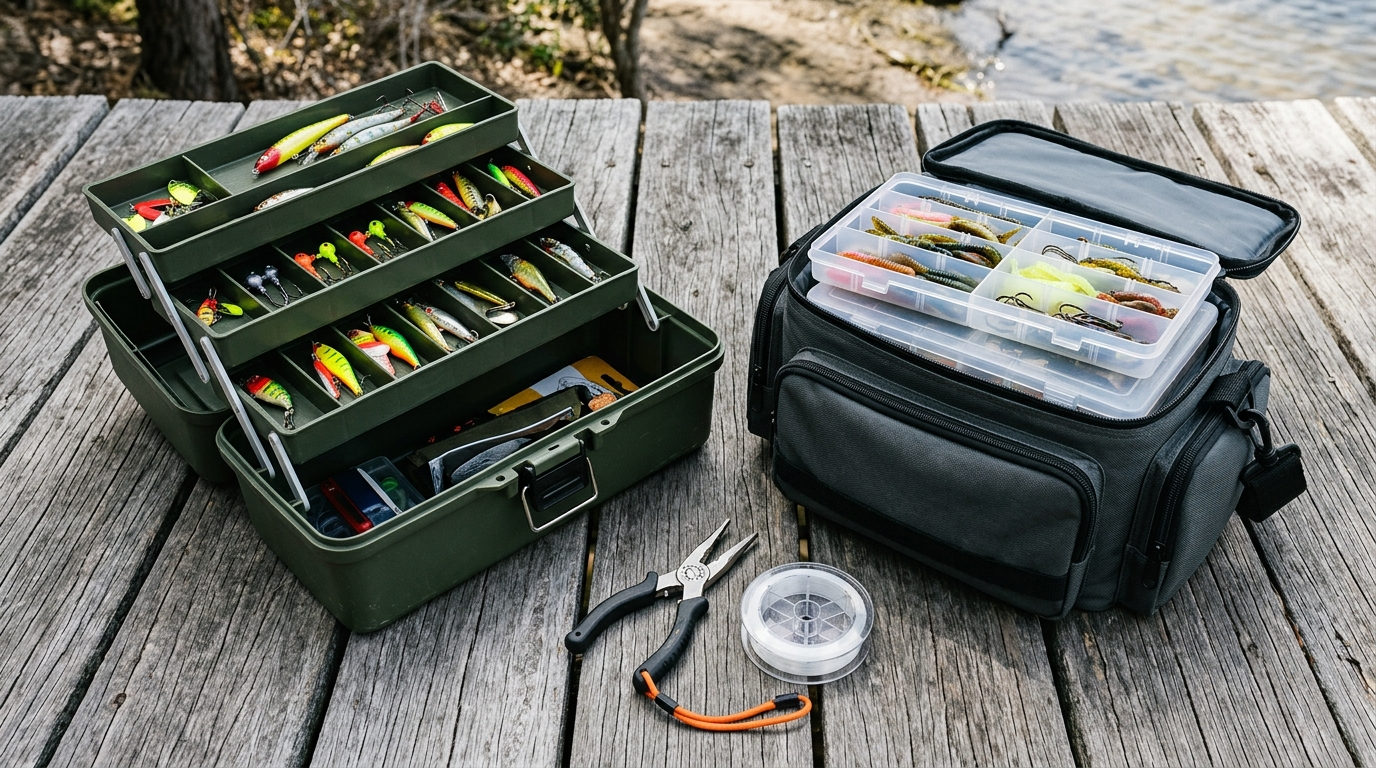
The traditional box, with tiered trays that swing up and out on cantilever arms so every compartment is in view at once. Rigid walls stop lures being crushed and hooks migrating between sections. It is bulky and slow to reconfigure next to a modern tray system, but for a fixed kit that lives on a boat or in the shed, the at-a-glance layout is genuinely handy. Do not buy this if you carry your gear any distance on foot. Compare cantilever hard boxes that fan their trays open.
Tackle bag with utility trays
This is the sensible default. A padded bag holds four or five removable 3700 utility trays, so you pull only the trays you need for the day and swap in fresh ones without repacking. Outer pockets take pliers, leader spools and a scale, and a decent strap makes it easy to carry. Plano and Flambeau both build reliable versions; buy one sized to the standard trays and refills are everywhere. Check padded tackle bags built around removable trays.
Sealed waterproof case
Built for kayaks, small boats and surf work, a sealed case uses a rubber gasket and clamping latches to shut water out completely, which protects hooks and terminal tackle from the rust that spray and humidity cause fastest. The trade-off is bulk and cost, and the seal needs an occasional wipe to stay reliable. It is overkill if you fish dry from a bank, but if you sit low to the water it earns its place. Look over gasket-sealed cases for kayak and surf.
Slim stowaway trays
These flat trays with adjustable dividers are the building blocks of every other system. On their own they are the lightest way to carry a focused selection, slipping into a backpack, a jacket pocket or a boat locker. Buy them all in one size, 3600 or 3700, so they stack and interchange, and choose worm-proof versions for soft plastics, because the cheapest trays warp and leak scent over time. Size up the standard 3700 and 3600 utility trays.
Rugged crate or station
A crate or station is the heavy-duty option for boats and serious shore sessions, holding several trays plus rod tubes, tools and a lid that doubles as a work surface. It keeps everything in one liftable unit you drop on a deck or a jetty. It is the least portable choice by far, so it only makes sense when your fishing starts and ends at a vehicle or a boat rather than a long walk in. Price up a rugged crate for boat or vehicle work.
Comparison
| Type | Capacity | Waterproofing | Best for |
|---|---|---|---|
| Cantilever hard box | High | Basic | Fixed kit, boat or shed |
| Tackle bag with trays | Medium to high | Good | All-round use |
| Sealed waterproof case | Low to medium | Excellent | Kayaks and wet decks |
| Stowaway trays | Modular | Varies | Sorting and light trips |
| Crate or station | Very high | Good | Serious collections |
Frequently Asked Questions
What is the difference between 3600 and 3700 trays?
They are the two common tray footprints. A 3700 tray is larger and deeper, good for bigger lures and more terminal tackle; a 3600 is more compact for finesse gear and light trips. Pick one standard and stick to it so every box, bag and refill you buy fits together.
How many trays do I actually need?
Fewer than you own. Two or three loaded trays cover a typical session, so a bag that holds four is plenty for plenty of anglers. Anything bigger tends to travel half empty and heavy, which is exactly the box that gets left behind.
Tackle box or tackle backpack?
A backpack wins when you cover ground on foot or by kayak, since it frees your hands and carries trays, a drink and a rain layer together. A bag or hard box is simpler and cheaper if you fish mostly from one spot or a boat.
How do I stop tackle rusting?
Rinse metal tackle in fresh water after salt trips and let it dry fully before you close the lid. Drop a couple of silica-gel sachets or corrosion-inhibitor chips into each tray, and never store hooks damp.
The Bottom Line
There is no single best tackle box, only the one that matches your water and your walk. A bag built around standard utility trays suits most anglers because it flexes from a quick bank session to a full day afloat. Add a sealed case if you fish salt or from a kayak, keep a slim tray for light missions, and reserve the crate for boat days. Buy for the trips you actually take, not the collection you hope to own.
Round out your setup with the right small gear: see our guides to hooks and terminal tackle, soft plastic lure kits, and fishing pliers and tool kits.
Compare your options on Amazon →
