
This page contains affiliate links. Far Cornel may earn a commission if you buy through them, at no extra cost to you.
See the top-rated gear on Amazon →
Quick answer: For most tourers the smartest buy is a complete kinetic recovery kit built around a rated snatch strap, two rated bow or soft shackles and a heavy recovery blanket. Get a bare strap-and-shackle set if you already own a blanket and gloves, step up to a winch-ready kit with a snatch block and tree-trunk protector for remote solo travel, and choose a kinetic rope over a strap if you want gentler, longer-lasting stretch.
A snatch strap turns “we’re stuck for the night” into “we’re moving in five minutes,” and it is also the piece of kit most likely to hurt someone if you rush it. The strap stretches roughly 20 percent under load, stores that energy like a giant rubber band, then springs back to drag the bogged vehicle free. Done properly it is almost boring; done badly, a shackle or a failed mount becomes a projectile.
ARB, Saber Offroad, Bushranger and Ironman 4×4 all sell strap-and-shackle kits that look near identical in the bag, so the real decision is rating, hardware and what has been left out. Budget kits cut corners on the safety blanket and the shackles, the exact parts keeping everyone safe. Here is how the pieces work as a system, and how to size a kit to your rig.
Quick Picks
- Best overall: a complete kinetic kit with a rated strap, two shackles, a recovery blanket and a bag.
- Best budget add-on: a bare rated snatch strap to pair with shackles you already trust.
- Best for solo remote travel: a winch-ready kit with a snatch block and tree-trunk protector.
- Best gentler option: a kinetic recovery rope instead of a nylon snatch strap.
- Best safety upgrade: a heavy recovery blanket, the part most people skip.

How to Choose a Snatch Strap Kit
Start with your loaded weight, not the biggest number on the shelf. The rule of thumb is a minimum breaking strength around two to three times your gross mass, so a fully loaded 3,000 kg tourer wants roughly an 8,000 kg strap. Now the myth worth busting: a bigger, stronger strap is not a safer strap. Over-rate it badly and it barely stretches, which kills the elastic tug that does the work and dumps more shock straight into your recovery points.
The hardware matters more than the strap’s colour. Shackles must be load-rated with a stamped working load limit, either rated bow shackles or, kinder to hands and paintwork, soft shackles from someone like Saber that physically cannot fly like a lump of steel. Never join two straps with a steel shackle through both eyes, never recover off a tow ball or a tie-down eye, and only ever connect to engineered recovery points. A recovery blanket over the middle of the strap is not optional; it is the pad that drops a failed strap to the ground instead of launching it.
Then decide between a kit and loose parts. A boxed set from ARB, Bushranger or Ironman 4×4 guarantees the pieces match, which matters at dusk when patience is thin. If you already own quality shackles and a blanket, a bare strap is smarter. Look for reinforced eyes and a tough bag, since a strap stored wet and full of grit ages fast.
The Snatch Strap Kits
Check today’s prices on Amazon →
Complete kinetic recovery kit
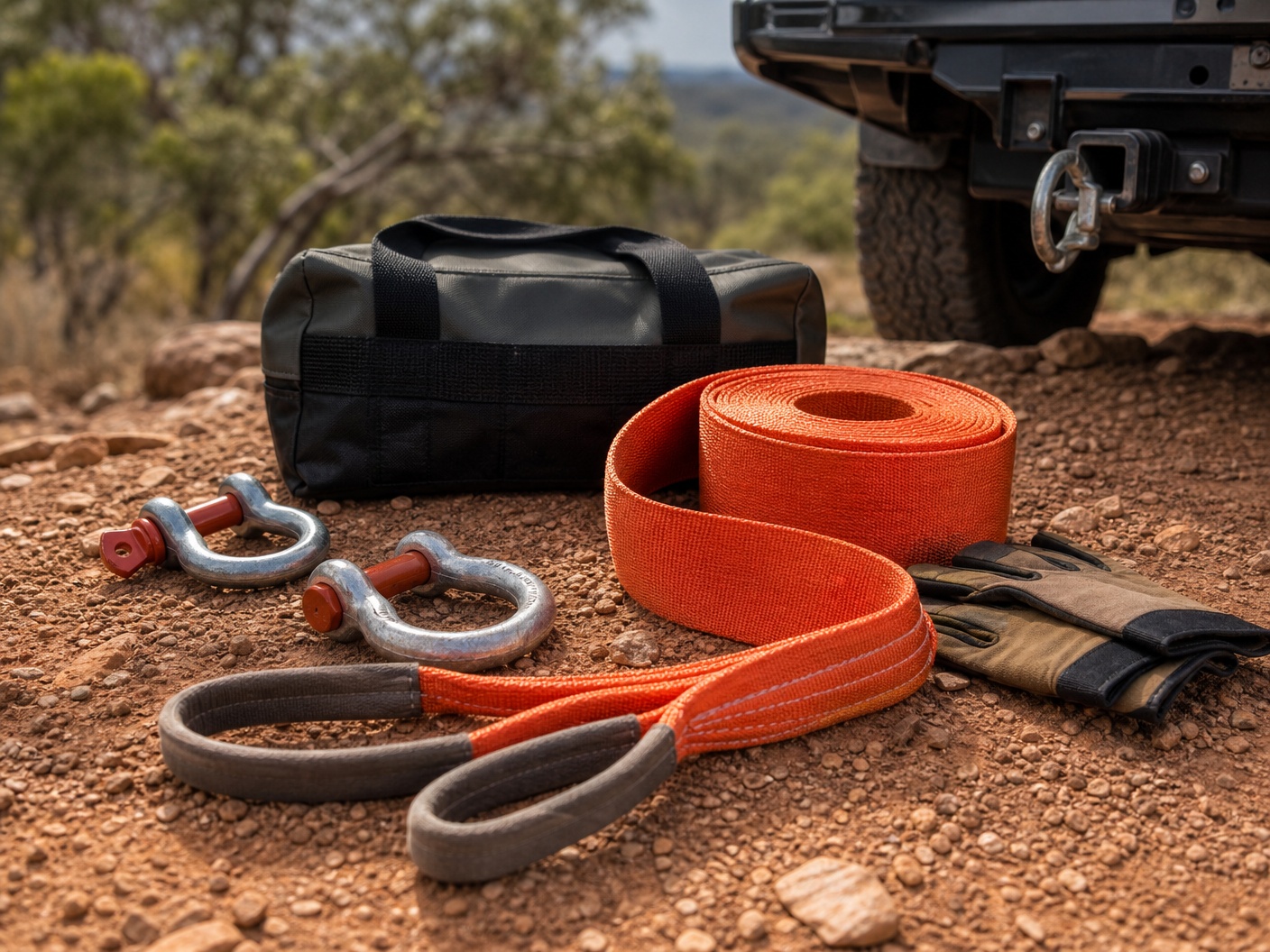
This is the one I would hand a first-time tourer without a second thought. A complete kit bundles a rated snatch strap, two rated shackles, a recovery blanket, gloves and a bag, so the ratings already match. The good ones from ARB or Ironman 4×4 print the strap rating on the label and include a proper heavy blanket rather than a token flap of nylon. Buy the kit rated for your loaded weight, not the empty kerb weight. Have a quick look at the current and most recent options on Amazon for the kinetic recovery kit.
Bare rated snatch strap
If you already run trusted shackles and a blanket, skip the boxed set and buy the strap on its own. A nylon strap of around 8,000 to 11,000 kg minimum breaking strength suits most mid-size and larger four-wheel drives, with reinforced eyes and sewn-in wear sleeves. Match the rating to your loaded mass, and keep it separate from your winch extension. Don’t buy this if you have no rated shackles yet, because a strap alone recovers nothing. Have a quick look at the current and most recent options on Amazon for the snatch strap.
Rated shackles and soft shackles
Shackles are where I refuse to save money. Rated steel bow shackles with a stamped working load limit are the traditional pick, but soft shackles from a maker like Saber have largely won me over: lighter, they float, they will not gouge your recovery points, and if something lets go they cannot become flying steel. Carry a couple of each so you can rig around an awkward angle. Whatever you buy, it must be load-rated, never a hardware-store shackle. Have a quick look at the current and most recent options on Amazon for the recovery shackles.
Heavy recovery blanket
The recovery blanket is the cheapest, dullest and most-skipped part of the kit, and the one that actually saves a windscreen or a collarbone. A heavy padded blanket laid over the middle of the strap smothers the stored energy if a strap or mount fails, dropping everything straight down instead of catapulting it. The better ones add pockets so you can weigh them down with a shackle. If your kit came with a flimsy token flap, upgrade it. Have a quick look at the current and most recent options on Amazon for the recovery blanket.
Winch-ready recovery kit
For remote solo travel where there may be no second vehicle to snatch you, a winch-ready kit earns its bulk. On top of the strap and shackles it adds a snatch block to double your winch line’s pull and change its direction, a tree-trunk protector so you can anchor without ringbarking anything, and often an equaliser strap. Pair it with a decent winch from Runva or Bushranger and rated recovery points. Overkill for a well-travelled track; genuinely reassuring miles from anywhere. Have a quick look at the current and most recent options on Amazon for the winch recovery kit.
Comparison
| Kit type | Typical contents | Best suited to | Watch-out |
|---|---|---|---|
| Bare strap | Rated snatch strap only | Owners who already have shackles and a blanket | Useless without rated hardware |
| Complete kinetic kit | Strap, two shackles, blanket, gloves, bag | Most tourers and weekend drivers | Check the strap rating, not just the box |
| Winch-ready kit | Strap, snatch block, tree protector, extra shackles | Remote and solo travel | Heavier, dearer, needs a winch to shine |
| Kinetic rope kit | Braided kinetic rope with soft shackles | Frequent recoveries, gentler pulls | Keep it clean and out of grit |
Frequently Asked Questions
What size snatch strap do I actually need?
Size it to your loaded weight, aiming for a minimum breaking strength around two to three times your gross vehicle mass. Buying the strongest strap sold is a common mistake: it stretches too little and hits your recovery points harder. If two very different vehicles are involved, size to the lighter one.
What is the difference between a snatch strap and a kinetic rope?
Both stretch to store energy, but a woven nylon strap gives roughly 20 percent stretch and costs less, while a braided kinetic rope stretches more, holds its shape over many uses and sheds mud more easily. Ropes cost more and hate grit. For occasional use a strap is fine; for frequent recoveries a rope lasts longer.
Can I recover off a tow ball or a tie-down point?
No. A tow ball can snap off and fly like a cannonball, and factory tie-down eyes are for transport, not the shock load of a snatch. Only ever connect to engineered, rated recovery points fitted to the chassis, and use a rated shackle or soft shackle to join up.
How long does a snatch strap last?
There is no fixed number of pulls. Retire a strap once it is heavily faded, stiff with ground-in grit, cut or frayed at the eyes, or stretched so far it no longer returns to length. Wash it in clean water, dry it before storage, and inspect the eyes every trip.
The Bottom Line
Buy recovery gear on rating and completeness, never on price. For most people a complete kinetic kit sized to their loaded weight, with rated shackles and a proper heavy recovery blanket, covers the vast majority of bogs. Add a winch-ready kit and a kinetic rope as your trips get more remote. Whatever you choose, sort it before you are buried to the axles, and practise rigging it calmly in daylight.
For the rest of your setup, see our guides to soft shackles and our recovery gear checklist.