
This page contains affiliate links. Far Cornel may earn a commission if you buy through them, at no extra cost to you.
See the top-rated gear on Amazon →
Quick answer: A pair of stiff reinforced-nylon recovery boards like MAXTRAX or TRED is the best all-round self-recovery tool, since they work in sand, mud and snow with no second vehicle and no anchor. Budget boards suit occasional soft-sand use, roll-up mats save space in a small wagon, and longer boards bridge deeper holes. Skip the cheapest brittle boards under a heavy tourer.
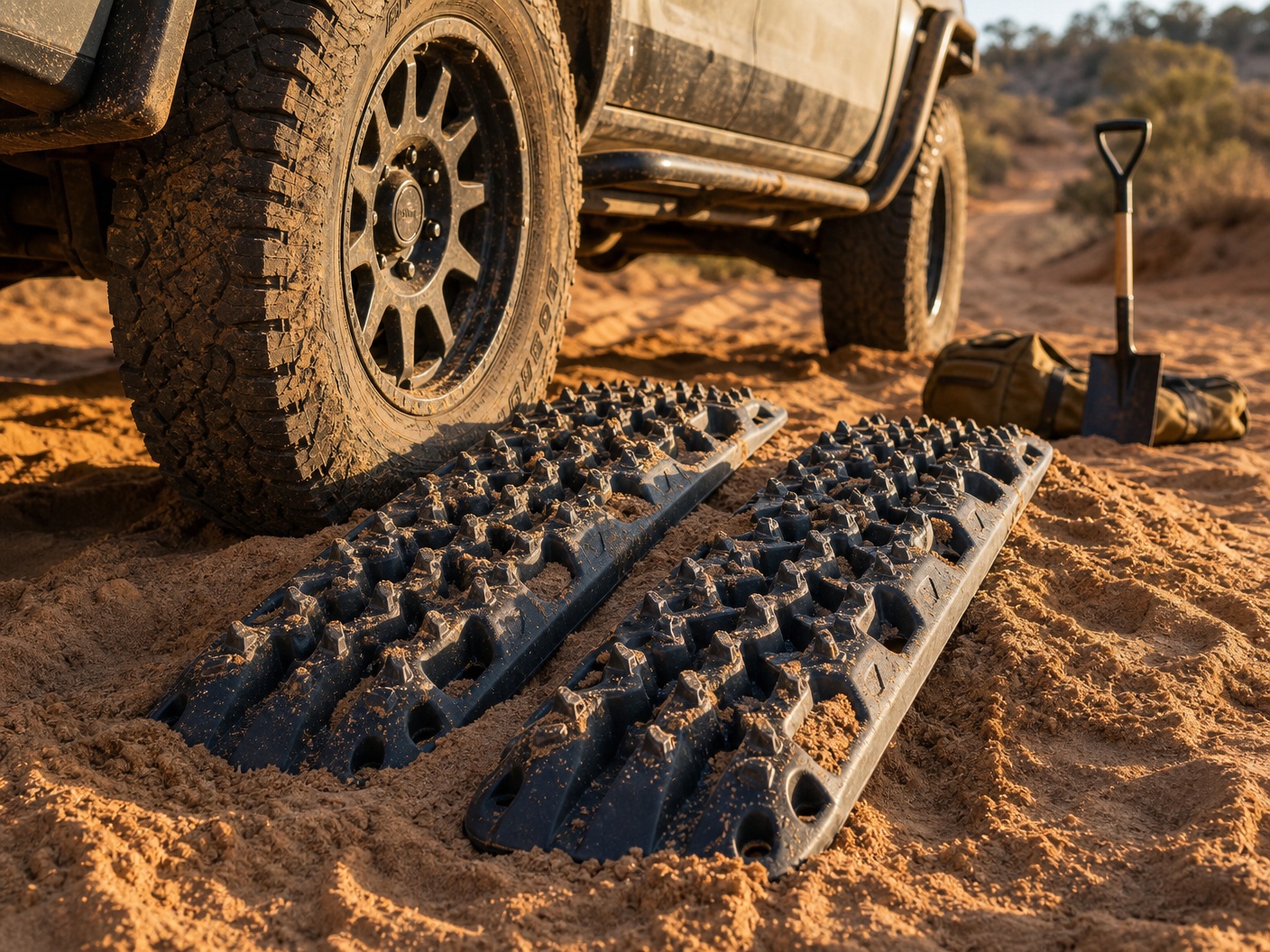
Traction boards are the first recovery item I tell anyone to buy, because they get you out on your own. No second vehicle, no tree to winch off, no shackles to rig: clear the wheel, wedge the board, drive up onto it. For soft sand, greasy clay and mud they solve most bogs before a snatch strap even comes out of the bag.
The trap is thinking every orange board is the same board. They are not. What separates a set that hauls a loaded tourer out from a set that shatters on the second attempt is the plastic they are moulded from and the shape of the teeth, not the colour or the sticker. MAXTRAX, TRED, Bushranger and a wall of budget copies all look similar in a photo and behave very differently in a hole.
Quick Picks
- Best overall: a pair of stiff reinforced-nylon boards from MAXTRAX or TRED.
- Best budget: value boards for light, occasional soft-sand use.
- Best for tight storage: roll-up traction mats for a small wagon or crossover.
- Best for deep bogs: longer boards with more bridging length.
- Best add-on: mounting pins and a bright leash so you can find and carry them muddy.

How to Choose Traction Boards
The plastic is everything, because the board carries the full weight of a spinning wheel. The boards worth owning use tough, slightly flexible reinforced nylon that bends under load and springs back, often with glass-fibre reinforcement for heavier vehicles. The cheap ones use brittle recycled polypropylene that goes hard in the cold and can crack or snap, usually on the second or third attempt when you need them most. If you run a 2,500 kg-plus tourer, this is where the budget sets quietly let you down.
Then look at the teeth and the length. Tall, sharp, well-spaced nodules bite a spinning tyre and soft ground at once; the shallow, crowded patterns on bargain boards skate. Most boards run about 1 to 1.2 metres, which suits an average wheel and an average bog, while longer boards float better in deep sand and bridge bigger holes at the cost of weight and storage. Here is the myth to bust: a bigger board does not make up for bad technique.
That technique is the whole game, and the classic mistake is spinning the wheels. Wheelspin glazes the teeth into a smooth, useless surface within seconds and digs you deeper. Clear the sand, seat the board firmly under the tread, then feed in gentle, steady throttle and let the tyre walk up. Treat them gently and a good pair lasts years; boot the throttle and you will melt the teeth off any brand.
Boards are only as good as the technique. The first move when you are bogged is not the boards — it is airing down: dropping tyre pressures alone often floats you out, and it makes the boards bite far better if you still need them. Clear the sand or mud from in front of the driven wheels, wedge a board hard against each tyre (jack and pack underneath if it has dug in), then drive off gently at low revs. This is what wrecks cheap boards: spin the wheels and you glaze and melt the lugs in seconds, so it is slow steady throttle, never a bootful. Two habits that cost nothing: never stand behind a vehicle driving over a board, because one can spit out like a missile, and once you are on firm ground, stop and collect them — more boards are left buried in a track than ever wear out. Leash them and mount them where you can actually reach them in a hurry.
The Traction Boards
Check today’s prices on Amazon →
Reinforced-nylon recovery boards
This is the pair I would buy once and keep. Flexible reinforced-nylon boards from MAXTRAX or TRED conform to the tyre and the ground instead of fighting them, which is why they grip when a stiff board skates. They shrug off repeated hard use and take metal-free moulded teeth that grip without shredding a tyre if you stay gentle. They cost the most, and for remote travel where a snapped board ends the day, they are worth every dollar. See what a pair of reinforced-nylon boards costs
Budget traction boards
Value boards have a place: a light wagon that only ever sees soft sand, or a spare pair to leave in a mate’s vehicle. They will get a lighter rig moving on the flat. What they will not reliably do is bridge a rut, carry a heavily loaded tourer, or survive being driven onto with any wheelspin, so treat them as an occasional tool rather than your only line of defence. Don’t buy these as your sole boards if you travel remote or heavy. Compare the budget boards for occasional use
Roll-up traction mats
Roll-up mats use rigid segments linked by cable or webbing, so they roll into a small bundle and slide down the side of a boot. For a crossover or small wagon with no roof rack and no spare space, that packability is the whole appeal. The trade-off is real: they have almost no bridging strength and struggle in deep, soft bogs, working best as a grip aid on firmer ground rather than a rescue from a proper hole. Look at the roll-up traction mats that pack flat
Long bridging boards
When your usual trouble is deep, soft sand or a washout that swallows a standard board, a longer board earns its bulk. The extra length spreads the load, floats better on top of the sand and bridges gaps a short board drops into. You pay for it in weight and in awkward storage, since these are the boards that will not tuck neatly inside, so plan a mount. For soft-sand work they are the difference between one attempt and five. Price up long bridging boards for deep ruts
Board mounts and leashes
The boards are only half the purchase; how you carry them decides whether they are handy or a hassle. Mounting pins let you bolt a pair to a roof platform or bar and pull them free fast, while a bright leash means you can drag a buried board out of a hole and find it again in churned mud. Nesting shapes stack flat to save room. Skip the mounts and your boards live under everything else, exactly where you cannot reach them bogged. Grab proper mounts and leashes for your boards

Comparison
| Board type | Best terrain | Bridging strength | Watch-out |
|---|---|---|---|
| Reinforced nylon | Sand, mud, clay, snow | Strong | Highest price |
| Budget plastic | Light, occasional soft sand | Weak | Can crack under load or spin |
| Roll-up mats | Firm ground, tight storage | Very low | Poor in deep bogs |
| Long bridging boards | Deep soft sand, washouts | Strong | Bulky, need a mount |
Frequently Asked Questions
Do I need one pair or two?
A single pair under the driven wheels recovers most bogs, so start there. A second pair helps for very long stretches of soft sand where you leapfrog the boards forward, for recovering more than one vehicle, or when you want a set under all four wheels. Most people are fine with one good pair.
Why do the teeth melt, and how do I stop it?
Melted teeth come from wheelspin. A spinning tyre generates enough heat to glaze or melt the nodules in seconds, which is why the boards then skate. The fix is throttle control: as soon as the board is seated, feed in gentle, steady power and let the tyre walk up rather than flooring it.
Are cheap boards worth it?
For a light vehicle on soft sand, occasionally, they can be. For a heavy loaded tourer, remote travel or any bridging, the brittle plastic is a false economy that fails when it matters. If your trips are serious, buy reinforced-nylon boards once rather than replacing cracked budget sets.
Can I use them to bridge a rut or a ledge?
Only stiff, reinforced-nylon boards are built to bridge, spanning a rut or a step while the tyre rolls across. Budget boards and roll-up mats will flex, crack or fold under that load. Even with good boards, keep the span short and the throttle gentle to avoid launching a board.
The Bottom Line
If you buy one recovery item, make it a pair of quality traction boards, because they let you self-rescue with no anchor and no second vehicle. Reinforced-nylon boards from MAXTRAX or TRED are the pick for anyone travelling heavy or remote; budget boards and roll-up mats have niches for light, occasional or space-tight use. Add a mount and a leash, keep the throttle gentle, and a good set will dig you out of trouble for years without a single melted tooth.
For the rest of your kit, see our guides to maxtrax alternatives and recovery tracks mounting brackets.
Build out the rest of your self-recovery kit with our guides to the 4×4 recovery gear checklist, tyre deflators, and kinetic recovery ropes.