
This page contains affiliate links. Far Cornel may earn a commission if you buy through them, at no extra cost to you.
See the top-rated gear on Amazon →
Quick answer: For most campers a twin-burner gas stove is the best all-rounder — enough heat and space to cook a main and a side while feeding a family. Choose a single butane cartridge stove for simple, cheap solo cooking, a screw-on canister stove for hiking, an integrated system when you mostly boil water fast, and a liquid or multi-fuel stove for cold, wind and genuinely remote trips.
Most stove disappointments come down to one thing people never test in the shop: wind. I have watched an expensive high-output burner take fifteen minutes to boil a pot because a light breeze was peeling the heat straight off the base, while a cheap stove with a proper windscreen next to it had the kettle singing in five. Heat output looks great on the box, but on an exposed site a windscreen does more for your cooking than another few thousand BTU ever will.
A good stove is the heart of camp cooking — fast, clean, controllable heat that does not care whether you managed to gather dry wood. The trap is that “portable gas stove” spans everything from a pocket screw-on burner to a two-ring family cooker, and they suit completely different trips. Get the type right for how and where you cook, and mediocre meals stop being the stove’s fault.
Quick Picks
- Best overall: a twin-burner gas stove for cooking a main and a side at once.
- Best budget: a single butane cartridge stove, cheap and dead simple.
- Best for hiking: a compact screw-on canister stove that weighs almost nothing.
- Best for fast boiling: an integrated stove system with a locking pot.
- Best for cold and remote: a liquid or multi-fuel stove that works anywhere.

How to Choose a Portable Gas Stove
Start with how many mouths you feed. A single burner is light and quick for a brew or a one-pot meal; a twin burner lets you run a main and a side together, which is the difference between eating at the same time and eating in shifts when there is a group. Then look at heat: most camp stoves land somewhere around 7,000 to 12,000 BTU per burner, which is plenty for real cooking. Chasing the highest number is less useful than it sounds once wind enters the picture.
Fuel is the decision that bites people. Butane cartridge stoves are cheap, compact and simple, but butane fades badly in the cold and struggles below freezing. Propane and isobutane keep working when it is cold, which is why gas-bottle and isobutane-canister stoves suit cooler trips. Match the fuel to where you camp, and check you can actually buy that fuel on a long trip rather than assuming it is stocked everywhere.
Then the practical details. A piezo ignition saves fumbling for matches, but always carry a lighter as backup because piezos fail eventually. Look for a stove that is easy to wipe clean, stable under a full pot, and — the day-one upgrade — pair it with a fold-out windscreen. A windscreen is the cheapest performance boost you can buy, cutting boil times and fuel use dramatically on any breezy day. Have a quick look at the current and most recent options on Amazon for the portable gas stoves.
The Portable Gas Stoves
Check today’s prices on Amazon →
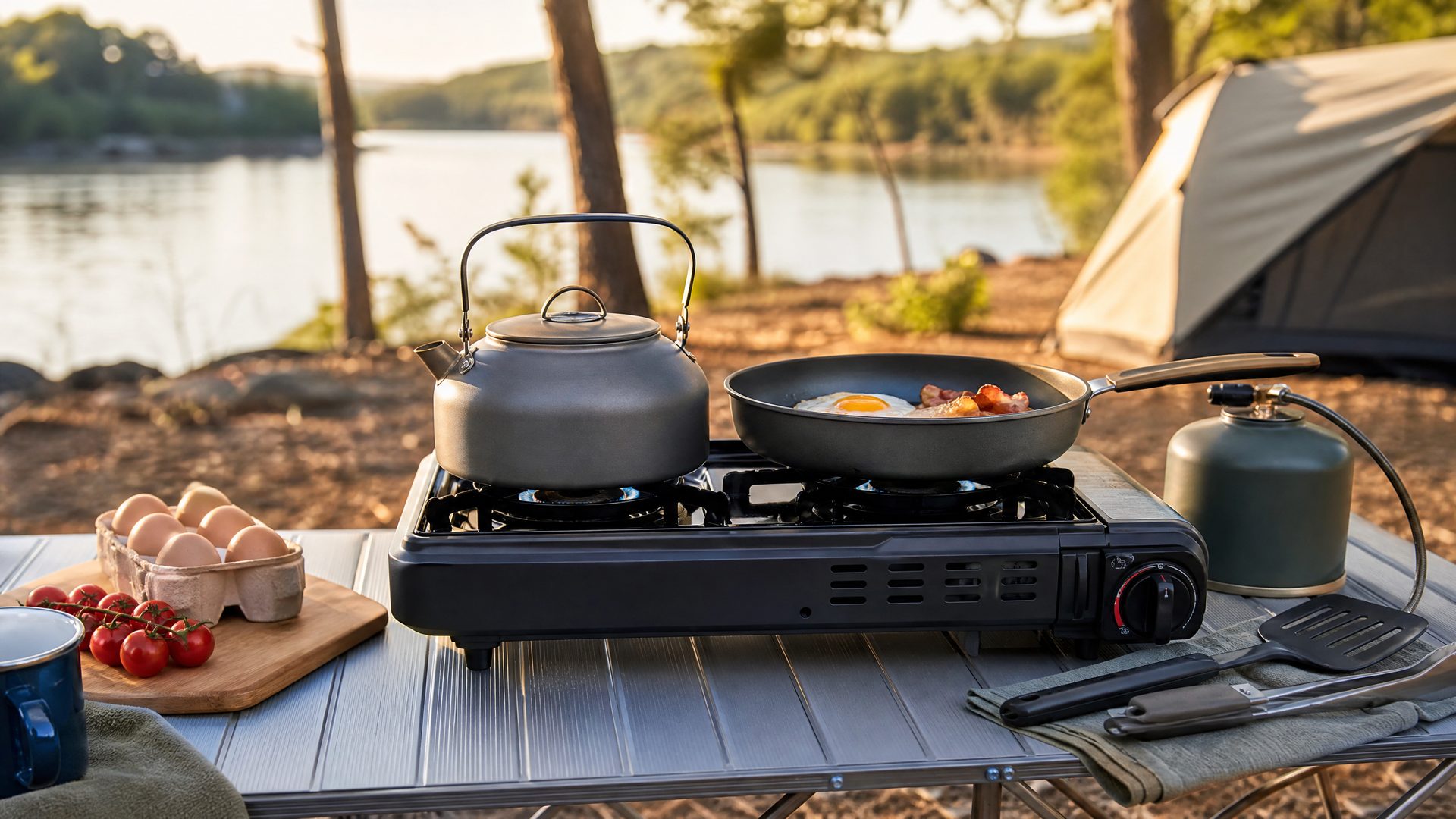
The twin-burner gas stove
For family and group camping this is the one to buy. Two burners let you simmer a sauce on one ring while the pasta boils on the other, and most fold into a hard case with a lid that doubles as a small windbreak. Coleman and Gasmate make reliable versions that run off a gas bottle or a screw-on canister. It is bigger and heavier than a single burner, so it lives in the vehicle rather than a pack, but for cooking actual meals for more than one it is worth the space every time. Have a quick look at the current and most recent options on Amazon for the twin-burner camping stove.
The single butane cartridge stove
The little butane cartridge stove is the cheap, cheerful workhorse of car camping. It clicks a cartridge in, lights with a push button, and boils a kettle or cooks a one-pan meal with no fuss. They cost very little and the cartridges are easy to find. The honest limits are cold weather, where butane loses pressure and the flame drops off, and wind, which they hate. In mild conditions for one or two people, though, it is hard to argue with the value. Have a quick look at the current and most recent options on Amazon for the butane camping stove.
The screw-on canister stove
When every gram counts, a screw-on canister burner is the hiker’s pick. It threads onto an isobutane canister, folds to the size of a fist, and weighs next to nothing while still putting out serious heat. Primus and Kovea make dependable ones. It is built to boil and simmer for one or two, not to cook a spread, and it needs a windscreen and a stable base since the tall canister-and-pot stack can be tippy. For walk-in camping it earns its place in the pack. Have a quick look at the current and most recent options on Amazon for the canister backpacking stove.
The integrated stove system
If your camp cooking is mostly boiling water — brews, dehydrated meals, a quick noodle hit — an integrated system is unbeatable. A Jetboil-style unit locks a heat-exchanger pot onto the burner and boils half a litre in a couple of minutes, sipping fuel while it does. The trade-off is versatility: the tall, narrow pot is poor for actually frying or simmering a real meal, so it is a specialist, not an all-rounder. Buy it for speed and fuel economy, not for cooking dinner in a pan. Have a quick look at the current and most recent options on Amazon for the integrated stove system.
The liquid and multi-fuel stove
For cold, wind, altitude or long remote trips, a liquid or multi-fuel stove is the reliable choice. Running on shellite, unleaded or gas depending on the model, it keeps pumping out heat where cartridge stoves gutter and fade. MSR builds the benchmark units. They are heavier, need occasional maintenance and priming, and cost more, so they are overkill for a mild weekend. But when the weather turns and fuel is scarce, this is the stove that still cooks dinner. Have a quick look at the current and most recent options on Amazon for the multi-fuel camping stove.
Comparison
| Stove | Fuel | Best for | Cold-weather performance |
|---|---|---|---|
| Twin burner | Gas bottle or canister | Families, real meals | Good |
| Butane cartridge | Butane cartridge | Cheap, simple solo cooking | Poor |
| Canister burner | Isobutane canister | Hiking, light weight | Fair |
| Integrated system | Isobutane canister | Fast boiling | Fair |
| Liquid / multi-fuel | Shellite, unleaded, gas | Cold, wind, remote | Excellent |
Frequently Asked Questions
Single or twin burner?
A single burner is light and quick for a brew or a one-pot meal, while a twin lets you cook a main and a side at once, which suits families and longer stays. Choose for how many people you cook for — a group is much happier with two rings than taking turns on one.
What fuel type is best?
Butane cartridges are compact and simple in mild weather, but they fade in the cold. Propane and isobutane keep working when it is cool, so gas-bottle and isobutane stoves suit cold trips. Match the fuel to your conditions, and check you can restock it on longer trips.
How many BTU do I actually need?
Around 7,000 to 12,000 BTU per burner covers real camp cooking comfortably. Beyond that, extra output helps less than you would expect, because wind and pot size affect boil times more than raw numbers. A moderate burner with a windscreen beats a high-output one left exposed.
How do I cook better in the wind?
Use a windscreen and set the stove where something blocks the breeze. Wind steals heat and wastes fuel faster than a cold day does, and a simple fold-out screen can halve boil times. It is the cheapest upgrade you can make to any stove, expensive or not.
The Bottom Line
Pick the stove for how and where you cook, not the biggest BTU figure. A twin burner is the right call for families and real meals; a butane cartridge stove is unbeatable value for simple solo cooking; a canister burner or integrated system suits hikers who mainly boil water; and a liquid or multi-fuel stove is the one for cold, wind and remote trips. Whatever you choose, add a windscreen and carry spare fuel — those two habits fix most camp-cooking headaches.