
This page contains affiliate links. Far Cornel may earn a commission if you buy through them, at no extra cost to you.
See the current rechargeable lanterns on Amazon →
Quick answer: Buy for usable runtime and a warm-to-cool dimmer, not the biggest lumen number on the box. A high-capacity basecamp lantern with a frosted globe is the do-everything pick; add a collapsible one to pack light, a solar or hand-crank hybrid for long off-grid stretches, a flood light only for big sites, and a small warm lantern for all-night ambience that draws fewer bugs.
Watch what happens the first night someone brings a brand-new 1000-lumen lantern to a shared camp table. They twist it to full, everyone flinches and looks away, and within ten minutes a fog of moths is orbiting the thing like it owes them money. Then the low-battery light starts blinking, because almost nothing runs its headline brightness for long. The number that sold the lantern is the number you will use least.
A camp lantern earns its keep at a soft, warm mid-setting that lights a table without turning faces into silhouettes, and it has to hold that glow from dinner until the last person gives up on the fire. That is a story about runtime, colour temperature and how evenly the light is spread, and it is barely related to the peak-lumen figure on the packaging. Sort those three out and the shopping gets simple.
Quick Picks
- Best all-rounder: a high-capacity basecamp lantern with a frosted globe and a warm-to-cool dimmer, so one charge lasts a weekend at a brightness you will actually sit under.
- Best for packing light: a collapsible compact lantern that flattens to a puck and tops up over USB-C.
- Best for long off-grid trips: a solar or hand-crank hybrid, so a flat battery is an inconvenience rather than the end of the light.
- Best for big sites and tasks: a rechargeable area or flood light, with huge output when you genuinely need it and short runtime when you push it.
- Best for ambience: a small warm-only lantern that sips power all night and keeps the bugs politely elsewhere.

How to Choose a Rechargeable Camping Lantern
Start by ignoring the big lumen figure, because it is measured at a turbo setting that cooks the battery flat in an hour or two. What matters is the runtime at a brightness you would actually sit under, which is often a third or a quarter of maximum. A lantern that holds 300 to 400 usable lumens for twelve hours beats one that flashes 1000 for ninety minutes every night of a trip. If the box only quotes its runtime at the lowest, dimmest setting, treat the headline brightness as marketing.
Colour temperature is the feature most people never think to check and the one they notice every single night. Warm light, roughly 2700 to 3000 kelvin, is easy on the eyes at a table and pulls in far fewer insects, because bugs home in on the shorter blue-white wavelengths a cool LED throws. Cool light past 5000K is for finding a dropped tent peg, not for dinner, so a warm-to-cool dimmer is worth more than a few hundred extra lumens. Pair that with a frosted globe or a 360-degree diffuser: even, hotspot-free light feels brighter and kinder than a bare, glaring LED of the same output.
Then check how it fills back up and how tough it is. USB-C in is the standard to hold out for, since micro-USB is slower and the cable is one more oddity to pack. Plenty of lanterns double as a power bank, which is handy in a pinch, but every bit you pour into a phone is runtime taken from the light, so never treat it as your only bank. And the honest read on those giant “20000mAh” numbers: those cells are rated at 3.7 volts, and stepping them up to deliver a 5-volt USB charge loses roughly a third along the way, so real usable capacity sits well under the sticker. Finally, look for at least an IPX4 splash rating, because dew, a knocked-over water cup and a surprise shower are all normal camping, and a lantern that quits in light rain is a torch you cannot rely on.
The Rechargeable Lanterns
Compare today’s lantern prices on Amazon →
The high-capacity basecamp lantern
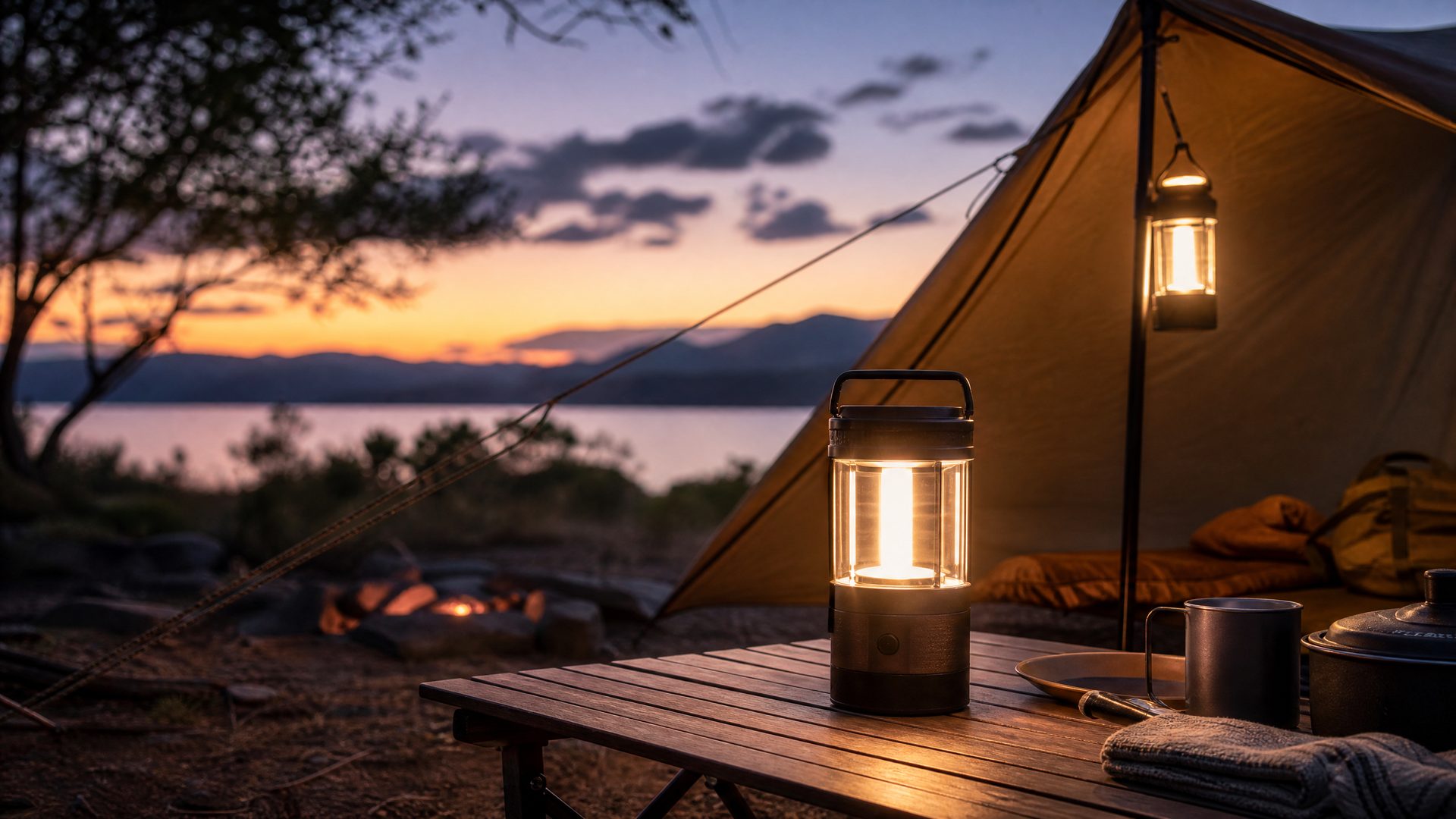
This is the one that lives on the table and does most of the work. Look for a big internal battery, a genuinely warm low end, a dimmer with real range rather than three coarse steps, and a diffused globe so nobody eats dinner staring into a bright dot. Brands like Goal Zero, BioLite and Black Diamond built their names here, and the better units hang from a tent ridgeline as happily as they sit on a table. Buy more battery than you think you need, because a lantern loafing at a third of full for two nights is far nicer to live with than one gasping at maximum to keep up.
The trap is chasing the highest lumen headline and landing a light that is harsh and thirsty. A warm, evenly diffused 500-lumen basecamp lantern with a fat battery will out-camp a raw 1000-lumen spotlight every evening of the trip. See what the big-battery basecamp lanterns are going for.
The collapsible compact lantern
For hikers, kids’ tents and glovebox duty, a lantern that collapses to a flat puck is worth a small trade in brightness. The concertina pop-up style packs tiny and throws a soft 360-degree glow that suits the inside of a tent; the folding-panel style is a touch brighter and sturdier. Neither lights a whole site, and neither is meant to. What you want is a warm tone, a USB-C port, a hook or magnet on the base, and enough output to read or play cards by.
Treat it as a second or third light rather than your only one, because the same trick that makes it pack small also caps how much battery it can carry. Scan the collapsible lanterns on the shelf right now.
The solar and hand-crank hybrid
Once a trip stretches past the point where you can plug in, a backup way to make light stops being a gimmick. Solar tops a hybrid up slowly over a day on the dashboard or a pack lid, so treat it as a trickle that stretches a charge rather than a full overnight refill. A hand crank is the real insurance: a minute of winding buys enough light to find the torch, sort the tent, or get through a blackout at home. Many of these also double as an emergency phone charger, which quietly makes them the most-used bit of kit in the cupboard between trips.
Do not expect the solar to match a wall charge, and do not buy one purely for the panel; buy it because the light itself is good and the backup is a bonus. Weigh up the solar and hand-crank hybrids on offer.
The rechargeable area and flood light
When you need to light a whole camp kitchen, a work area or a boat ramp, this is the tool: a wide, bright flood that mounts on a pole or tripod and washes the space in even light. The honest catch is runtime, because run one of these at full and you measure its life in hours, not nights, so most people pair it with a power station or a spare battery. Tilt and mounting options matter more than raw output here, since a flood aimed at the tarp does far more good than one blasting sideways into everyone’s eyes.
This is a specialist, not a do-everything lantern. If a flood light is the only light you buy, you will find it too harsh for the table and too hungry for a long weekend. Check the rechargeable area and flood lights available.
The warm dimmable ambience lantern
The little candle-warm lantern is the sleeper favourite. It does one thing, a soft low amber glow, and it does it for nights on end because it barely draws any power. It is the light that stays on while everyone drifts off, the one clipped inside the tent for a midnight find, and the one that pulls in far fewer insects than a cool-white blast. It will not light a cooking area, and that is the point: it is there for atmosphere and just enough glow to see your cup.
Most people end up wanting one of these alongside a brighter lantern rather than instead of it, because they cost little and change how a camp feels after dark. Browse the small warm ambience lanterns here.
Comparison
| Lantern type | Warm-to-cool dimmer | Usable runtime | Recharge | Best for |
|---|---|---|---|---|
| High-capacity basecamp | Usually | Long, a weekend | USB-C | The main camp light |
| Collapsible compact | Sometimes | Medium | USB-C | Hiking and tents |
| Solar / hand-crank hybrid | Often warm-only | Medium plus backup | USB, solar, crank | Long off-grid trips |
| Area / flood light | Rarely | Short on full | USB-C or battery | Big sites and tasks |
| Warm ambience | Warm-only | Very long | USB-C | All-night glow |

Frequently Asked Questions
How many lumens do I actually need?
Less than the box wants you to buy. Pottering around camp sits happily at 100 to 300 lumens, and a lit dinner table is comfortable at roughly 200 to 400. Four figures of output is flood-light territory for a big site or a work area, impressive in the shop and something you will almost always dim right back down in the field.
What runtime should I really expect from one charge?
It depends entirely on how bright you run it, which is why a single “up to” number is close to meaningless. A large basecamp lantern held at a warm mid-setting will usually see out a two-night weekend; wind that same lantern up to turbo and you might get a couple of hours. Judge a lantern by its runtime at a brightness you would actually use, not at its dimmest.
Is USB-C worth holding out for over micro-USB?
Yes. It charges faster, the plug goes in either way in the dark, and it is the same cable that already feeds your phone and power bank, so there is one less lead in the kit. A micro-USB lantern still works, but in a few years it will be the thing you can never find a cable for.
Does warm light genuinely keep insects away?
Relatively, yes. Many flying insects are drawn to the shorter, blue-rich wavelengths a cool-white LED pumps out, so a warm 2700K glow attracts noticeably fewer of them. It is not a force field, since nothing short of getting away from the light entirely is, but on a still night the difference between warm and cool is very easy to see.
The Bottom Line
If you buy one lantern, make it a high-capacity basecamp unit with a warm-to-cool dimmer and a diffused globe. It lights the table kindly, holds that glow for a weekend, and charges off the same USB-C cable already in your bag. Add a small warm ambience lantern for the all-night glow and a collapsible one for the pack, and skip the 2000-lumen floodlight unless you genuinely light big spaces. Chase usable runtime and light quality over the lumen headline and you end up with camp lighting that makes the evening feel good rather than just bright.
For more ways to light and power a camp after dark, see our guides to the best camping string lights, the best headlamps for camping, and the best portable power stations to keep everything charged.