
This page contains affiliate links. Far Cornel may earn a commission if you buy through them, at no extra cost to you.
See the top-rated gear on Amazon →
Quick answer: A high-back foam fishing PFD is the one to buy: the flotation sits above a tall kayak seat, the pockets carry your tackle, and there is nothing to service. Pick a mesh-back version for hot days, a touring cut for long paddles, and a plain foam vest if you only fish now and then. Leave inflatables to confident swimmers who will actually service them — and whatever you choose, wear it, because a jacket left in the hatch has never saved anyone.
On a kayak you sit at water level, far from shore, often alone, with a capsize always one wave away. The life jacket is the most important thing you carry, and a kayak fishing one is built for exactly that: it keeps you afloat, lets you paddle freely, and puts your tools within reach. It is the rare piece of gear where the cheapest option is genuinely a false economy.
Sheltered water or open, the same truth holds: a vest only saves you if it fits, floats to the right rating, and is comfortable enough that you actually keep it on. Those three things, not the badge on the front, are what matter. This guide sorts the styles by how and where you paddle, so you buy one you will wear rather than stow.
Quick Picks
- Best overall: a high-back foam fishing PFD with tackle pockets.
- Best for hot days: a mesh-back ventilated PFD.
- Best for long paddles: a touring-cut PFD.
- Best minimalist option: an inflatable PFD, for strong swimmers who service it.
- Best budget starter: a certified entry foam vest.

How to Choose a Kayak PFD
Certification and fit come before everything else, because they are what actually save you. Choose a vest certified to the standard that applies where you paddle, rated for your body weight, and then get the size right. It should sit snug enough that it cannot ride up over your head when you are floating and the vest is not, yet loose enough to breathe and twist. Multiple adjustment straps at the shoulders, sides and waist are what let you dial that in over a shirt or a spray jacket.
Then the myth that puts kayak anglers in the water without proper flotation: a cheap boating vest is not fine on a kayak. Its foam sits low and thick against your back, so a high kayak seat shoves it up around your ears, and the bulk fights every paddle stroke until you take it off, which is precisely when you should not. A kayak-specific PFD moves the foam up and forward, opens the armholes, and cuts the lower back away so a tall seat clears it.
Buoyancy type is the last real decision. Inherently buoyant foam is always working the moment you hit the water, needs no servicing, and suits everyone, which is why most kayak anglers choose it. An inflatable is cooler and less restrictive, but it must be worn correctly, serviced, and it relies on a cylinder firing, so do not buy one if you will skip the maintenance, cannot swim confidently, or fish cold or rough water. On a kayak, foam is the safer default.
Here is the fit test almost everyone skips. Buckle the vest up, then grab it at the shoulders and pull straight up as hard as you can. If it slides up past your ears on dry land, it will float up over your face in the water — the exact opposite of holding your chin clear when a wave puts you in. A snug chest fit stops that ride-up, and on a kayak, where you sit for hours, the vest that rides up is also the one you loosen and eventually stop wearing. Buoyancy itself is rated in newtons or pounds: around fifty newtons, roughly eleven pounds, is the usual floor for a competent swimmer on sheltered water, and you want more, not less, for cold or open water or a heavily loaded boat.
The PFDs
Check today’s prices on Amazon →
High-back foam fishing PFD
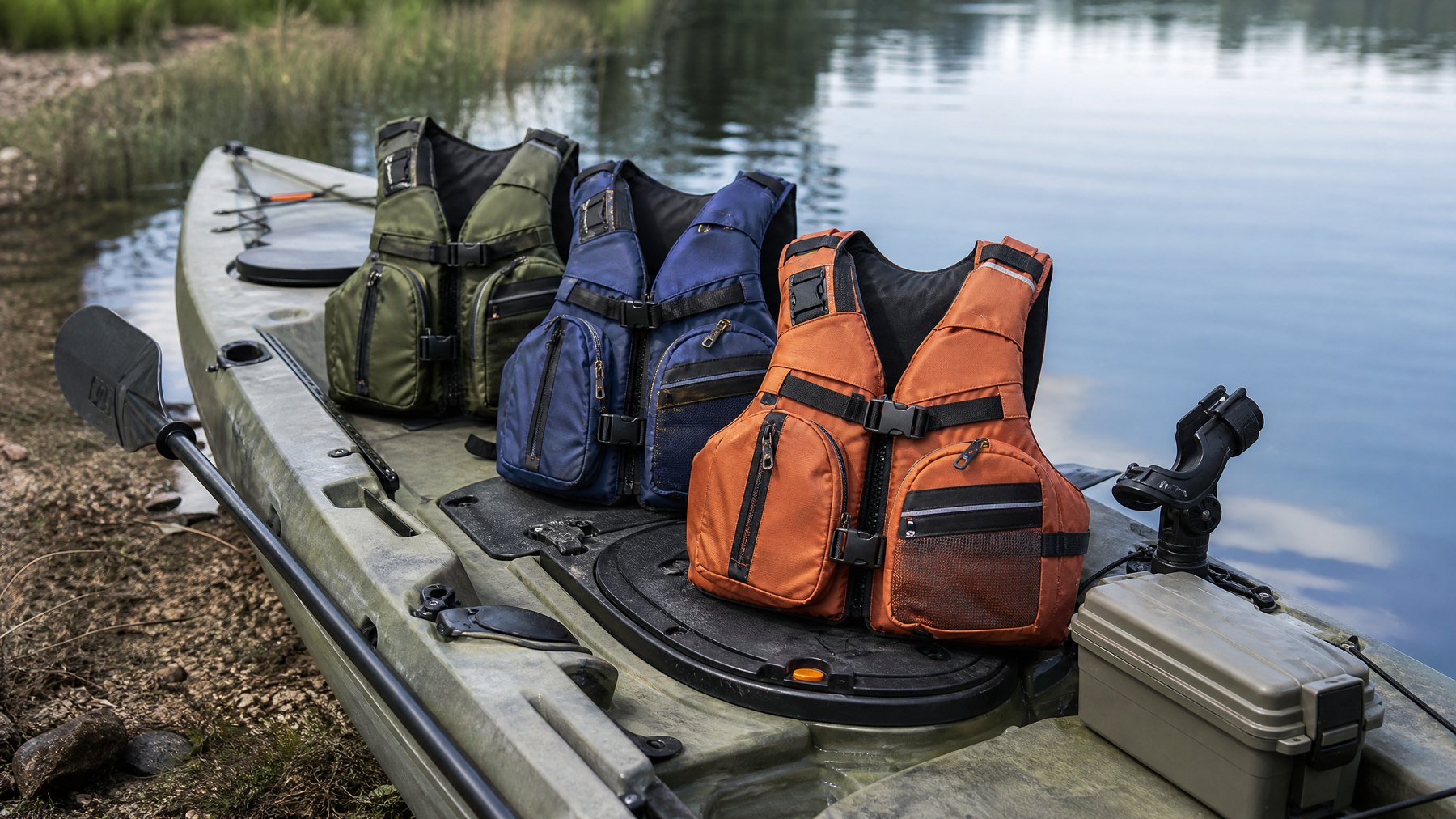
This is the one to buy if you fish from a kayak with any regularity. The foam is lifted high on the back so it clears a raised seat, the armholes are cut large for a full paddle stroke, and the front carries zippered and mesh pockets for pliers, leader and a few lures, with lash tabs for a knife and whistle. It is always buoyant, needs no upkeep, and is comfortable enough to stay on all day, which is the only version of a PFD that ever saves anyone. Compare high-back fishing PFDs options on Amazon.
Mesh-back ventilated PFD
On hot days, a vest with foam across your chest becomes something you want to take off, so a mesh lower back and vented panels are worth having. They let air move and sweat escape, which keeps the vest bearable through a long, still afternoon and, more importantly, keeps it on your body. It carries most of the same fishing features as a standard foam PFD, just with breathability designed in. If heat is the reason your vest ends up in the hatch, this is the fix. Browse the current ventilated fishing PFDs listings on Amazon.
Touring-cut PFD
If you cover distance rather than sitting on one spot, a touring or paddling PFD is shaped around the stroke. The foam is trimmed at the shoulders and lower torso for an unrestricted reach, and the cut suits long, repetitive paddling far better than a pocket-heavy fishing vest. It carries fewer tackle-specific pockets, which is the trade for that freedom of movement, so it suits the angler who paddles a long way to fish rather than one who works structure close to the launch. See how the touring kayak PFDs options stack up on Amazon.
Inflatable PFD
For a strong swimmer who will maintain it, an inflatable is the coolest and least restrictive option, packing flotation into a slim band that all but disappears until you need it. The catch is that it only works if you wear it correctly, service the cylinder, and it fires when it should, and it is a poor choice for non-swimmers or cold, rough conditions. Treat it as a comfort upgrade for calm, warm days rather than a set-and-forget safety net, and check it before every trip. Check the latest inflatable PFDs range on Amazon.
Entry foam vest
If you only paddle a few times a year, a certified entry-level foam vest covers the essentials without the fishing-specific price. It is always buoyant, simple, and does the one job that matters, though it lacks the high-back cut and tackle pockets that make the dedicated vests so comfortable to fish in. Check it is certified and rated for your weight, size it properly, and treat it as the safe starting point you upgrade from once you are on the water often enough to want the extras. Run your eye over the foam life vests range on Amazon.

Comparison
| PFD style | Buoyancy type | Seat fit | Watch-out |
|---|---|---|---|
| High-back foam | Inherent foam | Excellent | Warmer than mesh in summer |
| Mesh-back ventilated | Inherent foam | Excellent | Slightly less padding |
| Touring cut | Inherent foam | Good | Fewer fishing pockets |
| Inflatable | On-demand gas | Excellent | Needs servicing, not for non-swimmers |
| Entry foam vest | Inherent foam | Fair | No high-back cut or pockets |
Frequently Asked Questions
Do I have to wear a PFD in a kayak?
In most places a certified lifejacket is legally required in a kayak, and whether it must be worn or just carried depends on local rules. Either way, wearing it is what saves lives, since a stowed vest is no use in a sudden capsize. Check the rules where you paddle, and wear it regardless.
What PFD suits kayak fishing best?
A high-back or fishing-specific foam PFD sits above the seat, frees your shoulders for paddling, and carries tackle in built-in pockets. Choose one certified to your local standard, rated for your weight, and snug enough that it cannot ride up. That combination is what makes a vest comfortable enough to keep on all day.
Inflatable or foam for a kayak?
Foam is always ready, needs no maintenance, and suits everyone, at the cost of some bulk. Inflatables are cool and unrestrictive but must be worn correctly, serviced and activated, and they are a poor choice for non-swimmers or rough water. In a kayak, foam is the safer default.
How should a kayak PFD fit?
Snug but not restrictive. Loosen the straps, pull it on, then tighten from the waist up so the flotation is anchored low. Have someone lift firmly on the shoulder straps: if it slides toward your ears, it is too loose or too big. A correct fit barely moves when you tug it upward.
The Bottom Line
A kayak life jacket has to work on your worst day, so buy for fit, certification and comfort first. Choose an inherently buoyant, high-back fishing PFD rated to your weight and certified where you paddle, get the size right, and pick one cool enough that it stays on. Leave inflatables to confident swimmers who will service them, and remember the best PFD is simply the one you never take off.
Once the safety gear is sorted, get the rest of your kayak fishing kit right with our guides to the best fishing kayaks, the best kayak fish finders, and the best waterproof dry bags to keep your phone and keys safe if you go over.