
This page contains affiliate links. Far Cornel may earn a commission if you buy through them, at no extra cost to you.
See the top-rated gear on Amazon →
Quick answer: A quality 9-metre double-braided kinetic rope rated to two to three times your loaded vehicle weight is the safest, most forgiving recovery tool going, and the right first buy for nearly every tourer. The Saber Offroad rope is the all-round pick, the Rugged 4×4 13T is the smart-value buy, the Carbon Offroad Gen 2.0 suits heavy rigs, and a flat snatch strap like the Bushranger is a sound budget backup. Whatever you run, it is only as safe as the rated points and shackles around it.
A snatch strap does not tow a bogged truck out — it slings it. The nylon stretches like a giant rubber band, stores the momentum of the recovery vehicle, and springs the stuck one free in a smooth surge instead of a brutal jerk. That elastic snap is the whole point of a kinetic rope or strap, and it is exactly why the tool has to be chosen and used with respect: soft sand, deep mud or a greasy clay track will bog you sooner or later, and getting out safely comes down to the line and what you clip it to.
They are also, used carelessly, among the most dangerous things you can do off-road: the energy stored in a loaded rope can turn a failed fitting into a projectile. So two things matter far more than the badge on the label — getting the rating right for your vehicle, and connecting only to rated recovery points with rated shackles. Get those right and a recovery is quick and undramatic. Get them wrong and it is the sort of story that ends a trip, or worse.
Quick Picks
- Best overall kinetic rope: the Saber Offroad 9m Kinetic Recovery Rope.
- Best value kinetic rope: the Rugged 4×4 13T Kinetic Recovery Rope.
- Toughest for heavy rigs: the Carbon Offroad Gen 2.0 Kinetic Rope.
- Best for a full recovery-kit ecosystem: the Mean Mother Kinetic Snatch Rope.
- Best budget flat strap: the Bushranger 8,000kg Snatch Strap.

How to Choose a Recovery Rope or Strap
The single most important number is minimum breaking strength (MBS). The rule every recovery course teaches is to choose a rope or strap rated to roughly two to three times the loaded weight of the lighter vehicle in the recovery — the figure on the placard inside the driver’s door, not the empty weight. A typical dual-cab sits around 3,000 kg loaded and a big wagon closer to 3,300 kg, so a rope rated somewhere around 9,000 to 13,000 kg suits the vast majority of tourers. Too weak and it can snap; too strong and it barely stretches, losing the elastic effect that makes it both gentle and safe.
Rope versus strap comes down to stretch and durability. A flat nylon snatch strap stretches around 20 percent under load; a double-braided nylon kinetic rope stretches up to 30 percent, giving a softer, more controlled recovery with less shock on both vehicles and their recovery points. Ropes also shrug off mud and water better, last longer, and are often fully sheathed against sharp rock. The trade-off is price — a quality 9-metre rope can cost three to four times a basic strap — so a strap stays a fair budget choice for the occasional bog.
Whatever you choose, the line is only half the system. You still need rated recovery points bolted to the chassis at both ends, rated shackles or soft shackles to join them, and a recovery dampener — a heavy bag or blanket over the line — to kill any rebound if something lets go. Never hook a kinetic rope to a tow ball, which can shear off and fly back with lethal force, and never use a snatch strap for towing or lifting. This is where the money is well spent and the corners must never be cut.
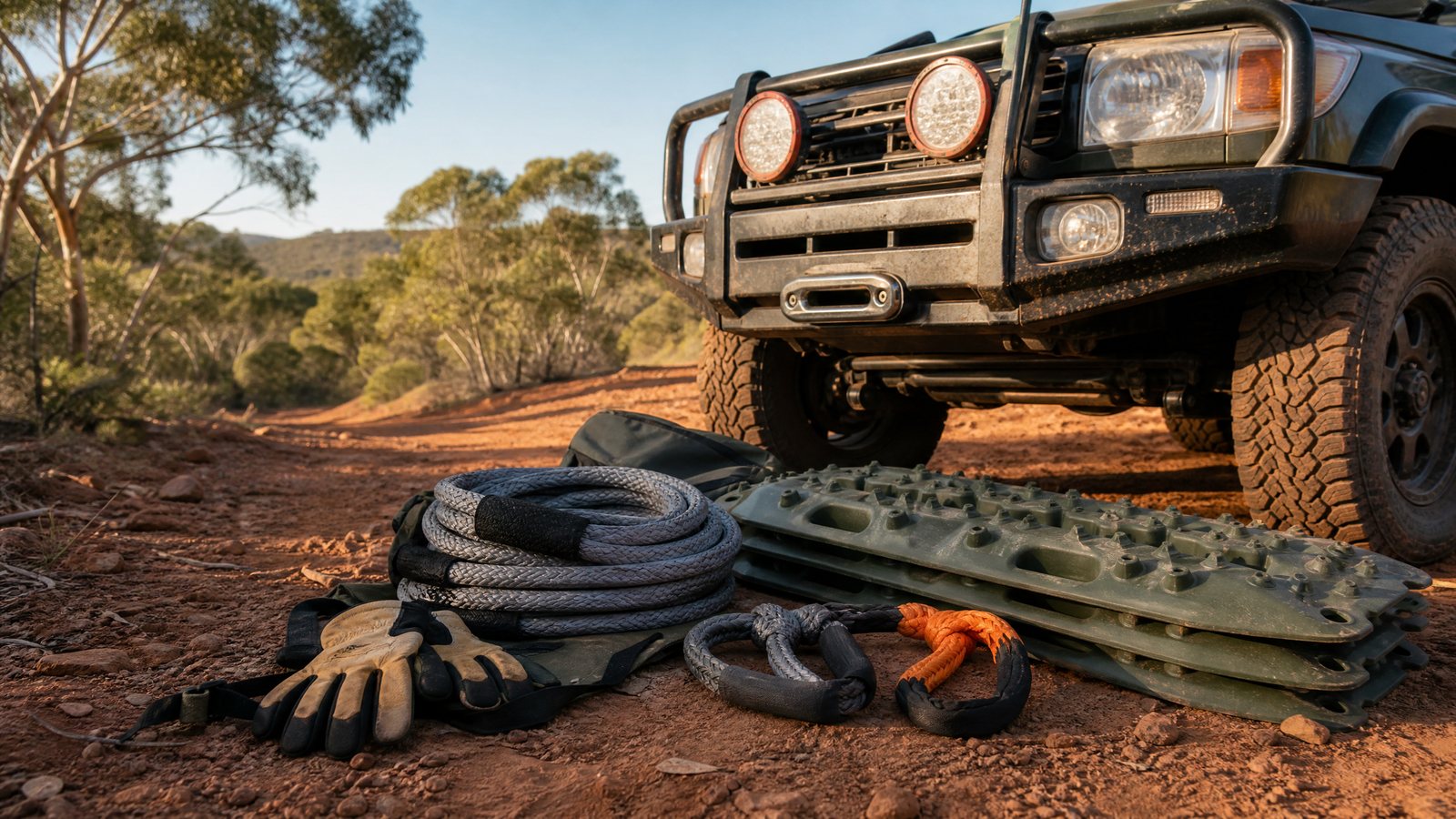
Whatever rope or strap you run, treat it as part of a kit: pair it with rated shackles or soft shackles and drape a weighted recovery blanket over the line so a failed connection drops to the ground instead of flying.
Two habits separate a safe recovery from a dangerous one, and neither costs a cent. First, stand everyone well clear: a loaded line that lets go can whip in an arc, so keep bystanders at least the rope’s length away and never straddle or step over a rigged line. Second, never join two ropes or straps with a steel shackle, because a lump of steel between two stretched lines is the classic missile — use a soft shackle or a rope-to-rope join with a recovery blanket draped over it. Then keep the run-up gentle and add momentum only if the first easy attempt will not shift the vehicle.
The Recovery Ropes and Straps
Check today’s prices on Amazon →
Saber Offroad 9m Kinetic Recovery Rope
A standout for serious tourers. The 9-metre length gives plenty of reach for awkward bog angles, the double-braided nylon delivers the full ~30 percent stretch, and the eye splices are reinforced and sheathed where wear bites hardest. Rated well above the loaded weight of most dual-cabs and wagons, it is a buy-once piece of kit that forgives a lot. If you tour remote tracks and want the smoothest, most controlled recovery, this is the one I would reach for first. See current Saber Offroad kinetic recovery rope prices on Amazon.
Rugged 4×4 13T Kinetic Recovery Rope
The value pick that does not cut corners. A 9-metre, 24 mm, fully double-braided nylon rope with a 13-tonne breaking strength — ample headroom for any standard recovery — at a noticeably friendlier price than the premium names. The balance of strength and weight is sensible and the construction resists abrasion well. If this is your first proper recovery rope and you want the right rating without the premium tax, start here. Run your eye over the Rugged 4×4 kinetic recovery rope range on Amazon.
Carbon Offroad Gen 2.0 Kinetic Rope
Built for heavier rigs and harder use. Thicker construction and a higher breaking strain make it the pick if you run a loaded wagon, tow a van, or regularly haul out bigger vehicles than your own. The extra mass is simply the price of the extra capacity. If you would rather over-spec the rope once than second-guess it at the bottom of a bog hole, this is the honest choice. Look over the current Carbon Offroad kinetic rope options on Amazon.
Mean Mother Kinetic Snatch Rope
A well-supported option made from quality nylon webbing with a guaranteed 30 percent elongation, delivering the smoother, safer pull of a kinetic rope over a traditional flat strap. The real draw is the ecosystem: the brand is widely stocked alongside matching deflators, compressors and 12V gear, so it is easy to build a complete recovery kit around one recognised name. A solid middle-ground buy for people who value support and availability. Compare Mean Mother kinetic snatch rope options on Amazon.
Bushranger 8,000kg Snatch Strap
The budget entry point, and a sensible spare. A traditional flat nylon snatch strap with reinforced, sleeve-protected eyes and an 8,000 kg rating that suits lighter vehicles and occasional use. It will not stretch as far as a kinetic rope, so the recovery is a touch sharper, but it costs a fraction as much and stows small. Keep one in the kit as a backup even if a rope is your main line, since a damaged strap should never be what ends a trip. Check the latest Bushranger snatch strap range on Amazon.

Comparison
| Product | Type | Length | MBS | Best for |
|---|---|---|---|---|
| Saber Offroad 9m | Kinetic rope | 9 m | High | All-round touring |
| Rugged 4×4 13T | Kinetic rope | 9 m | 13 t | Value buyers |
| Carbon Offroad Gen 2.0 | Kinetic rope | 9 m | Very high | Heavy rigs |
| Mean Mother | Kinetic rope | 9 m | High | Full kit ecosystem |
| Bushranger 8,000kg | Flat snatch strap | ~9 m | 8 t | Budget or spare |
Frequently Asked Questions
Kinetic rope or snatch strap — which should I buy?
A kinetic rope for most people. It stretches more, around 30 percent versus 20, giving a smoother pull with less shock on both vehicles, and it sheds mud and water and lasts longer. A flat snatch strap is cheaper and fine for light, occasional use, and makes a good spare to keep alongside a rope.
What breaking strength do I need?
Around two to three times the loaded weight of the lighter vehicle in the recovery. For a typical dual-cab or wagon that lands somewhere near 9,000 to 13,000 kg. Resist buying the strongest rope you can find — too much rating and it barely stretches, which makes the pull harsher, not safer.
Can I connect it to my tow ball?
Never. A tow ball can shear off under a kinetic load and fly back with lethal force. Connect only to rated recovery points bolted to the chassis, using rated shackles or soft shackles. This single rule prevents the worst recovery accidents, so treat it as non-negotiable.
Do I really need a dampener and rated shackles?
Yes to both. A recovery dampener — a heavy bag or blanket over the line — drives a failed rope down instead of letting it whip at head height, and rated shackles are the only safe way to join the line to a recovery point. The rope is only ever as safe as the weakest fitting in the system.
The Bottom Line
A quality 9-metre kinetic rope rated to two to three times your loaded weight is the safest, most forgiving recovery tool you can carry, and the right choice for nearly every tourer. The Saber Offroad is the all-round pick, the Carbon Offroad steps up for heavy rigs, the Rugged 4×4 13T is the smart-value buy, and a flat strap like the Bushranger makes a fair budget option or backup. Whatever you run, pair it with rated recovery points, rated shackles and a dampener, keep bystanders well clear, and start with the gentlest momentum that works — the line is only as safe as the system around it.
Then sort the rest of the system: our guides to the best soft shackles, the best rated recovery points, and the best recovery dampeners cover the fittings that keep a snatch safe.