
This page contains affiliate links. Far Cornel may earn a commission if you buy through them, at no extra cost to you.
See the top-rated gear on Amazon →
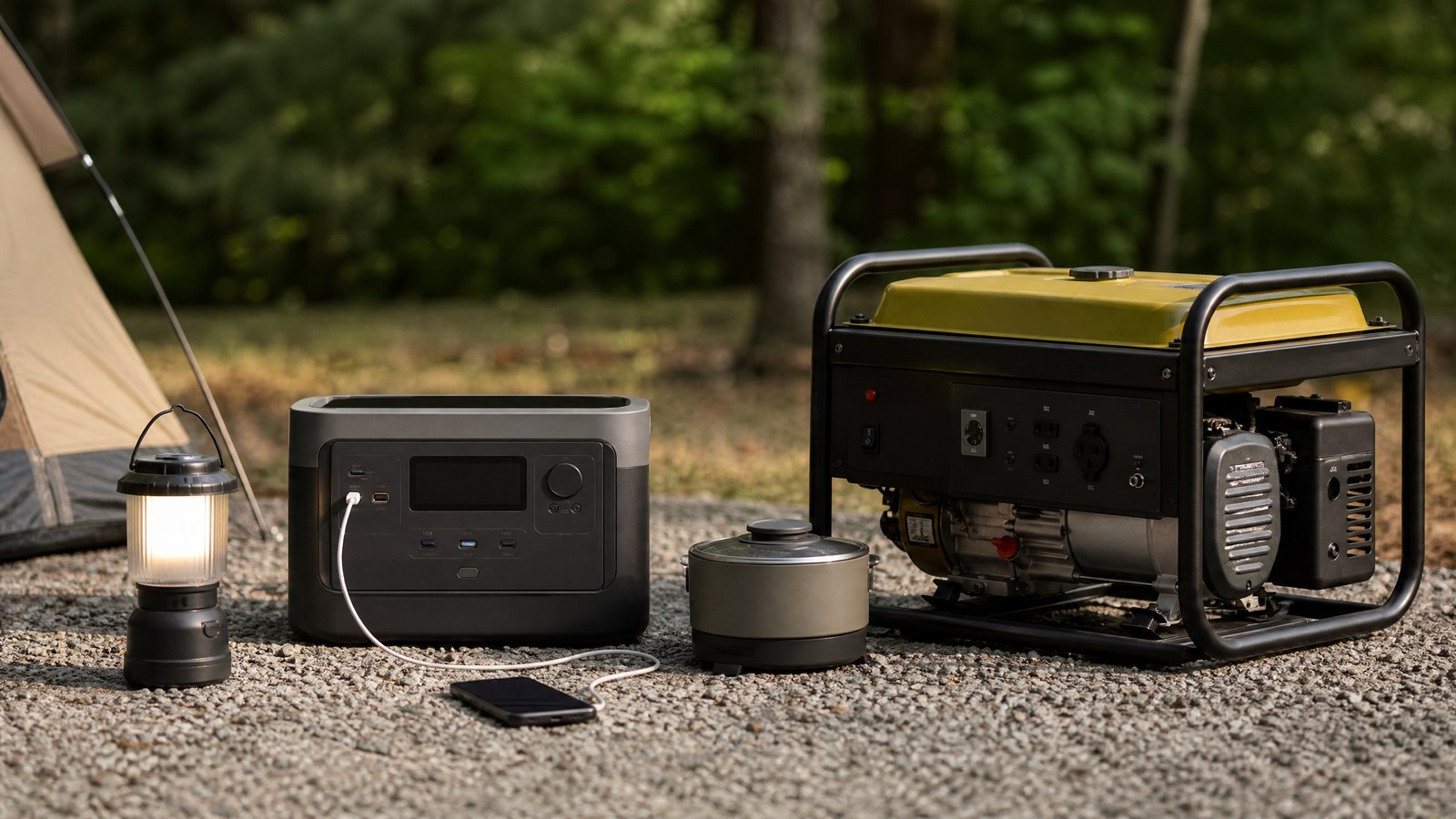
Quick answer: For the way most people camp, a battery power station wins — silent, fume-free, safe inside the tent, and able to recharge from solar, so it runs devices, lights and a fridge with no noise and no rules broken. A generator wins only when you need big, continuous power for tools or air-conditioning, or days of runtime with quick refuelling. Plenty of campers run a solar-charged station for everyday use and keep a small generator on hand for the heavy jobs.
There is a moment on a still evening when the only sound at camp should be the fire ticking over — and then someone three sites away pull-starts a generator and it drones until midnight. That contrast sums up the whole decision. A power station and a generator both make electricity, but one does it in silence and the other does it with noise, fumes and fuel, and they are built for genuinely different jobs.
Choose wrongly and you either run flat halfway through the trip because you undersized the battery, or you haul a heavy, thirsty machine you never needed. So it pays to be honest about what you actually run and where you camp. Below is how the two really stack up, followed by the five bits of kit — on both sides of the fence — that come out of that comparison.
Quick Picks
- Best all-rounder: a compact battery power station.
- Best for bigger loads: a large, expandable power station.
- Best partner for either: a fold-out solar panel to recharge by day.
- Best quiet fuel option: a petrol inverter generator.
- Best for heavy, long runtime: a dual-fuel or high-output generator.

How to Choose Between Them
A power station is a large battery with an inverter and sockets. It is silent, fume-free, and safe to run and recharge inside a tent, van or cabin, with no fuel and no maintenance. It works the instant you press the button and refills from mains, the vehicle, or — the big one for camping — solar. The limits: it holds a fixed amount of energy, topping it back up takes hours without strong sun or mains, and high-draw appliances drain it fast.
A fuel generator, usually a petrol inverter unit, burns fuel to make power. Its strengths are high sustained output and effectively unlimited runtime — refuel in seconds — driving power-hungry gear that would flatten a battery, at a lower cost per watt. The downsides are serious: noisy, exhaust so it runs outdoors only, fuel and servicing, and it is heavy. Many quiet sites ban them outright. So match the tool to the trip — a power station handles phones, lights and a fridge quietly and safely in the tent, endless with a panel, while a generator earns its place only for continuous high power or long runtime without a recharge. Check the rules where you camp, because bans are common and a battery sidesteps them.
The Options
Check today’s prices on Amazon →
The compact power station
For everyday camping, a compact battery station of 500 to 1,000Wh is all the power you need and the quietest way to get it. Something from Jackery, EcoFlow or Bluetti charges every device, runs lights and a fan, and keeps an efficient 12V fridge cold overnight, in silence and safe inside the tent. Insist on a LiFePO4 battery so it lasts years, not seasons. It will not run a kettle or air-conditioner for long, but for the everyday loads of a relaxed camp it fits. Find the right compact power station on Amazon
The large, expandable power station
When the loads get bigger — a fridge for days, modest mains appliances, a bigger group’s devices — step up to a large station of 2,000Wh or more, ideally one you can clip extra battery modules onto. The EcoFlow Delta and larger Bluetti units live here, and double as home backup when the grid goes down. It is heavy and dear, and most weekenders never use the capacity, so buy it only when your trips or loads genuinely call for it — not just for reassurance. Price up a large power station on Amazon
The fold-out solar panel
This is the piece that tips the whole argument toward batteries. A 100 to 200W fold-out solar panel — a Jackery SolarSaga, an EcoFlow or a similar folding blanket — laid out in decent sun tops the station back up while you are off doing something else, turning a finite battery into an effectively endless supply on a bright weekend. Angle it at the sun and move it a couple of times through the day. It is the upgrade that lets a quiet power station do the one thing a generator brags about — keep going — without the noise or fuel. See current portable solar panel prices on Amazon
The petrol inverter generator
If you do need fuel power, a petrol inverter generator is the civilised way to get it. Inverter models from names like Honda and Yamaha run far quieter and cleaner than old open-frame units, and they produce stable power that is safe for sensitive electronics. They give you high output and quick refuelling in a package you can actually carry. They still make noise and fumes, still run outdoors only, and are still banned at plenty of quiet sites, so treat one as the tool for high loads rather than an everyday camp companion. Compare inverter generator on Amazon
The dual-fuel or high-output generator
For the heaviest jobs — running power tools, a caravan air-conditioner, or several big appliances at once — a high-output or dual-fuel generator is the tool that will not flinch. Dual-fuel units run on more than one fuel, handy when one is hard to find, and the bigger frames deliver sustained watts a battery cannot match for long. The price: loud, heavy, thirsty, needs servicing, and least welcome at a quiet campground. Buy one only if your loads truly demand it. Check the latest dual-fuel generator on Amazon

Comparison
| Type | Noise | Runtime | Recharge / refuel | Best for |
|---|---|---|---|---|
| Compact power station | Silent | Fixed charge | Hours, or solar | Everyday camping |
| Large power station | Silent | Longer, expandable | Hours, or solar | Big loads, long trips |
| Fold-out solar panel | Silent | Extends any battery | Daylight | Staying out longer |
| Inverter generator | Moderate | Unlimited with fuel | Seconds | Quieter fuel power |
| Dual-fuel generator | Loud | Unlimited with fuel | Seconds | Tools, air-con, heavy loads |
Frequently Asked Questions
Power station or generator for camping?
For the average camper, a battery power station is the better tool — silent, fumeless, maintenance-free and safe for electronics inside the tent, especially when paired with solar. A fuel generator makes far more power for longer but is noisy and needs fuel, so it only makes sense when your loads are genuinely heavy or you need days of runtime.
Which runs a camp fridge better?
A mid-size power station runs a 12V fridge quietly for a night or two and recharges from solar by day, which suits most people. A generator only pulls ahead when you are also running heavy or all-day loads on top, and even then many campers just add solar.
Are generators allowed at campgrounds?
Often not, or only within set hours. Many sites restrict or ban generators because of the noise, particularly at night, while a power station has no such issue and can run any time. If you camp at quiet or managed sites, check the rules first — it frequently decides the question for you.
Can I run a power station inside the tent?
Yes — that is its biggest advantage. With no fuel and no exhaust, a power station is safe to use and recharge inside a tent or vehicle. A fuel generator must never run in an enclosed space, so it always stays outside and well ventilated.
The Bottom Line
For the way most people camp, a portable power station is the better tool: silent, clean, safe inside the tent, and able to run on solar — ideal for devices, lights and a fridge. A generator is the right call when you need big, continuous power for tools or air-conditioning, or long runtime with quick refuelling, and can live with the noise and fumes outdoors. Many campers land on a hybrid: a solar-charged station for everyday use, a generator only when the load demands it.
For specific picks, see our guides to the best portable power stations, the best portable solar panels, and the top folding solar panel kits.