
This page contains affiliate links. Far Cornel may earn a commission if you buy through them, at no extra cost to you.
See the top-rated gear on Amazon →
Quick answer: Start around 160 to 200W of folding panel and you have most trips covered: portable enough for a vehicle camp, but realistic once a 12V fridge is drawing all day. A 100W panel suits light users and small batteries; a 200 to 220W suitcase panel earns its size on fridge-heavy weekends and cloudy runs. Whatever the wattage, match the connector and voltage to your power station’s solar input, because the battery, not the sticker, sets the real charging ceiling.
The number that sells a solar panel is the one you will almost never see. A 200W panel might read 120W on a good day and less through haze or a poor angle, because rated watts are measured in lab conditions your campsite does not reproduce. That gap is not a fault; it is just how solar works, and planning around it is the difference between a system that keeps up and one that slowly falls behind.
The second trap is buying on wattage alone and ignoring the connector and the battery’s input limit. A panel has to fit your power station, your storage space and your expected sun, not just win a spec sheet. Here are five folding options worth understanding, and how to match one to your setup.
Quick Picks
- Best budget and lightest: a 100 to 120W folding panel.
- Best all-round: a 160 to 200W folding panel.
- Best for fridge weekends: a 200 to 220W folding suitcase panel.
- Best for a matched setup: a brand-ecosystem panel for your power station.
- Best for a fixed or ultralight kit: a flexible or semi-flexible panel.

How to Choose a Portable Solar Panel
Buy the panel around the battery, not just the wattage. Open your power station’s manual and find the solar input specification: the accepted voltage range, the maximum current, the maximum solar watts, and the connector type. A 220W panel feeding a battery that only accepts 120W is capped at 120W, so the battery’s limit is the real ceiling, not the panel’s marketing number.
Then check the electrical fit. Panels often end in MC4 connectors, while power stations use XT60, XT60i, DC7909, Anderson-style or brand-specific inputs, and the panel’s open-circuit voltage must stay inside the battery’s window. Get the adapters or voltage wrong and a physically impressive panel simply will not charge, which is the most common and most avoidable solar mistake. The controller matters as much as the connector: a cheap PWM regulator drags the panel down to battery voltage and throws the surplus away, while an MPPT controller turns that spare voltage into charge and can pull twenty to thirty percent more on a cold, bright morning. Most quality power stations already run MPPT internally; a panel wired into a dumb regulator is where people quietly lose a third of their solar.
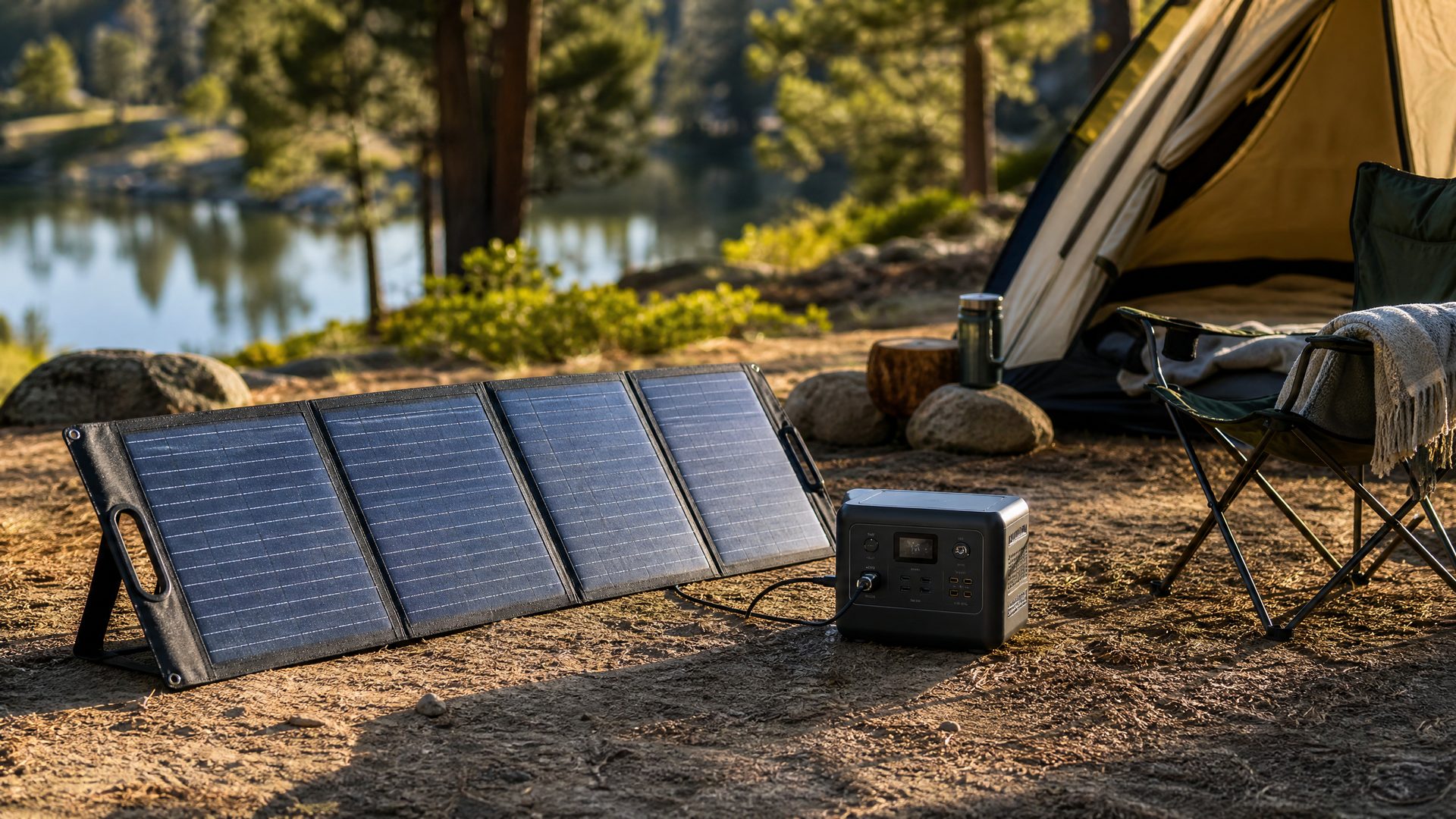
Finally, expect 60 to 80 percent of the rating in the real world, and buy the biggest panel you will actually set up. Kickstands, cable length, folded size and weight decide whether a panel gets deployed every day or stays in the bag, so a slightly smaller panel that is easy to aim often beats a bigger one that annoys you.
If you want something that packs flatter than a rigid folder, an ETFE-coated solar blanket rolls up small and drapes over a bonnet or roof, while stepping up to a 250 to 300W kit suits bigger batteries or faster top-ups on short daylight.
The Solar Panels
Check today’s prices on Amazon →
100 to 120W folding panel
The light, affordable starting point. A 100 to 120W folding panel keeps phones, lights and cameras topped up and supports a small fridge in good sun, and it packs small and sets up in seconds. Jackery and Renogy make tidy panels in this class. It is honest about its limits: treat it as a useful daily top-up rather than a full off-grid fridge solution and it earns its place. See 100W solar panel options on Amazon
160 to 200W folding panel
The size most campers should buy first. A 160 to 200W folding panel gives a realistic recovery path for a 12V fridge and daily device charging while staying manageable for vehicle camping. EcoFlow, BLUETTI and Anker all make strong panels here. It is the sweet spot between a panel that struggles to keep up and one that is a chore to carry and aim around the shade. Find the right 200W solar panel on Amazon
200 to 220W folding suitcase panel
The choice for fridge-heavy weekends and cloudy-day insurance. A 200 to 220W suitcase panel folds into a carry-handle package with built-in kickstands, giving you the strongest daylight recovery of the portable options. EcoFlow and Renogy make well-regarded suitcase panels. Just confirm your battery can accept that much input, or the extra wattage is clipped and you have paid for headroom you cannot use. Price up a 220W solar panel on Amazon
Brand-ecosystem panel
The safe pick when you already own a power station. Buying the panel, cable and battery from one maker, such as EcoFlow, Jackery, BLUETTI or Anker, removes most of the adapter guessing and makes support simpler because the parts are designed to work together. It sometimes costs a little more than a third-party panel, but for anyone who dislikes wiring puzzles the matched setup is worth it. See current power-station solar panel prices on Amazon
Flexible or semi-flexible panel
The option for a fixed roof or a weight-critical kit. A flexible panel bonds to a canopy, roof or camper and adds charging without the bulk of a rigid folding unit, and the lightest ones suit walkers counting every gram. The trade-offs are lower efficiency and a shorter life than a framed panel, and they run hotter laid flat, so they suit a permanent low-profile setup more than daily repositioning. Compare flexible solar panel on Amazon
Comparison
| Panel | Rated watts | Best for | Watch-out |
|---|---|---|---|
| Compact folding | 100–120W | Devices and light use | Not a full fridge solution |
| Mid folding | 160–200W | Fridge and devices | Check battery input limit |
| Suitcase folding | 200–220W | Fridge-heavy weekends | Battery may clip output |
| Brand-ecosystem | Varies | Matched power stations | Often costs a little more |
| Flexible | Varies | Fixed or ultralight setups | Lower efficiency, runs hot |
Frequently Asked Questions
What size solar panel do I actually need?
For phones, lights and a small fridge topped up, 150 to 200W is a sensible start. Go bigger if you run a fridge full time or expect cloudy weather, since undersizing is the most common regret. Always check that your power station will accept the panel’s output before buying the largest one you can find.
Folding panel or flexible panel?
Folding panels pack away and are easy to angle at the sun, which suits campers who move around and chase shade. Flexible panels bond to a roof or canopy for a permanent, low-profile setup and save weight, at the cost of efficiency and lifespan. Most tourers start with a folding panel and add flexible only for a fixed install.
Do I need a solar controller or regulator?
Yes, and many portable kits and power stations include one built in. A controller protects the battery from overcharging and manages the incoming voltage, so charging a bare battery straight from a panel without one can damage it. Always confirm whether the regulator is in the panel, the battery, or neither. One caveat from the electrical trade: a panel’s open-circuit voltage climbs as it gets colder, so on a frosty, sunny morning a 12V panel can push well above its rated voltage. Leave a little headroom under your controller’s voltage limit rather than running right at the ceiling, especially if you ever wire two panels in series.
Why does my panel make less power than the sticker says?
Rated watts come from lab conditions. In the field, haze, heat, a flat angle and cable losses mean you often see 60 to 80 percent of the number, and the battery’s input limit can cap it further. Angle the panel at the sun and move it through the day to claw back as much as you can.
The Bottom Line
A 160 to 200W folding panel is the honest first buy on most trips: enough to claw a fridge and your devices back through the day without being a chore to carry and aim. Buy it around your battery’s solar input, not the number on the box; favour an MPPT controller; and angle it at the sun through the day rather than leaving it flat. A mid-sized panel that gets pointed the right way quietly out-charges a bigger one that never does.
To build the rest of the system around the panel, see our guides to sizing a portable power station, choosing a 12V fridge the solar has to keep up with, and the lithium battery boxes that store what you harvest.
Compare your options on Amazon →
