
This page contains affiliate links. Far Cornel may earn a commission if you buy through them, at no extra cost to you.
See the top-rated gear on Amazon →
Quick answer: If you camp the odd weekend with no 12V setup, a good cooler is all you need, and a rotomoulded one holds ice for days. If you tour, camp for a week, or hate buying ice, a 12V compressor fridge-freezer earns its cost with steady cold, a freezer and dry food. Skip thermoelectric coolers, which are weak and cannot freeze. Power and trip length decide it.
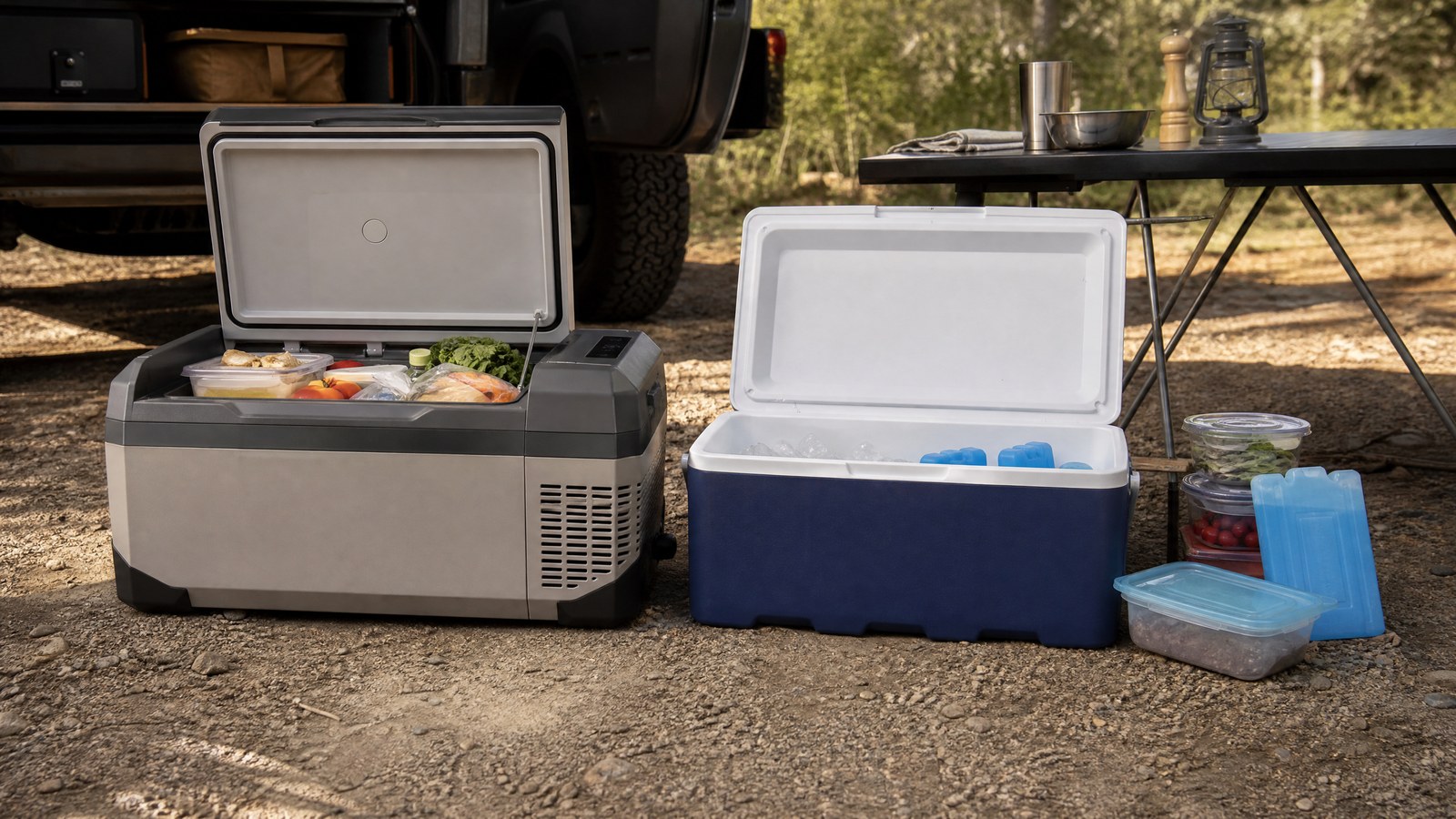
Keeping food and drinks cold is one of camping’s oldest problems, and there are two honest ways to solve it: a classic cooler packed with ice, or a 12V compressor fridge that runs off a battery. One is cheap and simple; the other is a real investment that changes how you camp.
Which makes sense for you comes down to how long you are out, whether you carry power, and how much you resent buying ice. This guide lays out both camps and the five options within them, so you spend on the one that suits your trips.
Quick Picks
- Best for short trips and budget: an everyday hard cooler you just fill with ice.
- Best ice retention: a rotomoulded hard cooler that holds cold for days.
- Best for day trips and drinks: a soft cooler bag that packs away flat.
- Best for touring and multi-day: a 12V compressor fridge-freezer.
- Best avoided: a thermoelectric cooler, weak in heat and unable to freeze.

How to Choose Between Them
A cooler is just an insulated box. You add ice, it keeps things cold for a while, and when the ice melts you top it up, with no power and no noise. Cheap boxes hold cold for a day, thick rotomoulded coolers several days, but the price is forever managing ice and fishing food out of the melt water. A 12V compressor fridge instead cools to a set temperature and holds it for days off a battery, power station or solar. No ice, dry food, and it can freeze, but it costs far more, needs power, weighs more, and hums as it cycles.
The deciding question is nearly always power and trip length. No 12V and short trips point straight to a cooler; a battery-and-solar setup and longer trips point to a fridge. Do the ice math: over a few big trips the ice you stop buying, plus dry, properly cold food, pays back a real slice of a fridge. Do not buy a fridge if you head out for a weekend a few times a year with no power, though, because you will never recoup it, and a good cooler will serve you better.
One trap to sidestep is the thermoelectric cooler. These cheap plug-in boxes only cool a set number of degrees below the outside temperature and cannot freeze, so in real heat they struggle while still drawing current. For serious cooling a compressor fridge is a different league, and a good icebox often beats one anyway. Have a quick look at the current and most recent options on Amazon for the portable fridges and coolers.
The Options
Check today’s prices on Amazon →
Everyday hard cooler
The cheap, simple starting point. A basic hard cooler or icebox like a Coleman is an insulated box you fill with ice, and for weekends, picnics and day outings it is all most people ever need. It costs little, needs no power, and nothing breaks. It holds cold for a day or so before it needs more ice, and food sits in the melt water. For occasional camping on a budget, it is the sensible buy. Have a quick look at the current and most recent options on Amazon for the everyday hard cooler.
Rotomoulded hard cooler
The ice-retention champion. A thick-walled rotomoulded cooler such as a YETI Tundra or an RTIC uses heavy insulation and a tight seal to hold ice for several days, which stretches a no-power setup much closer to a fridge’s convenience. Pre-chill it, pack it with block ice, keep it shut and out of the sun, and it will surprise you. It is heavy when loaded and dear to buy, but close to indestructible and the honest alternative to a fridge if you have no 12V. Have a quick look at the current and most recent options on Amazon for the rotomoulded hard cooler.
Soft cooler bag
The grab-and-go layer. A soft, collapsible cooler bag is the one to carry a day’s drinks and lunch, then fold flat and stash when it is empty. It is light, easy to sling, and less bulky than a hard box, the ideal second cooler while the big one lives in the back. Retention is shorter than a hard cooler, so it is a few-hours tool rather than a multi-day one, but for day trips it earns its keep. Have a quick look at the current and most recent options on Amazon for the soft cooler bag.
12V compressor fridge-freezer
The touring upgrade that changes everything. A compressor fridge like an Engel, Dometic or Bushman holds a temperature you set on a thermostat and runs for days or weeks off a 12V supply, so there is no ice, your food stays dry, and you can freeze as well as chill. It suits multi-day trips, touring and off-grid camping where ice runs are a hassle. The catch: it costs a lot more, needs power from a battery and ideally solar, weighs more, and hums. Match it to a proper power setup and it transforms the way you camp. Have a quick look at the current and most recent options on Amazon for the 12V compressor fridge-freezer.
Thermoelectric cooler
The one to think twice about. A thermoelectric, or Peltier, cooler plugs into 12V and cools only a set number of degrees below the outside temperature, which sounds handy until a hot day arrives and it simply cannot keep up, because it has no compressor and it cannot freeze. It draws current the whole time for a weak result, so you get the power draw of a fridge without the payoff. Unless you have a specific low-heat use in mind, a good icebox or a real compressor fridge is smarter money. Have a quick look at the current and most recent options on Amazon for the thermoelectric cooler.
Comparison
| Option | Power | Ice | Can freeze | Cold duration | Best for |
|---|---|---|---|---|---|
| Everyday hard cooler | None | Ongoing | No | A day or so | Short trips, budget |
| Rotomoulded cooler | None | Ongoing | No | Several days | Long no-power trips |
| Soft cooler bag | None | Ongoing | No | A few hours | Day trips, drinks |
| 12V compressor fridge | 12V battery/solar | None | Yes | Days to weeks | Touring, off-grid |
| Thermoelectric cooler | 12V | None | No | Weak in heat | Best avoided |
Frequently Asked Questions
Fridge or cooler, which should I get?
A cooler is cheaper and fine for short trips if you keep buying ice, while a compressor fridge holds a set temperature for days without any ice, which earns its place on longer trips. Trip length, heat and whether you carry 12V power decide it, not the price alone.
Is a fridge worth the extra cost?
If you camp often, for several days at a time, or in heat, a fridge saves the ongoing cost and hassle of ice and keeps food safely cold, which adds up over a few trips. For the occasional weekend a good cooler is enough, so match the spend to how you camp.
What do I need to run a 12V fridge?
A power source that lasts, because the compressor cycles day and night. Most run a second battery with solar to keep it topped up, though a power station covers shorter trips. Check the fridge’s rated current draw against your battery capacity so you are not caught flat on the second morning.
How long will a good cooler hold ice?
A cheap box holds ice for about a day, while a rotomoulded cooler stretches to several days if you pre-chill it, use block ice, keep the lid shut and store it out of the sun. A fridge sidesteps the question entirely by needing no ice at all.
The Bottom Line
A cooler is the simple, cheap answer for short trips and day use, with no power and no fuss, and a rotomoulded one stretches that to several days. A 12V compressor fridge is the upgrade for touring and multi-day camping: steady cold, a freezer, dry food, and no more ice runs, for the cost and the need for power. If you camp often and have or want a battery setup, a fridge transforms the experience; if you head out occasionally, a good cooler is all you need, and a thermoelectric box is the one option to leave on the shelf.
Related guides:best camping coolers|best portable power stations for camping|best portable solar panels for camping