
This page contains affiliate links. Far Cornel may earn a commission if you buy through them, at no extra cost to you.
See the top-rated gear on Amazon →
Quick answer: A snorkel earns its place for cleaner air on dusty tracks and a margin of safety at crossings — not as a licence to go deeper. The Safari ARMAX suits a modified engine that needs airflow, the Safari traditional a stock vehicle, the Rugged Ridge AmFib is the modular pick for a Jeep, the ARB Safari SS-series is the premium factory-matched fit, and an Ironman 4×4 unit is the value protector. Buy vehicle-specific and seal the whole intake.
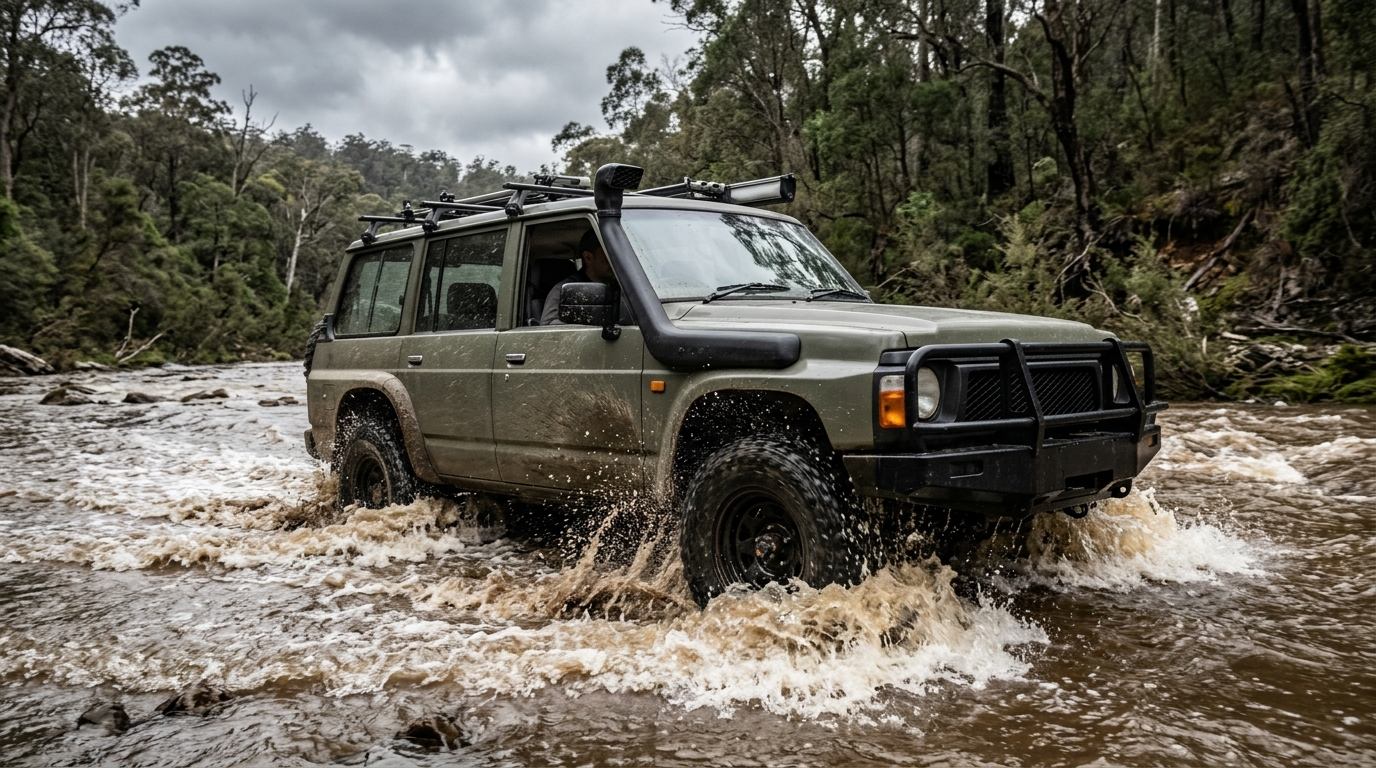
A snorkel is often the first modification people bolt to a touring 4×4, and one of the most misunderstood. It relocates the engine’s air intake from behind the guard up to roof height, and it does two genuinely useful things. On dusty tracks it draws cleaner, cooler air from above the dust cloud that hangs at bumper level, which spares the air filter and the engine. At a water crossing it raises the point where water could be drawn in, adding a real margin of safety against the engine ingesting water.
What it does not do is make deep crossings safe on its own — the misunderstanding worth clearing up before you buy. It only helps if the whole intake path, airbox and every join included, is sealed, and plenty of other parts of a vehicle still dislike deep water: the electrics, the diffs, the interior. Buy one made for your vehicle, and treat it as protection, not permission to go deeper.
Quick Picks
- Best overall: the Safari ARMAX Snorkel — flow-tested raised intake with serious airflow and a lifetime warranty.
- Best traditional: the Safari V-Spec / Traditional Snorkel — proven protection without the performance focus.
- Best for a Jeep: the Rugged Ridge AmFib — a modular low-and-high mount kit in one.
- Best premium fitment: the ARB Safari SS-series — vehicle-specific kits with precise factory-matched fit.
- Best value: an Ironman 4×4 or quality polyethylene snorkel — solid water and dust protection for less.

How to Choose a Snorkel
Choose a snorkel around your real use, and be honest about the limits. Whether dust or water is your main concern, fitment is the part that actually decides whether it works. A vehicle-specific snorkel is moulded to your guard and airbox with the correct seals, which is what keeps water and dust out of the join — a cheap universal kit that does not seal properly is close to pointless, because dust or water simply enters through the gaps. Budget for sealing the airbox lid and every connection, or the snorkel is decoration rather than protection.
Material comes next. UV-stabilised polyethylene is tough and slightly flexible, so it shrugs off branches and stone strikes and resists going brittle in the sun; ABS moulds to a crisper finish but cracks and fades more readily. For a vehicle that lives outdoors and pushes through scrub, quality polyethylene is the more durable pick. Then there is the head: a traditional ram head scoops the most air but lets more dust and water straight in, while a vortex head spins the incoming air so heavier dust and water are flung out before the filter. For heavy dust, a vortex head earns its keep.
The airflow question is where the marketing gets loud. The bore needs to be large enough to feed your engine without choking it, so a properly engineered, vehicle-matched snorkel matters far more than any claimed power gain — of which there is little to none. Installation is the other reality check: fitting one means cutting a hole in the guard, which is not trivial. Quality kits include a drilling template and many people manage it in a couple of hours, but if you are not confident cutting bodywork, pay for professional fitting — a poorly sealed snorkel is worse than none, because it can funnel water straight to the engine.
The most expensive myth about snorkels is that one turns a 4WD into a submarine. It does not. A raised intake keeps water out of the engine, but at a serious crossing water still finds the diff and gearbox breathers, the alternator, the door seals and the cabin floor long before it reaches the airbox — and a hydro-locked engine is only one of the ways a crossing ends badly. Treat a snorkel as one part of water-crossing prep, not the whole answer: extend the diff, gearbox and transfer-case breathers up high so they draw air instead of water, walk the crossing first to read the depth and the bottom, and enter slowly to push a bow wave that keeps the engine bay dry. The snorkel earns its keep every dusty day; the crossing is where the rest of the prep matters.
The Snorkels
Check today’s prices on Amazon →
Safari ARMAX Snorkel
The performance benchmark and a genuinely world-leading name. Safari’s ARMAX range is flow-bench tested to move significantly more air than the factory airbox while still giving a watertight, raised intake — ideal if you plan to tune the engine, add an intercooler or upgrade the exhaust and need the airflow to match. It uses a water-separating air ram, industrial-grade UV-stabilised polyethylene and stainless hardware, is vehicle-specific, and carries a lifetime warranty. For serious touring and modified 4WDs it is the standout, and the one I would fit to a built engine. See what the Safari ARMAX is going for.
Safari V-Spec / Traditional Snorkel
The proven protector. Safari’s traditional range gives the same robust protection against water, dust and snow ingress as the performance models, but matches factory airflow rather than boosting it — exactly right for a stock vehicle with no engine mods to feed. It is made from the same resilient UV-stable polyethylene with quality sealing and a vehicle-specific fit, a dependable, no-nonsense snorkel from a trusted name. On a stock touring 4WD, this is all you actually need. Look up the Safari traditional.
Rugged Ridge AmFib
The flexible pick for Jeep Wrangler and Gladiator owners. Its modular design lets you run a low-mount intake for everyday and dusty driving, then convert to a high-mount raised intake for water crossings — two configurations from one kit. That adaptability, plus solid build quality at a fair price, has made it a favourite in the Jeep scene. If you own a Wrangler or Gladiator and want to switch between dust and deep-water setups, it is the value standout here. Check the Rugged Ridge AmFib.
ARB Safari (SS-Series)
The precision-fit premium choice. ARB distributes Safari’s vehicle-specific SS-series kits, each thoroughly researched, 3D-laser-scanned and purpose-built for one model, so every bracket and hose lines up with the factory panels — often adapting to the airbox without cutting it. The build quality is obvious: rigid UV-stable polyethylene, stainless hardware, weather-sealed fittings and a detailed drilling template. If you want gold-standard fit and long-term durability, ARB Safari is the reference point. Weigh up the ARB Safari SS kit.
Ironman 4×4 / Budget Polyethylene Snorkel
The value protector. Brands like Ironman 4×4, and other quality polyethylene snorkels, deliver genuine water and dust protection at a fraction of the premium price. They may lack the flow testing and lifetime warranty of the top names, and you should check the fitment and sealing carefully, but for solid functional protection without the premium tax they get the job done. A sensible entry point into snorkel protection. Price up an Ironman 4×4 snorkel.
Comparison
| Snorkel | Best for | Type | Why it stands out |
|---|---|---|---|
| Safari ARMAX | Modified engines | Performance | Flow-tested, more airflow |
| Safari V-Spec / Traditional | Stock vehicles | Protection | Proven, lifetime warranty |
| Rugged Ridge AmFib | Jeep owners | Modular | Low and high mount in one |
| ARB Safari SS-series | Premium fit | Vehicle-specific | Precise factory-matched fit |
| Ironman 4×4 / budget | Value | Polyethylene | Solid protection, lower cost |

Frequently Asked Questions
Does a snorkel let me cross deeper water?
It raises the air intake, which cuts the risk of the engine drawing in water, but it does not make deep crossings safe by itself. Water can still reach the electrics, enter through an unsealed airbox, and get into the diffs. A snorkel helps only with the intake, and only when the whole path is sealed — treat it as one part of preparing for water, never as a guarantee.
Do snorkels really help with dust?
Yes, and for many people this is the bigger benefit. Dust sits heaviest close to the ground, so an intake at roof height draws noticeably cleaner air, which extends the life of the air filter and cuts the grit reaching the engine. A vortex head helps further by spinning out heavier dust before the filter. On long, dusty tracks it is a real, practical advantage, quite apart from any water crossing.
Polyethylene or ABS snorkel?
For durability, UV-stabilised polyethylene is usually the better choice. It is tough and slightly flexible, so it takes knocks from branches and stones and resists going brittle after years in strong sun. ABS can be finished more crisply but is more likely to crack and fade over time. If your vehicle lives outdoors and works in scrub, polyethylene tends to last longer, which matters more than the finish on a part meant to protect the engine.
Can I fit a snorkel myself?
Many people do, but it means cutting a hole in the guard, so it is not a casual job. A quality kit comes with a detailed drilling template that removes most of the guesswork, and a confident owner can fit one in a couple of hours. If cutting bodywork worries you, pay for professional fitting — a poorly sealed snorkel is worse than none, because it can funnel water straight into the intake it was meant to protect.
The Bottom Line
A snorkel is worth fitting for the clean air on dusty tracks and the margin of safety at crossings, as long as you understand its limits. Choose one made specifically for your vehicle in tough, UV-stable material, pick a vortex head if dust is your main problem, and seal the entire intake. The Safari ARMAX is the pick for a modified engine, the Safari traditional for a stock one, the Rugged Ridge AmFib for a Jeep, the ARB Safari for gold-standard fit, and an Ironman 4×4 unit for value. Treat it as protection, not permission to go deeper, and it is one of the more genuinely useful additions to a touring rig.
Pair it with the rest of a water-and-dust-ready setup: our guides to 4×4 recovery gear, 4WD underbody protection, and tyre deflators round out the kit.