
This page contains affiliate links. Far Cornel may earn a commission if you buy through them, at no extra cost to you.
See the top-rated gear on Amazon →
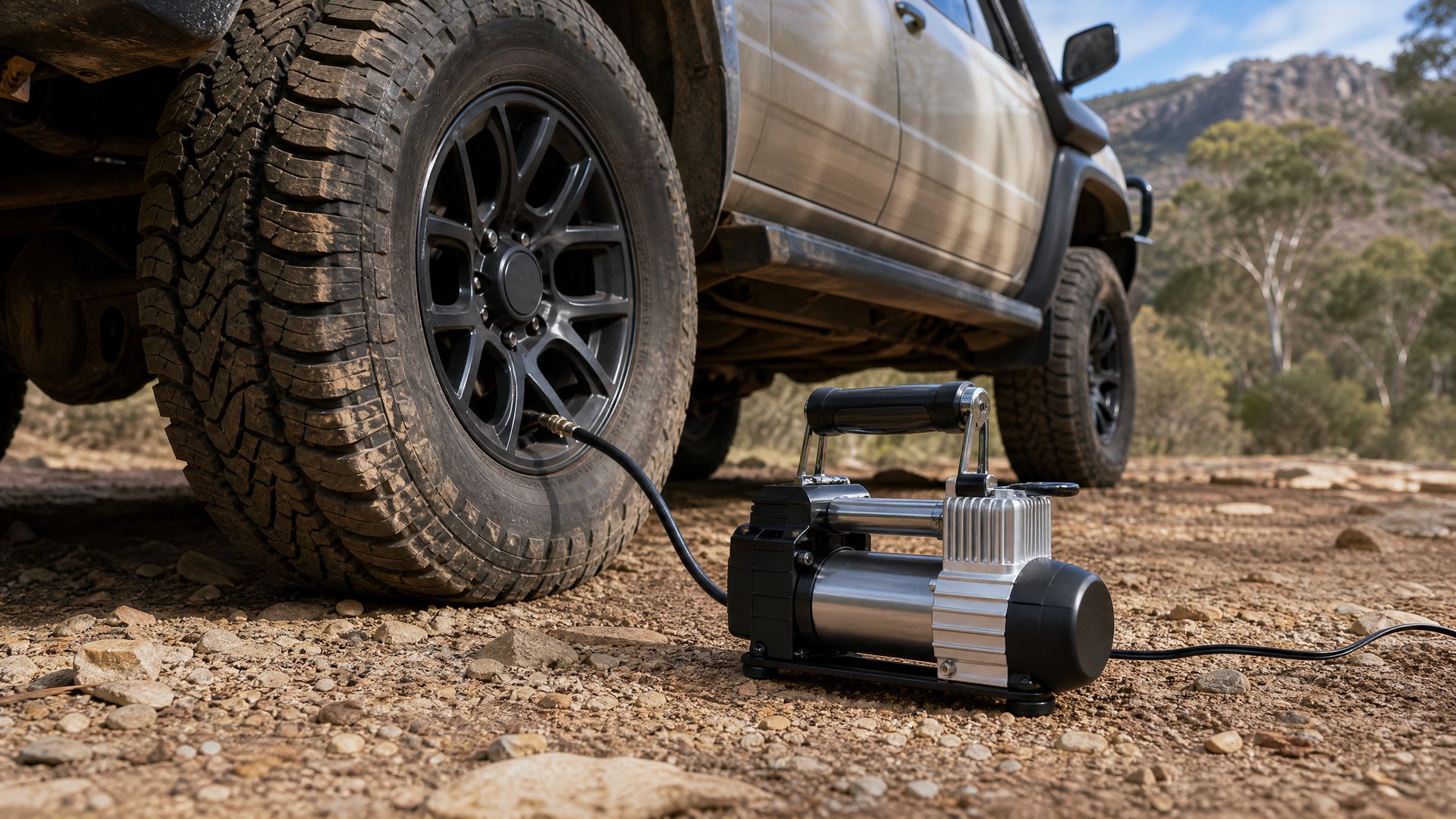
Quick answer: Buy for the hardest job you do regularly, which usually means airing four big tyres back up after sand or tracks. That means a compressor with real airflow, an honest duty cycle and direct battery clamps rather than a socket plug. A cordless or compact inflator is brilliant for a bike or one soft car tyre, but it will overheat on a full set of off-road tyres. Match the pump to how many large tyres you inflate and how often.
Inflating four large, aired-down tyres is a heavy, heat-generating job, and it is nothing like topping up one car tyre in a driveway. The work is measured in the volume of air moved and how long the pump can run before it overheats and cuts out, not in the headline pressure on the box. A unit that copes fine with a commuter car can stall halfway through a set of muddy tyres.
That last point is the myth worth killing: a 150 or 160 PSI maximum rating sounds impressive, but almost all 4WD tyre work happens far below it. What decides how long you stand around is airflow under load and duty cycle. Chase those two, plus a clean battery connection and a hose that reaches every wheel, and airing up becomes a two-minute stop.
Quick Picks
- Best for regular airing-up: a heavy-duty twin-motor compressor with 100 per cent duty.
- Best all-rounder: a mid-size single-cylinder 12V unit on battery clamps.
- Best for tool-battery owners: a cordless inflator that shares your existing batteries.
- Best emergency backup: a compact 12V socket inflator for the boot.
- Best partner buy: a tyre deflator so airing down is as quick as airing up.

How to Choose a Compressor
Start with the job, not the price tag. Decide how many large tyres you inflate at once and how often, because that sets every other spec. Then look past the maximum PSI to two numbers: airflow, usually shown in litres per minute, and duty cycle, how long the pump runs before it needs to rest. For four big tyres you want strong airflow and a duty cycle that lets you do the whole set without a forced cool-down. For the odd car tyre, almost anything copes.
How the compressor is powered quietly decides what it can do. Serious units draw far more current than a cigarette socket can safely pass, so they clamp straight to the battery terminals; try to run one through a 12V socket and you will blow the fuse. Socket-powered inflators are capped by that fuse to modest airflow, fine for a passenger car but slow on off-road tyres. For real 4WD inflation, plan on battery clamps and a decent lead.
Brands give you useful reference points. A twin-motor unit like the ARB CKMTP12 sits at the premium end, moving well over 150 litres a minute of free air with a full continuous duty cycle. Single-cylinder kits from Bushranger, Mean Mother or Adventure Kings cover the middle ground, while NOCO, Makita and Ryobi make neat clamp and cordless inflators. Read the airflow and duty-cycle figures each maker publishes, not the big PSI number on the front.
The Compressors, Matched to the Job
Check today’s prices on Amazon →
A heavy-duty twin-motor compressor
This is the buy for anyone airing up four large tyres every trip. A twin-motor unit in the mould of the ARB CKMTP12 moves a lot of air and runs a full duty cycle, so you inflate the whole set without waiting for it to cool. You are paying for airflow, heat management and a robust electrical design that shrugs off repeated hard work. The trade-off is honest size, weight and price, so do not buy this if your off-road use is occasional and gentle, where a mid-size unit does the same job with far less bulk. Price up a heavy-duty air compressor on Amazon
A mid-size single-cylinder 12V unit
For a weekend 4WD that airs down now and then, a good single-cylinder compressor on battery clamps is the sensible middle. Kits from Bushranger, Mean Mother or Adventure Kings give you enough airflow to do a set of tyres without the size and cost of a twin motor, usually with a long hose and a pressure gauge built in. Expect to let it breathe between tyres on a hot day. This is the class most owners actually need, balancing speed, cost and storage. See current 12V air compressor prices on Amazon
A cordless inflator
If you already own a tool battery platform, a cordless inflator from Makita or Ryobi is a tidy convenience. It airs a bike, a trailer or one soft car tyre with no leads and no engine-bay setup, and it doubles as a household inflator. The honest limit is volume: ask one to air four big 4WD tyres from low pressure and it will run hot, slow down and shut off to cool. Do not make it your only compressor if you air down for tracks; keep it for top-ups and let a clamp unit do the heavy work. Compare cordless tyre inflator on Amazon
A compact 12V socket inflator
The cheapest way to never be caught with a soft tyre is a compact digital inflator that lives in the boot and plugs into the 12V socket. Set a target pressure, press go, and it stops itself, which is genuinely handy for passenger cars and emergency corrections. It is limited by the socket fuse to modest airflow, so it is slow on large tyres and not the tool for regular airing-up. Treat it as backup and road-trip insurance rather than a 4WD compressor, and it earns its small place easily. Check the latest 12V tyre inflator on Amazon
A tyre deflator
The compressor is only half the setup, and airing down quickly matters as much as airing up. A dedicated deflator takes each tyre down to a known figure fast, instead of you guessing with a valve key and doing it four times over. Some models unscrew the valve core for very rapid deflation; simpler ones read and vent in one tool. Either way it makes you far more likely to actually drop pressures at the start of a track, which is what prevents bogging. Pair it with a gauge you trust. Browse tyre deflator on Amazon

Comparison
| Type | Airflow & duty | Powered by | Best for |
|---|---|---|---|
| Twin-motor | High, full duty | Battery clamps | Four big tyres, every trip |
| Single-cylinder | Moderate, rest between | Battery clamps | Weekend 4WD, occasional sand |
| Cordless inflator | Low, short runtime | Tool battery | Top-ups, trailers, bikes |
| 12V socket inflator | Low, fuse-limited | 12V socket | Cars, emergency backup |
| Tyre deflator | N/A | Manual | Fast, even airing down |
Frequently Asked Questions
How big a compressor do I need for large 4WD tyres?
Enough airflow and duty cycle to inflate the whole set without a forced cool-down. A single-cylinder clamp unit handles an occasional weekend set with rests between tyres; a twin-motor unit does it faster and cooler if you air up every trip. Favour more airflow when unsure, because a faster pump also runs cooler for a given job and saves you standing around.
Battery clamps or 12V socket?
Clamps for real 4WD work. A cigarette socket is limited by its fuse to modest current, so a socket inflator is slow and can trip on big tyres. Clamping to the battery terminals lets a serious compressor draw the current it needs. Keep a socket inflator only as a light-duty backup, and reach for clamps when you are inflating a full set after a track.
Can a cordless inflator air down and up a full set?
It can, slowly, but it should not be your main tool if you do it often. Cordless units run hot and drain their battery inflating four large tyres from low pressure, and many shut off to cool partway through. They shine for top-ups and small tyres. If you air down for tracks regularly, buy a clamp compressor and keep the cordless for convenience.
Do I need an air tank?
Not for tyres alone. A compressor moves plenty of air on its own, and a tank mainly helps if you run air tools or need a burst to seat a stubborn bead. If your use is airing tyres up and down, skip the tank and put the money into airflow and a good hose instead. Add a tank later only if you take up jobs that genuinely need reserve air.
The Bottom Line
Buy for the hardest job you do regularly, not the easiest. If you air down for sand or tracks and inflate four large tyres afterwards, get a high-airflow unit with a strong duty cycle and battery clamps, and accept the size and weight. If your off-road use is occasional and gentle, a mid-size single-cylinder unit does the job without the bulk. Whatever you choose, pair it with a long hose, a trusted gauge and a deflator, and let it cool on a big set. Spend on airflow and cooling, not gimmicks.
For the rest of the tyre setup, see our guides to tyre deflator kits, tyre pressure monitoring systems, and the beginner 4×4 recovery gear checklist.