
This page contains affiliate links. Far Cornel may earn a commission if you buy through them, at no extra cost to you.
See the top-rated gear on Amazon →
Quick answer: For a touring vehicle the best setup is a 5-watt fixed set, usually a tidy remote-head unit in a modern 4WD, paired with a well-mounted antenna that does the real work on range and clarity. Add a handheld or two for spotting and walking ahead. Match your antenna gain to your terrain, and spend on the aerial before you chase extra features on the radio.
The moment a convoy strings out on a dusty track, or you need to warn the vehicle behind about oncoming traffic, a UHF radio stops being a nice-to-have. It is how vehicles talk to each other away from phone signal, sort out who goes first at a tight obstacle, and call nearby travellers for a hand. A phone is useless when there are no bars for two days; the radio still works.
The choice is smaller than the wall of models suggests. You are really deciding between a fixed set and a handheld, how much antenna you need, and how tough the unit has to be. Brands like GME, Uniden, Oricom and ICOM cover the field, and the honest truth is that the aerial on the roof matters more than the badge on the radio. Sort that and even a mid-priced set serves for years.
Quick Picks
- Best overall: a 5-watt remote-head fixed set with a quality antenna.
- Best for older dashes: a 5-watt in-dash set with a simple handpiece.
- Best second unit: a 5-watt handheld for spotting and walking ahead.
- Best range upgrade: a well-matched antenna chosen for your terrain.
- Best fix-it-once buy: a solid antenna mount that puts the aerial up high.

How to Choose a UHF Radio
Start with power, but keep it in perspective. Legal output limits vary by area, so check your local rules, and a full-power fixed set (commonly up to 5 watts) will punch through hills and scrub better than a 1 or 2 watt handheld. Here is the myth worth busting, though: more watts does not simply mean more range. A radio at 5 watts with a poorly mounted aerial will be beaten by the same radio feeding a good antenna, every time.
So spend on the antenna, and match its gain to your country. Low-gain aerials of around 2 to 3 dBi throw the signal in a fat, round pattern that suits hilly, wooded terrain where you need it to bounce around; high-gain aerials of 6 to 9 dBi flatten that pattern into a longer, lower beam that reaches further across open, flat ground but can shoot over vehicles down in a gully. A medium-gain aerial is the sensible all-rounder if you cross both.
Then weigh toughness and controls. A vehicle bay batters electronics with dust, vibration and water crossings, so look for a sealed, well-built unit, and an IP rating such as IP67 on any handheld or exposed control head. On a rough track you want big, glove-friendly buttons, a clear backlit screen and quick access to channel scan, not a fiddly menu. Get the aerial and the ergonomics right and the rest is detail.
Here is the thing nobody tells a first-time buyer: the antenna decides your range, not the radio, and higher gain is not simply better. A low-gain antenna (around 2-3 dBi) throws its signal in a fat doughnut that reaches up and over hills and trees — the right pick for gorges, forest and convoy work in rough country. A high-gain antenna (6-9 dBi) squashes that signal flat and long, which is brilliant across open plains but goes half-deaf in the hills. Match the antenna to your terrain, and plenty of tourers simply carry both. One more thing that quietly wrecks range: the mount. A fixed set needs a solid earth and a decent ground plane, or the SWR climbs, the range collapses and you can cook the radio — mount the antenna to bare metal with a proper bracket, not a plastic panel, and check it transmits clean.
The UHF Radios
Check today’s prices on Amazon →
Remote-head fixed set
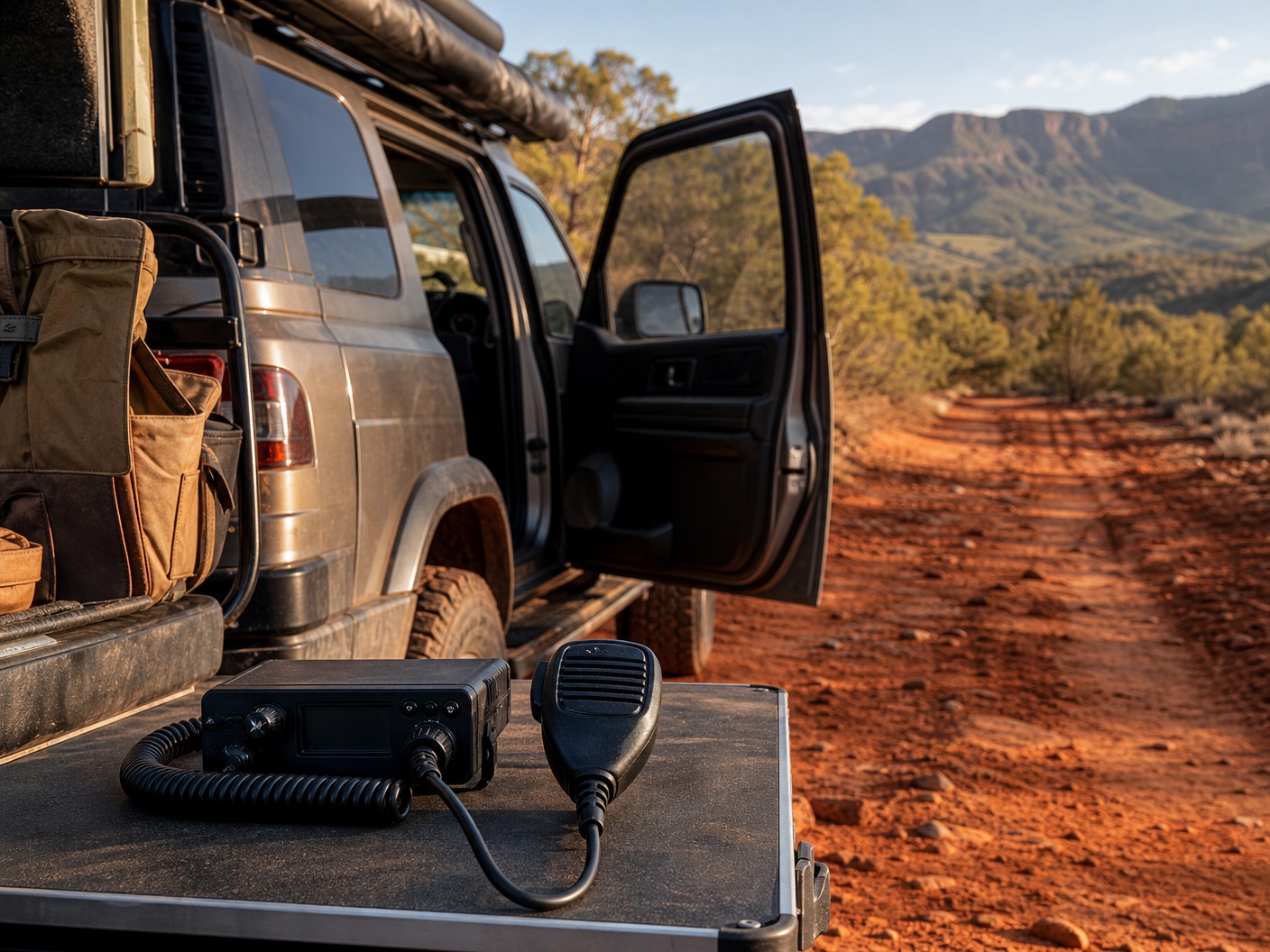
This is the setup most modern touring vehicles land on, and for good reason. The radio’s guts hide under a seat or behind the dash while the whole control head, screen and speaker live in the handpiece, so you get a clean install and full 5-watt output without sacrificing dash space. Units like the GME XRS or a compact Uniden run this way and pair with the phone for updates and channel setup. It costs a little more and the handpiece is chunkier, but the tidiness wins. See what a remote-head 5-watt set costs
In-dash fixed set
The traditional in-dash unit puts the screen and controls on the main box with a plain corded microphone, and it still makes sense in older vehicles with a spare DIN slot. They tend to be robust, simple and a touch cheaper than the remote-head style, with the same 5-watt output where the rules allow it. The catch is that you need the dash real estate and a clean cable run, which is harder in a newer cabin where every panel is already full. Compare the in-dash fixed sets
Handheld UHF radio
A handheld is the second unit I would not travel without. Battery-powered and pocket-sized, it puts out less power through a short aerial, so its range is shorter, but it goes where the vehicle cannot: guiding a driver through a tricky line, walking ahead to check a crossing, or passing a message between two rigs. A 5-watt handheld from Oricom or GME with an IP-rated body handles dust and rain. Keep a pair in the glovebox and they earn their keep constantly. Grab a handheld or two for spotting
UHF antenna
If you upgrade one thing, upgrade the aerial. A quality antenna, correctly mounted and tuned, does more for real-world range than any extra watt on the label, which is why it deserves the budget the radio often gets. Pick the gain for where you travel: lower gain for hilly, timbered country, higher gain for long, open runs, or a medium-gain stick if you want one aerial for everything. Brands like GME and RFI make ranges specifically for this, and a whip that flexes past branches lasts longer. Look at the antennas by gain for your terrain
Antenna mount and bracket
Where the aerial sits changes how well it works, so the mount matters more than people expect. Higher and more central is better: a bar or bracket that lifts the antenna clear of the body gives it a cleaner pattern than a low guard mount tucked behind metal. A quality bracket with a spring base also lets the whip fold away from low branches instead of snapping. Get a solid mount and a good aerial together and a modest radio suddenly reaches. Price up a solid antenna mount and bracket

Comparison
| Type | Typical power | Best use | Watch-out |
|---|---|---|---|
| Remote-head fixed | Up to 5 W | Main radio, modern dashes | Dearer, bulkier handpiece |
| In-dash fixed | Up to 5 W | Older vehicles with a DIN slot | Needs dash space |
| Handheld | 1 to 5 W | Spotting, walking, backup | Shorter range, battery-limited |
| Antenna | N/A | The real range upgrade | Match gain to terrain |
Frequently Asked Questions
Fixed or handheld first?
Fit the fixed set first. A 5-watt unit with a roof or bar aerial has far better range and clearer audio, so it is the right main radio for a touring vehicle. A handheld is a brilliant second unit for spotting at obstacles and walking ahead, but it should not be your only radio if you travel remote.
Does more power mean more range?
Not on its own. Once you are at the legal maximum, usually 5 watts on a fixed set, extra “range-boosting” claims are marketing. What actually extends range is a good antenna, correctly tuned and mounted high, plus a clear line of sight. Terrain beats watts: hills and dense scrub cut range no matter how strong the radio.
What antenna gain should I pick?
Match it to your country. Low gain for hilly, timbered terrain where the signal needs to spread and bounce; high gain for long, flat, open runs; medium gain as the do-it-all compromise. Many tourers carry a low and a high aerial and swap them, but a single medium-gain stick keeps life simple.
Do I need a licence to use one?
UHF CB channels are generally licence-free for public use, but the channel plan and power limits vary by area, so check the rules where you travel. Certain channels are reserved for emergencies and for repeaters and must be kept clear, and it is good manners to listen before you transmit.
The Bottom Line
A UHF radio is one of the smartest additions to a touring rig, because it keeps a group together and turns a solo problem into a shared one. In most vehicles a 5-watt fixed set from GME, Uniden or Oricom, paired with a well-chosen and well-mounted antenna, is the sensible core, with a handheld or two for spotting and walking. Put the money into the aerial, mount it where you can reach the controls without staring away from the track, and it will serve for years.
For the rest of your comms, see our guides to satellite communicators and PLBs and GPS navigators.
Round out your touring comms and safety kit with our guides to the best satellite communicators and PLBs, GPS navigators, and dual battery monitors.