
This page contains affiliate links. Far Cornel may earn a commission if you buy through them, at no extra cost to you.
See the top-rated gear on Amazon →
Quick answer: An external cap-sensor system from Safety Dave, Tyredog or Steelmate is the best start: it screws onto the valves in minutes and warns you of a slow leak or heat spike before it becomes a blowout. Choose internal sensors for a permanent, protected fit, a solar display to save a socket, and a high-pressure kit with a repeater if you tow a van or trailer.
Tyres are the only thing keeping a loaded rig moving, and they get the least attention until one lets go. A slow leak from a staked sidewall or a weeping valve will quietly drop a tyre until the heat builds and it shreds, usually with a van on the back. A tyre pressure monitoring system is the cheap early warning that turns that disaster into a routine stop.
The good news is the choice is simple once you know the levers: internal or external sensors, how the display is powered, the pressure range you need, and whether you tow. Brands like Safety Dave, Tyredog and Steelmate cover the ground from a basic four-wheel kit to a full setup that watches a tow vehicle and a caravan together.
Quick Picks
- Best overall: an external cap-sensor kit you can fit yourself in minutes.
- Best permanent fit: internal sensors mounted inside the tyre, out of harm’s way.
- Best for convenience: a solar-powered display that frees a 12-volt socket.
- Best for towing: a high-pressure kit with extra sensors and a signal repeater.
- Best add-on: a booster and spare sensors to extend range and cover a trailer.

How to Choose a TPMS
Start with the sensor type and the pressure range, because they decide the rest. External cap sensors screw onto the valve in minutes and swap between vehicles; internal sensors sit inside the tyre, protected but needing a fitter. Then check the range: a standard system reads to about 80 PSI, which suits most four-wheel drives, but a light truck or a heavy van may run higher, so a towing kit that reads to 150 PSI is worth having if that is you.
Next look at the display and the batteries. A solar-topped monitor is genuinely handy because it frees a 12-volt socket and stays charged on the dash, while a plug-in unit is simpler but ties up a socket. External sensors run small button batteries, commonly a CR1632, that last a year or two, so buy sensors you can open and re-battery yourself and keep a spare set in the glovebox. For anything that fords water or lives in dust, insist on an IP67 or better rating.
Here is the myth to bust: a TPMS is not a substitute for a quality gauge. Set your pressures with a good manual gauge when you air down for sand or air up for the highway, then let the TPMS monitor those pressures on the move and shout when one drifts. Used that way it catches the slow leak and the overheating tyre you would otherwise miss, which is the whole point of fitting it.
The Tyre Pressure Monitoring Systems
Check today’s prices on Amazon →
External cap-sensor kit
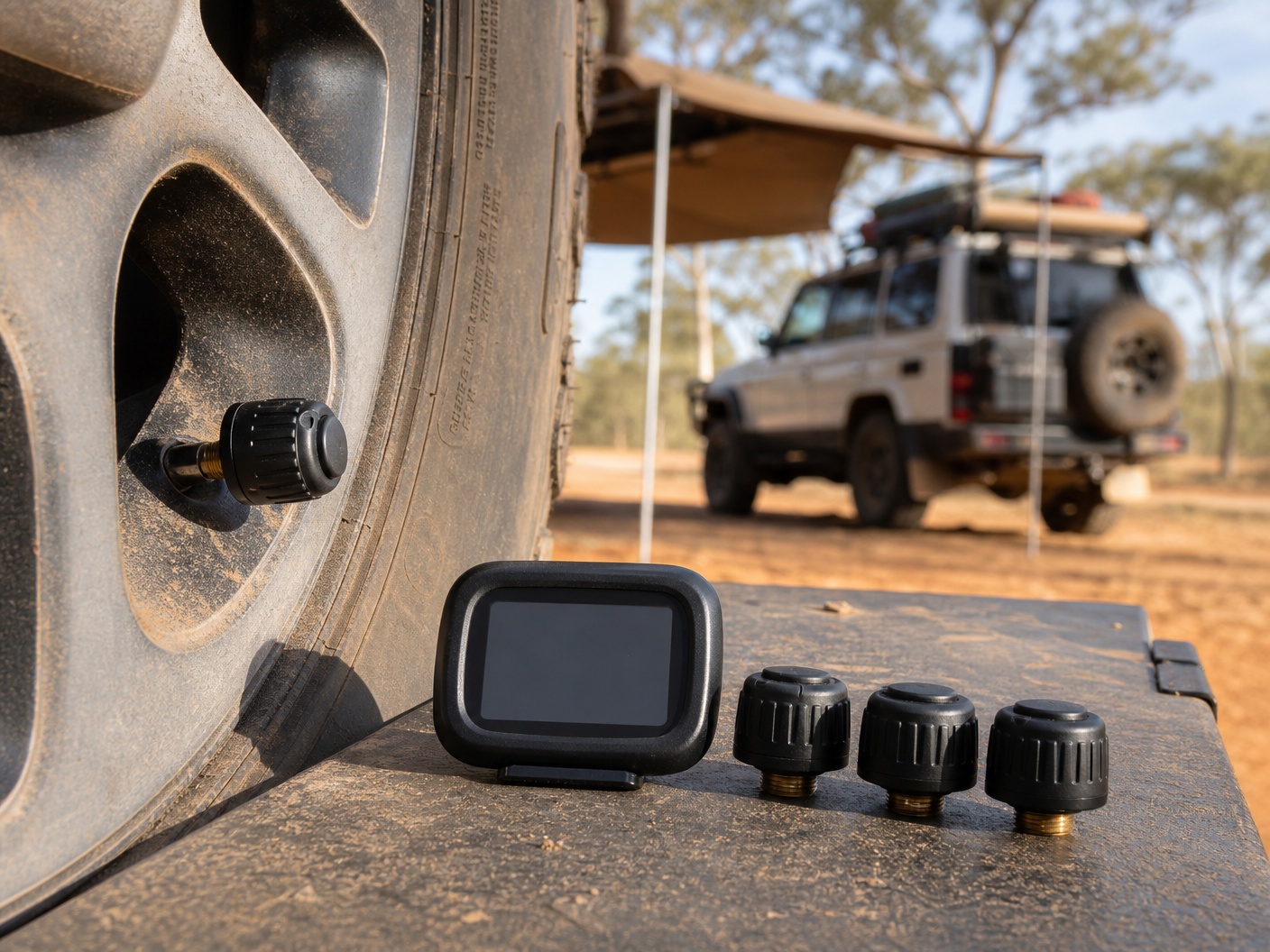
This is where most tourers should start. The sensors from Safety Dave or Tyredog replace your dust caps and start reading in minutes, with no tyre shop and no fitting bill, and you can move them to another vehicle just as fast. They sit exposed to rock and mud, so the good kits include anti-theft locking nuts, and a smear of anti-seize on the valve threads stops them binding. For the ease alone, external sensors are the sensible first TPMS for a four-wheel drive. See what the external cap-sensor kits cost
Internal sensor kit
If you are fitting new tyres anyway, internal sensors are the tidy, permanent answer. Mounted to the valve stem inside the tyre, they are completely protected from rock strikes, mud and sticky fingers, and they read the air temperature directly for a slightly truer number. The catch is the install: the tyre has to come off the rim and be rebalanced, so you pay a fitter, and swapping them between vehicles is a job rather than a minute. For a set-and-forget system on a permanent touring rig, they are excellent. Compare the internal-sensor systems
Solar-powered display kit
The small thing that makes a TPMS nicer to live with is a solar-topped monitor. It sits on the dash charging itself, so it is always on without stealing a 12-volt socket you would rather use for a fridge or a phone. The screen stays readable in bright sun, and most take a USB top-up for cloudy days. It is a convenience feature rather than a safety one, but it is the detail that stops the monitor living in a drawer. Check the solar-display units that free up a socket
High-pressure towing kit
Tow a van or a trailer and a standard four-wheel kit no longer covers you, because an unnoticed flat on a trailer axle is exactly where trouble hides. A towing kit adds sensors for the extra wheels and reads to a higher pressure, often 150 PSI, to suit heavier rubber. The distance to the rear of a long rig can outrun the signal, so these kits usually include a repeater to boost it. If you tow anything serious, this is the system to buy rather than the base kit. Look at the high-pressure kits made for towing
Booster and spare sensors
Even a good system can lose the far sensors on a long combination, so a signal booster earns its keep by carrying the reading from the trailer axle back to the dash. Spare sensors are the other sensible buy, since one can be knocked off on a rock or simply need a fresh battery mid-trip, and being able to swap in a spare keeps the whole set working. Match the booster and spares to your existing system, not a random brand, so they pair cleanly. Find a signal booster or a set of spare sensors

Comparison
| Feature | External sensors | Internal sensors |
|---|---|---|
| Fitting | DIY, screws on in minutes | Professional, tyre off the rim |
| Protection | Exposed to rock and mud | Sealed inside the tyre |
| Battery service | Easy, swap the button cell | Needs the tyre removed |
| Moving between vehicles | Quick and simple | A refit job |
Frequently Asked Questions
What does a TPMS actually do?
It watches each tyre’s pressure and temperature and alarms when one drifts, so you catch a slow leak or an overheating tyre before it becomes a blowout. That matters most on long highway hauls and when towing, where a deflating tyre can go unnoticed until it shreds. Catching it early saves the tyre and a dangerous moment.
Internal or external sensors?
External cap sensors are easy to fit yourself and swap between vehicles, which is why most tourers start there. Internal sensors are tidier and better protected from rocks and theft, but they need fitting inside the tyre and cost more to service. If you are already changing tyres, internal makes sense; otherwise external is the quick win.
Does it cover my caravan or trailer too?
Many systems take extra sensors for a van or trailer, and this is exactly where an unnoticed flat tends to happen, out of sight behind you. If you tow, choose a kit that monitors those axles and includes a repeater to carry the signal the length of the rig back to the display.
Can I just use a manual gauge instead?
A gauge and a TPMS do different jobs. Use a quality manual gauge to set your pressures when airing up or down, and the TPMS to monitor those pressures while you drive. The TPMS is what warns you of a change on the move, which a gauge in the glovebox never can, so most tourers carry both.
The Bottom Line
A TPMS is a safety device, not a gadget, because it catches the slow leak and the heat spike that turn into blowouts far from help. For most tourers an external cap-sensor kit from Safety Dave, Tyredog or Steelmate is the easy, sensible start; step up to internal sensors for a permanent protected fit, add a solar display for convenience, and choose a high-pressure kit with a repeater if you tow. Set your pressures with a proper gauge, let the TPMS watch them, and keep a spare sensor battery in the glovebox.
For the rest of your tyre kit, see our guides to tyre deflator kits and portable air compressors.
Tyre pressure is a system, not a gadget: pair a monitor with a good set of tyre deflators for airing down, a fast portable air compressor to air back up, and a basic recovery kit for the day a slow leak strands you.