
This page contains affiliate links. Far Cornel may earn a commission if you buy through them, at no extra cost to you.
See the top-rated tyre deflators on Amazon →
Quick answer: The best all-round tyre deflator is a rapid valve-core type with a clear, accurate inline gauge — it dumps air far faster than any pin-press tool and lets you stop dead on your target pressure. Preset screw-on sets suit set-and-forget airing on all four tyres at once; a digital deflator earns its price when you want exact, matched pressures; and a keychain deflator is the cheap backup that lives in the glovebox.
The moment you leave sealed roads for soft sand, mud or rock, the most effective thing you can do is let air out of your tyres. Lower pressure lengthens the contact patch so the tyre floats instead of digging, wraps around rock for grip, and soaks up the corrugations that would otherwise shake the vehicle apart. It is free traction — all it needs is a tool that releases air quickly and, just as importantly, tells you the pressure you have reached.
The catch is that a fast deflator without a gauge is only half a tool. A heavy tourer might drop from the high thirties to the mid teens in psi depending on the surface, and doing that blind means you either stop too high to help or go dangerously low. A deflator you can read as the air escapes turns a guess into a target. This guide sorts the types, the features that actually matter, and the mistake that leaves people limping home on ruined tyres.
Quick Picks
- Best overall: a rapid valve-core deflator with an accurate inline gauge.
- Best for precision: a digital rapid deflator with a backlit readout.
- Best set-and-forget: a matched set of preset screw-on deflators.
- Best backup: a simple keychain deflator for the glovebox.
- Best minimalist tool: an accurate standalone gauge with a bleed valve.

How to Choose a Deflator
Deflators look alike and perform very differently, so judge them on four things. Speed comes first for anyone who airs down at every terrain change: the rapid designs that unscrew the valve core entirely empty a tyre in a fraction of the time a tool that just presses the pin takes. Accuracy comes second — a built-in gauge you can trust means you set the pressure once and move on, while a cheap unmarked deflator sends you back with a separate gauge to check.
How low you go depends on the surface, not the tool. As a rough guide, hard-packed tracks want only a small drop, soft sand and mud reward going lower, and rock crawling lower still — but there is a floor. Drop too far and a hard hit can roll the tyre off its bead and break the seal, which is a far worse afternoon than staying a few psi higher. Air down in stages, feel how the vehicle starts to float, and note the pressure that works so you can repeat it next time.
The step people skip is re-inflating. Soft tyres run hot and squirm at speed, so airing back up before you rejoin the blacktop is not optional — it is what stops a shredded sidewall on the drive home, which is exactly why a deflator and a compressor are a matched pair. Beyond that, look for a solid gauge (a dial with a rubber boot or a backlit digital), a hose long enough to reach an awkward valve, and a build that shrugs off being dropped in grit. These tools are often sold as ‘tire deflators’ too — same job, different spelling.
The Deflators
Check today’s deflator kit prices on Amazon →
Rapid Valve-Core Deflator
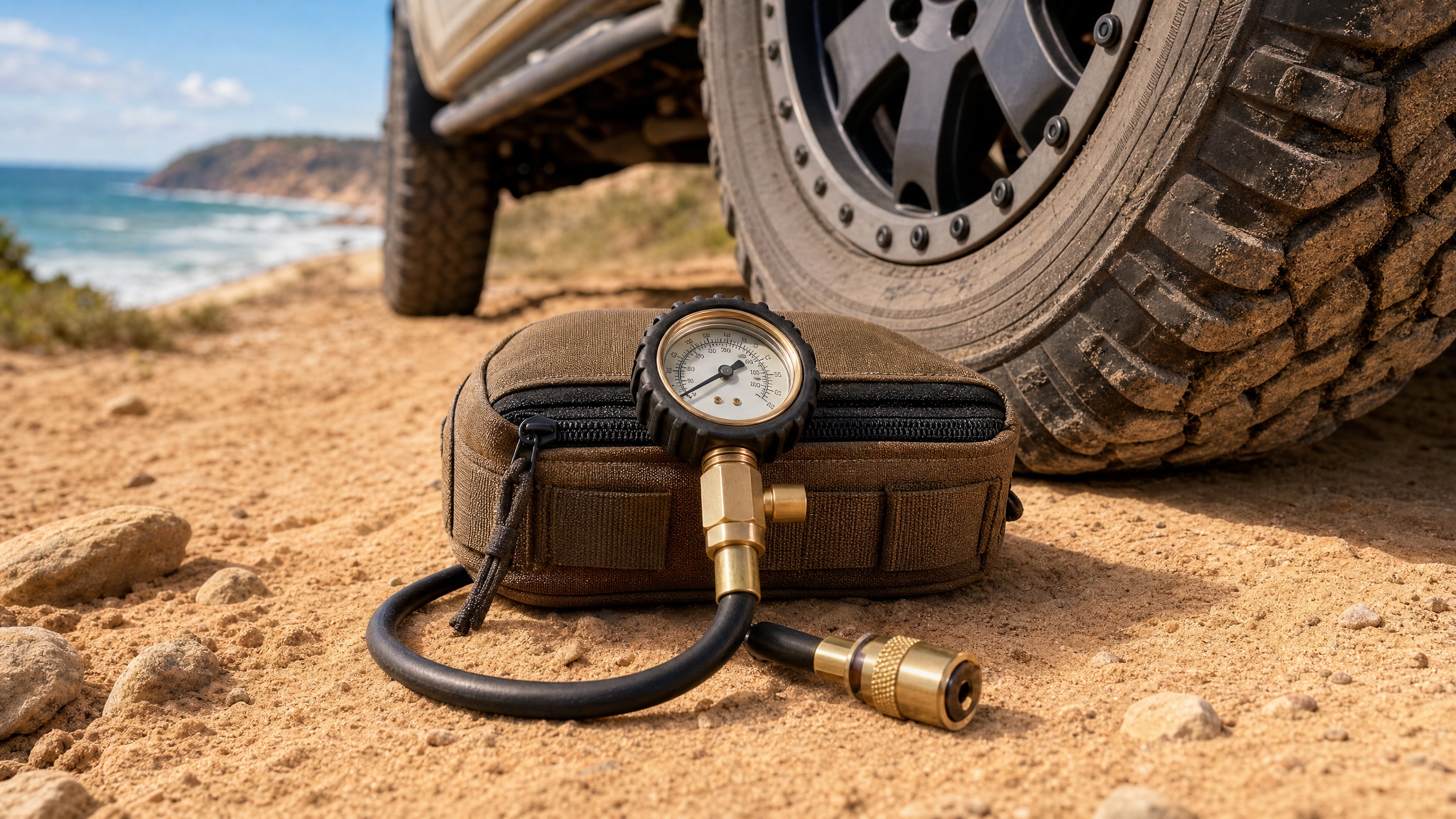
This is the tool most serious tourers settle on. You screw it onto the valve, unwind the core, and the tyre empties in seconds; an inline dial then lets you re-seat the core and stop exactly where you want. It handles one tyre at a time and you must not drop the loosened core in the dirt, but nothing beats it for daily airing down at a pressure you can trust. Compare rapid tyre deflator options on Amazon.
Digital Rapid Deflator
Same fast valve-core action, but with a backlit digital readout instead of a dial. The screen is easier to read in low light and down to the exact psi, which matters if you like all four tyres matched to the same number for even wear and predictable handling. You pay more and you lean on a battery, so keep a spare; for drivers who want precision over ruggedness, this is the pick. See current digital tyre deflator gauge prices on Amazon.
Automatic Preset Screw-On Set
These screw onto all four valves at once and stop automatically at a preset pressure, so you set them going and walk around the vehicle doing other jobs. They are the hands-free option, ideal when you air down to the same number every trip. The trade-offs are that presets drift and need occasional calibration, and you should confirm the result with a separate gauge — but for airing all four together they are hard to beat. Look over the current automatic tyre deflators options on Amazon.
Keychain Deflator
The cheap, tiny brass tool that presses the valve pin and bleeds air slowly. It is not fast and it has no gauge, so it is a backup rather than a main tool — but it costs almost nothing, lives on a keyring or in the glovebox, and will get you out of trouble the day your good deflator is sitting in a drawer at home. Pair it with a standalone gauge and it becomes a genuine emergency kit. Shop keychain tyre deflator choices on Amazon.
Standalone Accurate Gauge
Not every setup needs a fast deflator, but every setup needs to know its pressure. A good standalone gauge with a bleed valve lets you drop pressure a little at a time and read it precisely — the minimalist’s whole kit, and the essential partner to any preset set you want to verify. Choose a quality dial or digital gauge with a rubber boot and a hold function. Even a driver who never leaves the tarmac benefits from one, so it is the tool no vehicle should be without. Browse the current tyre pressure gauge listings on Amazon.
Comparison
| Style | Speed | Gauge | Best for |
|---|---|---|---|
| Rapid valve-core | Very fast | Inline dial | Regular airing down |
| Digital rapid | Very fast | Backlit digital | Exact, matched pressures |
| Preset screw-on set | Hands-free, slower | None, verify separately | Airing all four at once |
| Keychain | Slow | None | Glovebox backup |
| Standalone gauge | Manual bleed | Dial or digital | Precision and checking |

Frequently Asked Questions
Why air down off-road?
Lower pressure lengthens the tyre’s footprint for far more traction on sand, mud and rock, and softens the ride so corrugations batter the vehicle less. It also lets the tyre deform around obstacles instead of being punctured by them. It is the cheapest, biggest handling gain available once the tarmac ends.
Which tyre deflator is quickest?
A rapid deflator that unscrews the valve core dumps air far faster than any tool that only presses the pin. The trade-off is one tyre at a time and a loose core to keep track of. Preset screw-on sets feel faster overall because they run on all four at once while you do other jobs.
How low should I air down?
It depends on the surface and the vehicle, so treat it as a range rather than a single number: a small drop on hard tracks, more for soft sand, more again for rock. Go in stages and stop before the tyre looks like it could unseat from the rim under a hard hit — too low breaks the bead, which is worse than being a few psi high.
Do I need a gauge as well as a deflator?
Yes, unless your deflator has an accurate built-in one. Setting pressure by eye is guesswork, and matched pressures across all four tyres give even wear and predictable steering. A deflator with a trustworthy inline gauge does both jobs; a bare deflator needs a separate gauge alongside it.
The Bottom Line
The right tyre deflator is the one you will actually reach for at every trailhead. A rapid valve-core deflator with an accurate inline gauge is the everyday sweet spot — fast, precise, and trustworthy enough to set and forget. Step up to a digital model when you want exact matched pressures, choose a preset set for hands-free airing on all four, and always keep a keychain deflator or a standalone gauge as backup. Whatever you pick, air down in stages and carry a compressor to put it all back before the highway.
Deflating is only half the loop: see our guide to the best portable air compressors for the re-inflation half, and the best tyre pressure monitoring systems to keep an eye on pressures once you are rolling.