
This page contains affiliate links. Far Cornel may earn a commission if you buy through them, at no extra cost to you.
See the top-rated 4×4 awnings on Amazon →
Quick answer: A 2.5-metre straight pull-out is the best 4×4 awning for most tourers — nearly all the shade you’ll actually use, at a third of the weight and price of a wraparound. Buy a freestanding 270 if camp is home for days at a time and you want walk-around coverage with no poles. Skip vehicle awnings entirely if you park in one spot for a week — a gazebo does fixed-site shade better.
The 270 wraparound has become the reflex recommendation for every touring build, and on a still evening with the walls zipped on it does look like a house. Here’s the bit the brochure leaves out: an awning that throws twelve square metres of shade also catches twelve square metres of wind. Plenty of 270 owners reach a blustery lunch stop, weigh ten minutes of pegging against a sandwich in the front seat, and leave the thing in its bag — stop after stop.
That’s why the type decision matters more than the model decision. A straight pull-out is shading your table thirty seconds after the handbrake goes on, which means it earns its keep at every stop, not just the overnight ones. A 270 pays off when you’re moving between the kitchen, the fridge and the back door all day. This guide compares the five awning styles worth bolting to a rack — and is honest about which one you’ll still be rolling out two years from now.
Quick Picks
- Best first awning for most tourers: a 2.5-metre straight pull-out — thirty-second shade, light enough to forget it’s up there.
- Best for smaller wagons and vans: a two-metre straight awning — the same idea trimmed for shorter rooflines and lighter racks.
- Best walk-around coverage: a freestanding 270 wraparound — huge shade with no legs to trip over, at a premium.
- Best big shade on a budget: a pole-supported 270 — the same footprint for hundreds less, if you’ll tolerate poles.
- Best for canopy-fitted tray-backs: a 180-style wing awning — wraps the rear corner where the camp kitchen usually lives.

How to Choose a 4×4 Awning
Start with an honest tally of how you stop. If most of your shade moments are morning tea, a lunch break and one night somewhere new, deployment speed is worth more than square metres — the awning that opens in half a minute gets used, and the one that needs pegs and a plan gets skipped. If you set up camp and stay put, the maths flips: a wraparound turns the shaded side of the vehicle into a room you live in, and the slower setup happens once.
Weight deserves more respect than it gets. A freestanding 270 hangs 22 to 30 kilograms off one side of your rack, and that load counts against the rack’s dynamic rating alongside everything else up there. Check the rated figure for your specific rack — not the roof — and remember it’s a twisting, cantilevered load, which is why serious 270s specify full-length platforms rather than a pair of crossbars. A straight awning, by contrast, sits happily on almost anything.
The classic mistake is buying shade area and ignoring the mounting. Brackets differ between rack systems, some awnings need three mounting points where your rack offers two, and the side matters: most tourers mount on the passenger side so camp sits away from passing traffic during quick pull-overs. And whatever you buy, treat wind as the deciding vote — any awning left unpegged in a gust becomes a sail with hinges.
The Awning Types Worth Bolting On
Check today’s awning prices on Amazon →
The 2.5-metre straight pull-out awning
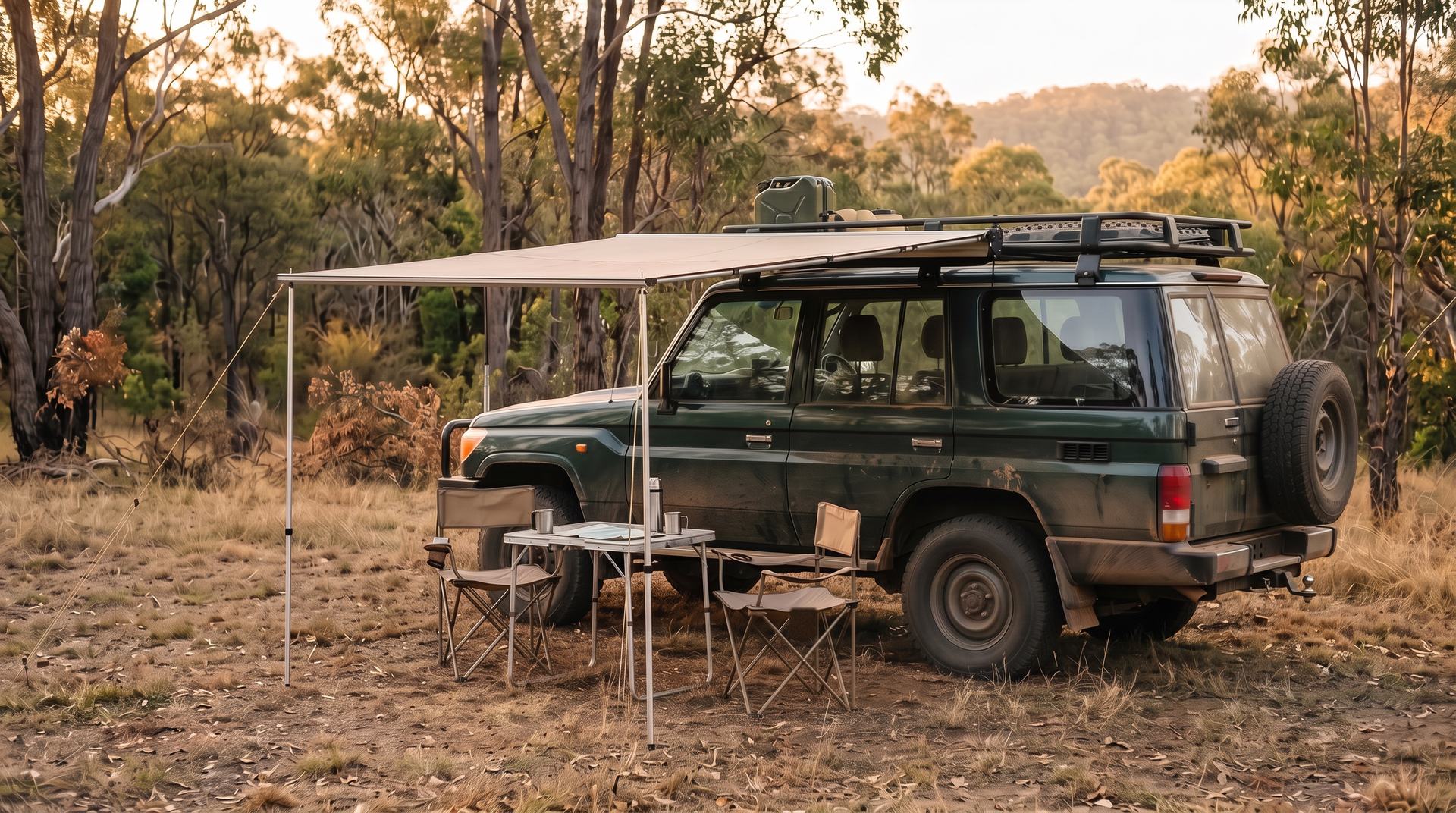
The default for good reason. A bag or alloy cassette bolts along the rack, two legs swing down, and you have a strip of shade running the length of the vehicle before the kettle’s out. Dometic and Thule build the slick cassette style where the fabric rolls into a hard housing; ARB and Darche made the classic PVC-bag version a staple. The honest limitation is geometry — the shade is a rectangle on one side, it moves as the sun does, and the rear of the vehicle stays in full glare. But at 12 to 16 kilograms it suits nearly every rack, and it’s cheap enough that leaving it mounted year-round is no decision at all. See what a 2.5-metre pull-out actually costs
The compact two-metre awning
Same mechanism, shorter roll. On a short-wheelbase wagon, a van with a sliding door, or a light-duty rail system, a full 2.5-metre awning overhangs the bodywork and picks up wind it can’t carry — the two-metre version fits the roofline it’s bolted to. At 8 to 12 kilograms it’s also the answer where the rack’s rating is nearly spent on a tent and recovery gear. Shade for two chairs and a table rather than a whole camp, and that’s exactly the brief. Size up the two-metre options for smaller rigs
The freestanding 270 wraparound
The one everybody photographs. Cantilevered arms sweep from the front door around past the tailgate, throwing ten-plus square metres of shade over the side and rear with no poles in the walkway — one person can have it open in a minute or two. Darche and ARB set the benchmark here, with rafters and joints built to hold the span unsupported in calm conditions. Two truths before you spend up: it still needs pegging and guying the moment wind arrives, freestanding or not, and the 22-to-30-kilogram figure plus a serious mounting spread means it belongs on a proper platform rack. For a camp you live in, nothing else comes close. Line the freestanding 270s up and see what pole-free costs
The pole-supported 270
The same footprint for hundreds of dollars less — the catch is a leg under each rib. Setup stretches to five or ten minutes because each pole wants levelling on ground that’s never level, and the poles stand exactly where people walk. But the shade delivered is identical, the weight often runs a few kilograms lighter than the freestanding equivalent, and for a camp that stays put for a week the extra minutes amortise to nothing. If the freestanding price stings, this is the sensible compromise rather than a lesser product. See where pole-supported 270s land on price
The 180-style wing awning
The in-betweener most buyers don’t know exists. A wing awning sweeps roughly half the arc of a 270 — across the rear corner rather than the full side-and-back — which is precisely where the action is on a canopy-fitted tray-back with a slide-out kitchen. You get six to eight square metres over the tailgate workspace at 15 to 20 kilograms, with a faster setup than any supported 270. Rhino-Rack popularised the format and several brands now build to it. If your camp happens at the back of the vehicle rather than beside it, this beats both a straight awning and a full wraparound. Look over the wing awnings built for rear corners
Comparison
| Awning type | Shade you get | One-person setup | Weight on the rack | Buy it when |
|---|---|---|---|---|
| Straight 2.5 m | ~4–5 m² along one side | About 30 seconds | 12–16 kg | You stop often and sleep somewhere new most nights |
| Compact 2 m | ~3 m² along one side | About 30 seconds | 8–12 kg | The roofline is short or the rack rating is nearly spent |
| Freestanding 270 | 10 m²+ around side and rear | 1–2 minutes | 22–30 kg | Camp is home for days and poles drive you mad |
| Pole-supported 270 | 10 m²+ around side and rear | 5–10 minutes | 18–25 kg | You want the footprint without the freestanding price |
| 180 wing | 6–8 m² across the rear corner | 2–4 minutes | 15–20 kg | The kitchen lives at the back of a canopy |

Frequently Asked Questions
Do I need a roof rack to mount an awning?
For anything beyond the smallest straight awnings, yes. A light pull-out can hang off gutter brackets or a sturdy pair of crossbars, but a 270’s cantilevered arms apply twisting loads that bare factory rails were never rated for — manufacturers specify full-length racks or platforms for good reason. Check your rack’s documentation for awning mounting before you buy the awning, not after.
Which side of the vehicle should the awning go on?
Passenger side, for most people. Quick roadside stops put your table away from passing traffic, and it keeps the shade on the same side as sliding doors and drawer systems in most builds. The exception is a wing awning, which is really a rear-corner decision — pick the corner your kitchen deploys from.
Will an awning handle rain?
Steady drizzle, yes — provided you drop one corner or leg so water sheds instead of pooling. A flat awning collects rain remarkably fast, and ten litres sitting mid-span will bend arms that shrug off years of sun. No awning of any style is a storm shelter: when serious weather arrives, the safest place for it is rolled up.
Can I run a rooftop tent and a 270 awning together?
Often, but do the sums first. A hard-shell tent at 60-plus kilograms and a freestanding 270 at 25 can exhaust a wagon rack’s dynamic rating once you add the rack’s own weight. There’s a geometry check too — the awning’s mounting brackets and the tent’s overhang compete for the same rack edge, so confirm the two systems clear each other at full deployment.
Are cheap awnings worth buying?
Split the answer by type. A budget straight pull-out is one of the genuine bargains in touring gear — the mechanism is simple enough that little goes wrong beyond fabric fade. Cheap 270s are a different story: the arm hinges and mounting plates carry real loads, they’re exactly where budget models save money, and a failed hinge in wind takes fabric and paintwork with it.
The Bottom Line
Buy the awning that matches how you stop, not the one that photographs best. For most tourers that’s a 2.5-metre straight pull-out first — used constantly, mounted permanently, forgotten until it’s needed. Move to a 270 when your trips involve real time living beside the vehicle, and pick the wing format when everything happens at the tailgate. The awning you open at every stop beats the bigger one you deploy twice a year.
Settled on the wraparound style? Our guide to the best 270-degree awnings compares the models worth the money, the awning walls and room kits guide covers turning that shade into a sleepable room, and the LED work lights guide sorts the lighting that goes under it.