
This page contains affiliate links. Far Cornel may earn a commission if you buy through them, at no extra cost to you.
See the top tyre repair kits on Amazon →
Quick answer: A quality string-plug kit with sturdy steel T-handle tools, paired with a good twelve-volt compressor, fixes the tread punctures behind most flats and gets you moving again in minutes. Carry a compact kit as a get-you-home backup, step up to a heavy-duty touring kit for long remote trips, and keep mushroom or patch plugs for a proper permanent repair later. One rule: plugs are for the tread only — a sidewall or shoulder puncture means the spare, not a plug.
A flat a long way from anywhere is one of the most common ways a good trip turns bad, and a spare only gets you out of trouble once. A tyre repair kit changes the maths: with a handful of plugs and the right tools you can fix a tread puncture by the roadside in minutes and keep driving, spare still in reserve. It is among the cheapest, most useful things you can carry, and it works without lifting the wheel off the vehicle.
It helps to know what these kits can and cannot fix. A plug repairs a puncture in the tread, the flat part that meets the road, where a nail or screw has gone more or less straight in. It cannot safely repair a torn sidewall or a large gash, which mean a new tyre. Carry a kit for the punctures it will fix and a spare for the damage it will not, and a flat stops being a trip-ender.
Quick Picks
- Best overall: a string-plug tyre repair kit with sturdy tools.
- Best budget backup: a compact emergency puncture kit.
- Best all-in-one: a repair kit with a compressor.
- Best for serious touring: a heavy-duty kit with spares.
- Best longer-term fix: a mushroom or patch-plug kit.

How to Choose
Start with the quality of the tools, because that is what fails when it matters. The heart of a plug kit is the reamer that cleans the hole and the insertion tool that drives the plug home, and cheap versions with thin metal and plastic handles bend or snap against a tough tyre. Forcing a plug into warm rubber takes real effort, so look for solid T-handle tools with a proper grip. Spare plugs, rubber cement, a valve tool and a couple of spare valve cores round out a kit you can rely on.
Then make sure you can finish the job, which means air. A plug seals the hole, but the tyre still has to be reinflated, so a kit is only complete if you also carry a twelve-volt compressor or buy a combo that includes one. The plugs themselves cost almost nothing, so spend on strong tools and a decent compressor and save on the consumables; ARB, Safety Seal and Viair are the names that keep coming up. The classic mistake is a bargain kit whose tools bend on the first real puncture, leaving you with the right idea and the wrong gear.
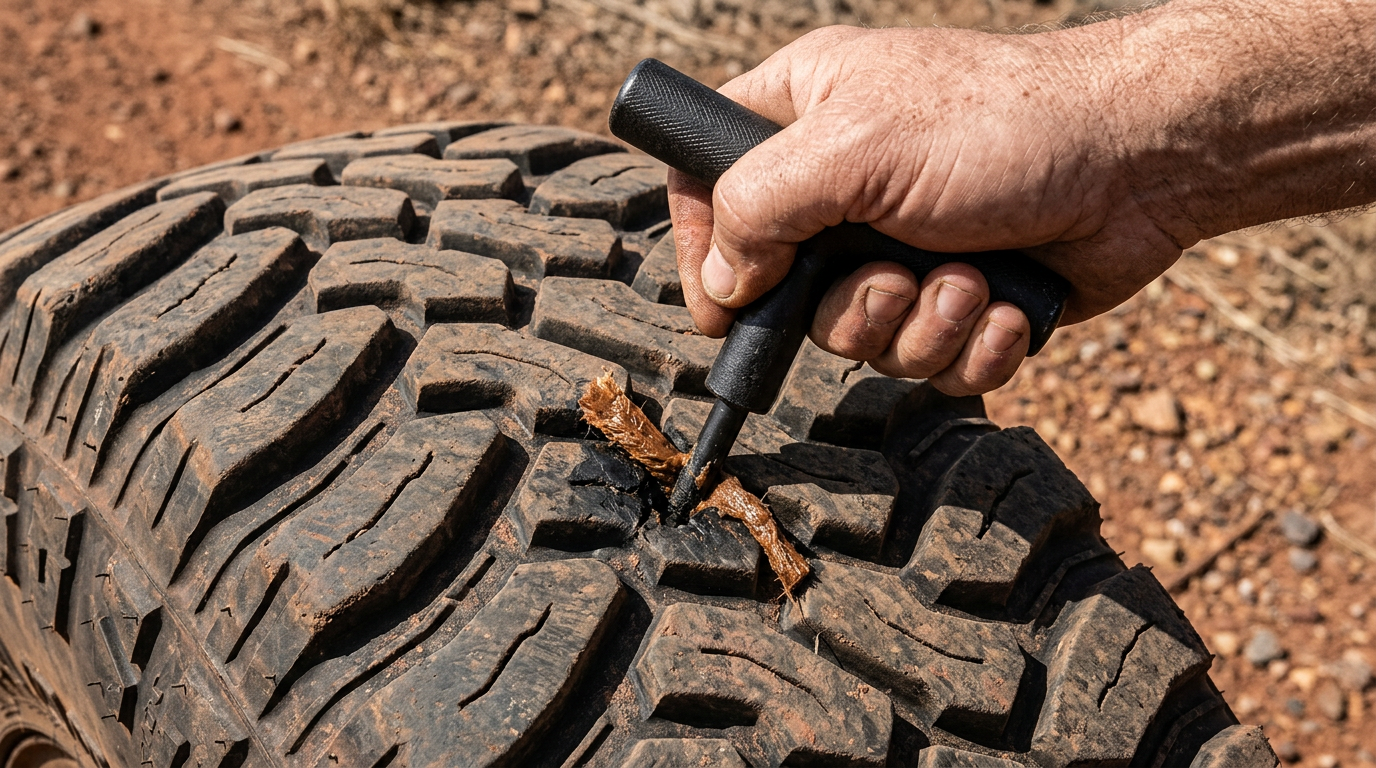
A kit is only as good as the technique. When you pick up a slow leak, spray the tyre with soapy water and watch for the stream of bubbles — that is your puncture, and it beats hunting by eye. Leave the screw or nail in until you are set up, because it plugs the hole while you work. Ream the hole to rough it up and warm the rubber, push a sticky string plug most of the way in with the tool, pull the tool straight back out so the plug stays behind, trim it just above the tread, then re-inflate and re-check with soapy water. And know the limit: a plug is a get-you-home repair for a tread puncture, never a sidewall — get the tyre patched from the inside, or replaced, once you are off the track.
The Tyre Repair Kits
Check today’s prices on Amazon →
String-Plug Repair Kit
The touring standard, and the one to own first. A reamer roughs and cleans the puncture, then a sticky vulcanising plug is pushed in from the outside with an insertion tool, all without removing the wheel. Trim the tail, reinflate, and you are moving in minutes. It handles the nail-and-screw tread punctures behind most flats, and one kit holds enough plugs for several repairs; ARB Speedy Seal and Safety Seal are the benchmarks. Quality tools are the difference between an easy fix and a bent reamer, so choose well. See what the string-plug kits are going for
Compact Emergency Kit
A compact emergency kit strips the idea to the essentials: a few plugs and basic tools in a package small enough for a glovebox or under a seat. As a just-in-case for a road car or a second vehicle it beats nothing and takes up almost no room. The trade-offs are limited supplies and often lighter tools, so keep it for occasional, short-range use rather than serious remote travel, where a fuller kit and better tools pay off. Compare the compact emergency kits
Repair-and-Inflate Combo
A repair-and-inflate combo bundles a plug kit with a way to put air back in, usually a twelve-volt compressor, so one purchase covers a complete roadside fix. That solves the most common gap, since a plug kit alone cannot reinflate the tyre, which makes it a sensible pick for anyone kitting out a vehicle from scratch. Just check the compressor is up to your tyre size, because some bundled units are slow to inflate a big four-wheel-drive tyre. Look over the repair-and-inflate combos
Heavy-Duty Touring Kit
A heavy-duty touring kit is built for remote travel, packing robust T-handle tools, a generous supply of plugs, valve tools, spare cores, pliers to pull the offending nail and often gloves, all in an organised case; Bushranger and ARB build good ones. When help is hours or days away, that completeness is exactly what you want. It costs more and takes more space than a basic kit, and is overkill for city driving, but for genuine off-grid touring it is the level to carry. Check the heavy-duty touring kits
Mushroom or Patch-Plug Kit
A mushroom or patch-plug kit is about a proper, permanent repair rather than a quick roadside fix. It combines an internal patch with a plug that fills the hole, sealing the puncture from the inside the way a tyre shop would. The catch is that it needs the tyre off the rim to fit, which is not a simple trackside job. Treat it as the correct long-term repair to do once you are set up or home, backing up the external plug that got you moving. See the mushroom and patch-plug kits on offer
Comparison
| Type | Best for | Ease of use | Needs a pump | Watch out for |
|---|---|---|---|---|
| String-plug kit | Most tread punctures | Easy | Yes | Buy strong tools |
| Compact emergency kit | Glovebox backup | Easy | Yes | Limited spare plugs |
| Repair-and-inflate combo | One box does it all | Easy | Included | Pump quality varies |
| Heavy-duty touring kit | Remote self-sufficiency | Moderate | Usually | Bulkier to store |
| Mushroom patch-plug kit | Longer-lasting repairs | Harder | Yes | Needs tyre removal |

Frequently Asked Questions
How long does a plug repair last?
An external string plug is designed as a temporary, get-you-home repair, though a good one in a clean tread puncture often lasts a long time in practice. The safe approach is to treat it as temporary and have the tyre repaired properly from the inside, or replaced, when you can.
Can I plug any puncture?
No. Plugs are for punctures in the tread, the flat part that contacts the road, where a nail or screw has gone in fairly straight. You cannot safely plug a damaged sidewall, a large gash or a puncture near the edge of the tread, all of which mean the tyre needs replacing.
Do I need a compressor as well?
Yes. A plug seals the hole, but you still have to reinflate the tyre, so a plug kit is only half a repair without a way to add air. A twelve-volt compressor is essential touring gear, useful for far more than punctures.
Is it hard to use a tyre repair kit?
Not really, though the plug takes a firm push. You ream the hole to clean it, load and coat a plug, drive it in with the insertion tool, trim the tail and reinflate. The main effort is forcing the plug into tough rubber, which is why solid tools matter. It is well worth practising once at home.
The Bottom Line
The best tyre repair kit pairs strong T-handle plugging tools with a reliable way to reinflate, in a package matched to how far off the beaten track you go. A quality string-plug kit and a good compressor will fix most flats by the roadside and keep your spare in reserve. Remember that plugs fix tread, not sidewalls, treat an external plug as temporary, and get a proper internal repair done later. Carry that, and a puncture stops being a trip-ender.
For more on keeping your tyres trip-ready, see our guides to the best tyre deflator kits, the best portable air compressors, and the best tyre pressure monitoring systems.