
This page contains affiliate links. Far Cornel may earn a commission if you buy through them, at no extra cost to you.
See the top-rated gear on Amazon →
Quick answer: For the cleanest fire, a double-wall smokeless stainless pit like a Solo Stove burns hottest and leaves the least smoke. Choose a fan-assisted pit if you want to cook over it, a collapsible or fold-flat pit if boot space is tight, and a gas fire pit if you camp through seasons of total fire bans, when a wood pit is often useless anyway.
A fire is still the best seat in camp, but a contained pit is increasingly the only way you are allowed to have one. It keeps embers off the ground, leaves no black scar to feel guilty about, and on the smokeless designs it burns hot and clean enough that you are not shuffling your chair around the circle to dodge the smoke all night.
The catch is that “smokeless” is the most oversold word in the category, and that the whole thing is pointless during a total fire ban. This guide sorts the field into five honest types, says which one suits the way you camp, and is upfront about the trade-offs, so you buy a pit you will actually use rather than one that looks good in the listing.
Quick Picks
- Best overall: a double-wall smokeless stainless pit for the cleanest, hottest burn.
- Best for cooking: a fan-assisted pit with a grill grate over wood or charcoal.
- Best packable: a collapsible or pop-up pit that folds into a carry bag.
- Best value: a fold-flat steel pit that sets up fast and costs little.
- Best for fire-ban seasons: a portable gas fire pit that lights clean with no sparks.

How to Choose a Fire Pit
First decide between smokeless and traditional. A smokeless pit uses a double wall and vents, or a battery fan, to feed the fire enough oxygen to burn its fuel more completely, which cuts the smoke dramatically. It is not magic: no wood fire is truly smoke-free, and wet or sappy wood still smokes badly. Traditional collapsible pits are simpler, lighter and cheaper, and you accept more smoke as the price.
Then weigh portability against size. A rigid stainless pit burns beautifully but eats real boot space, while a collapsible or fold-flat pit packs into a bag, which matters if space is tight or you carry it any distance from the car. Check the burn area as well, because a bigger pit swallows standard logs whole while a compact one has you sawing wood down to fit every time.
If you want to cook, look for a grill grate and a pit that takes charcoal as well as wood. Pay attention to material, because heavy-gauge stainless resists warping and rust far better than thin painted steel, which buckles after a few hot fires. Above all, buy around the reality that a wood pit is dead weight during a total fire ban, so if you camp through dry, high-risk months, a gas pit or no fire may be the honest call. Always check the current local restrictions before you light anything.
The word smokeless does a lot of heavy lifting on these products, so it helps to know what actually earns it. A double-wall pit pulls air up through the gap between its skins, preheats it, and jets it back in through a ring of holes near the top — that second hit of hot oxygen reburns the smoke before it escapes, which is why a good one runs clean and hot once it is up to temperature. The catch is fuel: secondary burn only works on dry, seasoned hardwood. Feed it damp or green wood and it will smoke like any other fire, whatever the box promised. Get it roaring first, then settle it down; a smouldering smokeless pit is just a smoky one.
Two things matter more than the badge. First, containment is the point — most managed campgrounds now require a raised, contained fire and ban ground fires outright, so a pit with legs that keep the heat off the dirt is often the only fire you are allowed. Second, respect a total fire ban: on a ban day a wood pit is illegal and a wind-blown ember from even a smokeless design can start something you cannot take back, which is when a gas pit earns its keep. Whatever you burn, keep a way to douse it within reach, never walk away from live coals, and drown and stir the ash cold before you pack up or sleep.
The Fire Pits
Check today’s prices on Amazon →
Double-wall smokeless stainless pit
The cleanest fire you can carry. Double-wall pits like the Solo Stove Ranger or a Breeo pull air in through vents at the base, preheat it, and feed it back above the flames, so the fire burns hot and fast with very little smoke once it is roaring. The build is heavy-gauge stainless that will not warp, and a drop-out ash pan makes clean-up quick. The one honest downside is bulk, since a rigid pit takes real space and does not fold away. See what the double-wall smokeless pits are going for.
Fan-assisted smokeless pit
The cook’s pit. Rather than relying on passive airflow, a fan-driven pit like the BioLite FirePit+ forces air through rows of jets for a near-smokeless burn you can dial up or down, and it arrives ready for a grill grate over wood or charcoal. The open mesh sides let everyone watch the flames, and the battery doubles as a phone charger. You are swapping simplicity for a part that needs charging, so keep it topped up before a trip. Check current pricing on the fan-assisted pits.
Collapsible or pop-up pit
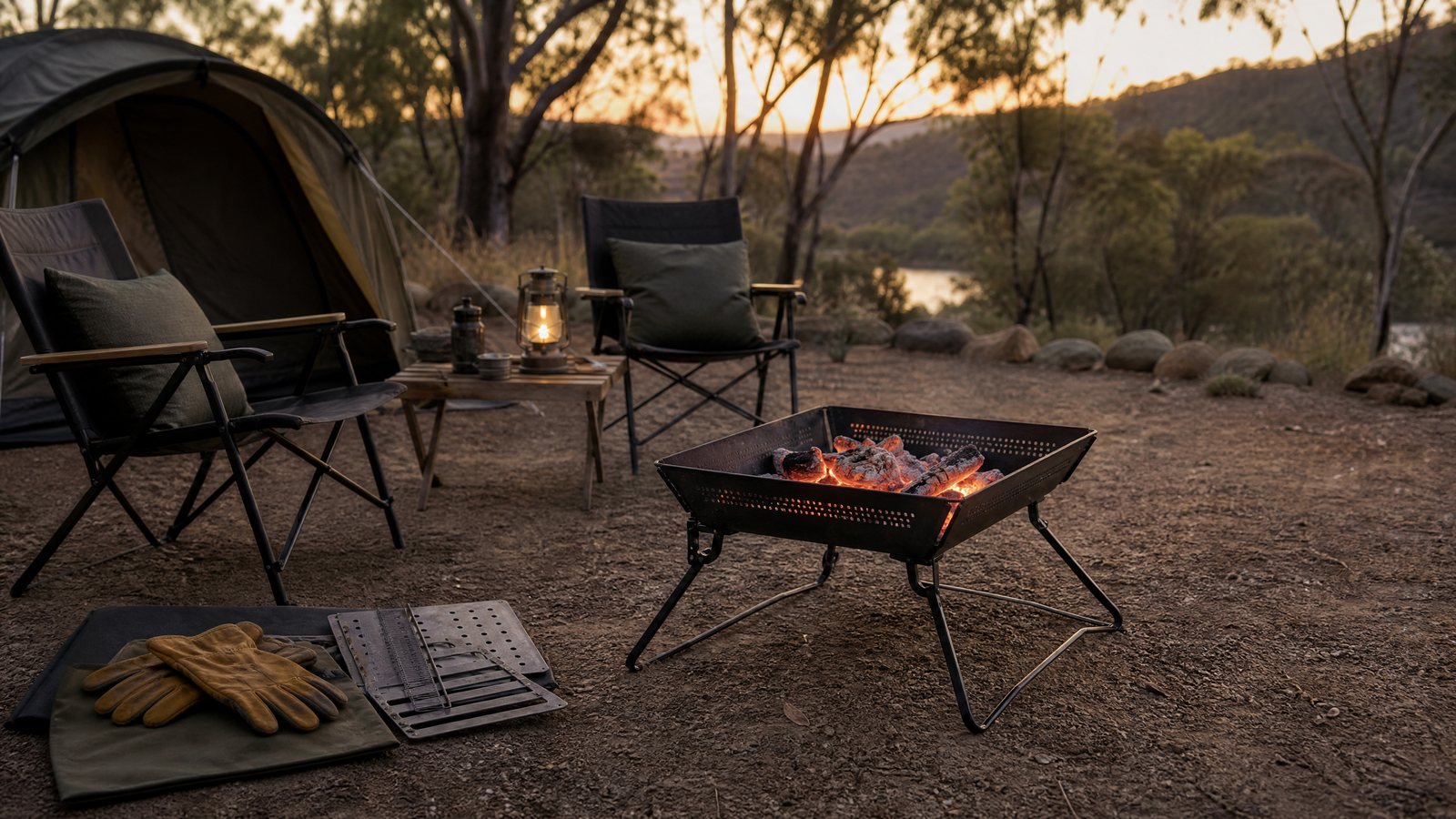
The space-saver. Collapsible pits fold flat into a carry bag and set up in about a minute: a pop-up mesh design like the Fireside Outdoor pit, or a fold-flat stainless one like the Snow Peak, both keeping the fire off the ground on a shield or legs. You give up the sealed airflow of a smokeless pit, so expect more smoke, but for a packed boot or a walk-in camp the tiny packed size earns its place. Compare the collapsible and pop-up designs in this class.
Fold-flat steel value pit
The budget workhorse. A simple fold-flat steel pit such as a Charmate or Oztrail costs a fraction of the premium designs, sets up fast and usually takes a grill grate for cooking. You accept more smoke and steel that will not last decades, but for the occasional campsite fire it does the job without denting the wallet. Steer clear of the very thinnest painted steel, which warps and flakes into rust after only a few hot burns. Weigh up the fold-flat steel pits on value.
Portable gas fire pit
The one that still works under restrictions. A gas fire pit runs off a bottle, lights instantly, throws no sparks and leaves no ash, and it is sometimes permitted when wood fires are banned outright, though you must never assume it and always check the current rules. It will not give you the crackle or a bed of coals to cook over, but for warmth and ambience through a dry, high-risk stretch it can be the only fire you are allowed. Look at what the gas fire pits cost.
Comparison
| Fire pit type | How it burns clean | Packs | Cooking | Watch-out |
|---|---|---|---|---|
| Double-wall stainless | Vents + preheated air | No, rigid | Add a grate | Bulky in the boot |
| Fan-assisted | Battery-driven jets | Folding legs | Yes, grate included | Battery to charge |
| Collapsible / pop-up | Open airflow only | Flat, carry bag | Optional grate | More smoke |
| Fold-flat steel | Open airflow only | Flat | Often | Thin steel warps |
| Portable gas | Clean gas flame | Compact | Warmth, not coals | No campfire feel |

Frequently Asked Questions
Are smokeless fire pits actually smokeless?
No, and it helps to expect that. A good double-wall or fan pit cuts smoke dramatically once the fire is hot and you are burning dry, seasoned wood. Feed it damp, sappy or green wood, or watch it during the smoky first few minutes of lighting, and you will still get plenty.
Can I use a fire pit during a total fire ban?
Usually not if it burns wood. A raised pit is often still caught by a total fire ban, and the rules change day to day and place to place. Gas is sometimes allowed when wood is not, but never assume it, and always check the current restrictions where you are before lighting.
Does a small pit mean cutting wood down?
Often, yes. Compact pits with a short burn area need logs sawn or snapped to fit, which is fine if you carry a saw but tedious if you do not. If you want to toss standard-length firewood straight in, choose a pit with a wider burn area and accept the extra bulk.
How do I protect the ground and clean up?
Use a pit that sits on legs or a heat shield, and set it on bare dirt or a fire mat rather than grass or timber decking. Let the fire burn down, then drown the ash cold with water before you leave. A drop-out ash pan turns the next-morning clean-up into a ten-second job.
The Bottom Line
For the cleanest fire a double-wall smokeless pit is the pick, with a fan-driven one close behind if cooking over the flames matters to you. A collapsible or fold-flat pit wins on packed size, and a gas pit keeps you legal through the dry months when wood fires are off. Whatever you choose, keep it clear of dry grass, never leave it unattended, and drown the ash cold before you move on.
Round out camp with our guides to the best camping stoves, the best camping chairs, and the camp kitchen setup guide.