
This page contains affiliate links. Far Cornel may earn a commission if you buy through them, at no extra cost to you.
See the top-rated gear on Amazon →
Quick answer: For a typical road trip, a self-contained chemical flush toilet in the 18 to 20 litre range is the safe first buy: comfortable, easy to empty and forgiving of mistakes. A cassette toilet suits a fixed van or caravan, a bucket-and-bag or folding unit covers occasional and emergency use, and a composting toilet earns its space only for long, chemical-free off-grid stays. Match it to how you travel.
There is no polite way around it: once you camp beyond serviced sites, sanitation becomes your problem to solve. A portable toilet is what keeps that problem contained, hygienic, and free of the smell that can ruin a small vehicle. The part that trips people up is that four quite different designs share the name, and the one that suits a weekend camper is not the one a full-timer should buy.
Getting the match right is the whole point, because the wrong choice is either more toilet than you will ever maintain or too little for the way you actually travel. The decision runs on comfort, price and, most of all, how much upkeep you are honestly willing to do, since a portable toilet rewards a little routine and punishes neglect fast. This guide sorts the designs, the features that decide day-to-day life with one, and the habits that keep it pleasant.
Quick Picks
- Best all-rounder: a self-contained chemical flush toilet around 18 to 20 litres.
- Best for a fixed van or caravan: a cassette toilet with a detachable tank.
- Best budget and backup: a bucket-and-bag toilet with a solidifier.
- Best for packing small: a folding toilet that lays flat.
- Best for long off-grid stays: a composting, chemical-free toilet.

How to Choose a Portable Toilet
Beyond the design, a handful of practical numbers decide how you live with a toilet. The waste tank capacity sets how often you empty it, and for a couple a tank around 18 to 20 litres hits the balance between too-frequent trips and too-heavy a tank to carry. The seat height and footprint decide whether it is comfortable and where it fits, and the seal and flush together control the one thing that matters most in a small space, which is smell.
Weight is the feature people forget until emptying day. A full holding tank is heavy, so a design where the tank detaches cleanly and has a decent pour spout is worth more than an extra litre of capacity. Look at build quality too, since a smooth interior and a slide valve that seals fully is what keeps odour in and cleaning quick. Thetford’s Porta Potti and Dometic’s portable range are the familiar names in self-contained flush toilets, and Nature’s Head is the reference for composting.
Here is the myth worth busting: more chemical does not mean less smell. Overdosing a holding tank wastes product, can overwhelm some dump systems, and does nothing a correct dose would not. Odour control comes from dosing to the instructions, emptying before the tank is full rather than after, and keeping the seals lightly lubricated so they close completely. Greener enzyme-based additives exist and some sites require them, so check before you travel.
The tank, not the bowl, is where people come unstuck. Use a proper toilet chemical: a measured dose in the holding tank digests the waste and keeps the smell down, and a modern enzyme or “green” formula is kinder to a dump point than the old formaldehyde blues. Put a splash of water in before the first use so nothing sticks. Then empty on a schedule, not a hope — a full 20-litre tank of waste is close to 20 kilograms and awkward to carry, so tip it at around two-thirds full while you still comfortably can, and only ever at a proper dump point or waste station, never down a drain or a bush long-drop. Wipe and lightly silicone the blade-valve seal, store it with the valve closed, and it will not leak or stink between trips. Done that way a portable toilet is a non-event; ignored, it becomes the smell you never forget.
The Toilets
Check today’s prices on Amazon →
Chemical Flush Toilet
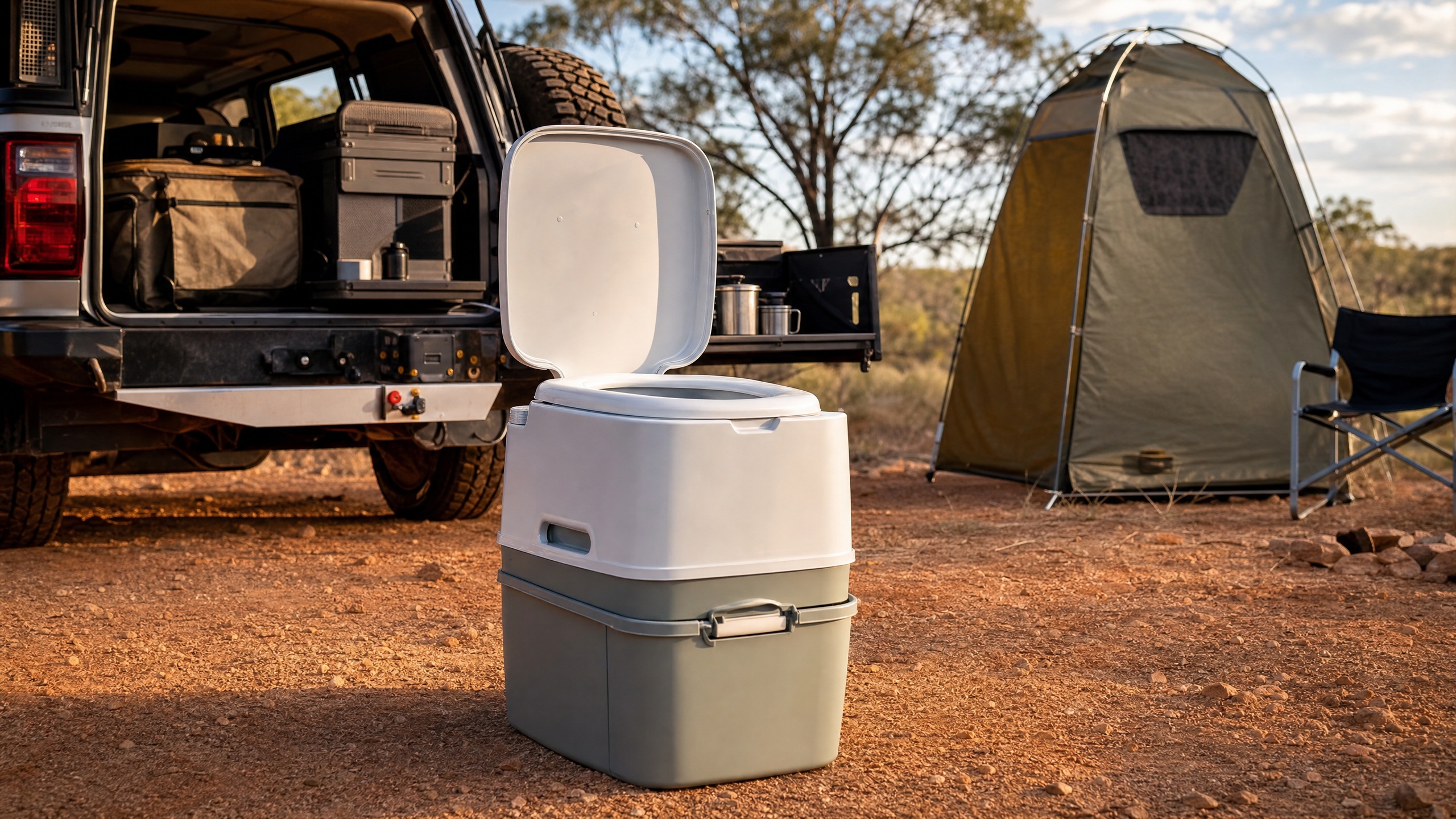
The road-trip default, and the safe first buy for almost everyone. A fresh-water tank on top flushes into a sealed holding tank below, where a deodorising additive breaks down waste and holds the smell until you empty it at a dump point. They are comfortable, self-contained, and forgiving of a beginner’s mistakes, which is why a Thetford or Dometic unit around 18 to 20 litres is where I send anyone starting out. You do need to buy additive, keep the seals happy, and know where your dump points are. See what the chemical flush units cost.
Cassette Toilet
The built-in answer for a van or caravan with a dedicated space. A cassette toilet mounts in place, and its waste tank, the cassette, slides out from an access hatch so you can carry it to a dump point, often on its own wheels with a pour spout. It flushes like a home toilet and seals odour well behind a slide valve. The trade-off is that it is the least portable option and assumes a semi-permanent install, so it suits a fixed fit-out rather than a car you pack and unpack. Price up a cassette toilet.
Bucket-and-Bag Toilet
The simplest thing that works, and an honest backup. A sturdy bucket, a proper seat and lid, and a liner bag with a solidifying powder or absorbent litter to gel the waste and trap the smell. It needs no water and no chemicals, costs very little, and stores flat. Bagged waste goes in a bin, and the experience is basic, so treat it as an occasional or emergency option rather than a daily driver. For the price, it is worth carrying even if you own something better. Look at the bucket-and-bag options.
Folding Toilet
For minimalists and small cars, a folding toilet collapses to a flat panel that slides behind a seat, then opens into a seat frame that takes a lined bag. It is the lightest, most packable way to carry a genuine seat rather than perching on a bucket rim, which matters more than it sounds after a long day. Capacity is whatever the bag holds, so it is a light-use and travel option, not a base-camp solution. Check the frame is rated for your weight and sits steady on uneven ground. Check the folding toilets.
Composting Toilet
The option for long, off-grid stays where you would rather avoid chemicals and dump points. A composting, or dry-separating, toilet keeps liquid and solid waste apart and uses a dry medium to reduce odour and volume, with Nature’s Head the name most people know. It is bulkier and pricier, and it is not the maintenance-free miracle some make out; it needs correct separation and periodic emptying. That makes it better for stationary camps than a vehicle you move daily, but genuinely freeing when you sit still for weeks. Compare the composting toilets.

Comparison
| Type | Comfort | Upkeep | Best for |
|---|---|---|---|
| Chemical flush | High | Additive, empty at dump point | Most road trips |
| Cassette | High | Slide out and empty the cassette | Fixed vans and caravans |
| Bucket-and-bag | Basic | Bag and bin, no water | Occasional and backup |
| Folding | Basic-plus | Lined bags, packs flat | Small cars, light use |
| Composting | Good, seated | Separate and empty periodically | Long off-grid stays |
Frequently Asked Questions
Which type should a first-timer buy?
A self-contained chemical flush toilet around 18 to 20 litres. It is comfortable, easy to empty, and forgiving of the mistakes everyone makes at the start. Add a solidifier and a spare set of seals, learn where your dump points are before you leave, and empty it more often than feels necessary while you get the feel for it.
How often do I empty it?
It depends on tank size and how many people use it, but plan on every two to three days for a couple sharing a 20 litre chemical toilet, and sooner for a small tank or a family. It is far better to empty a part-full tank than to leave a full one sitting, which is when odour and mess start.
What chemical do I use, and are there greener options?
Use the additive matched to your toilet, dosed to the instructions rather than piled in. Enzyme-based products are gentler on the environment and on some dump systems, and a number of sites now require them over the harsher standard type, so check the local rule and carry the right one.
Do I need a privacy tent for it?
Not if you use it inside a van or caravan, but for a bucket or standalone unit at a campsite a pop-up privacy tent makes it genuinely usable, giving shelter, somewhere to stand, and a dry spot for paper and hand sanitiser. It is a cheap addition that transforms the experience.
The Bottom Line
Match the toilet to how you travel rather than to the biggest tank on the shelf. For occasional trips a bucket, folding or small chemical unit is plenty; for regular touring a chemical flush or a cassette is the comfortable middle ground; and a composting toilet is worth its space only if you sit off-grid for long stretches. If you are new to it, a well-regarded chemical flush toilet in the 18 to 20 litre range is the buy you will not regret, so long as you empty it early and keep the seals sweet.
Related: privacy and ensuite tents, camp shower systems, and vehicle water tanks.