
This page contains affiliate links. Far Cornel may earn a commission if you buy through them, at no extra cost to you.
See the top-rated gear on Amazon →
Quick answer: For anyone starting out, a spinning reel is the right first buy — it casts light lures a mile, rarely tangles, and does a bit of everything. Step up to a baitcaster once you’re throwing heavier lures, fishing heavy line or braid, or want pinpoint casts around cover. Plenty of anglers own both; if you’re buying one, buy spinning.
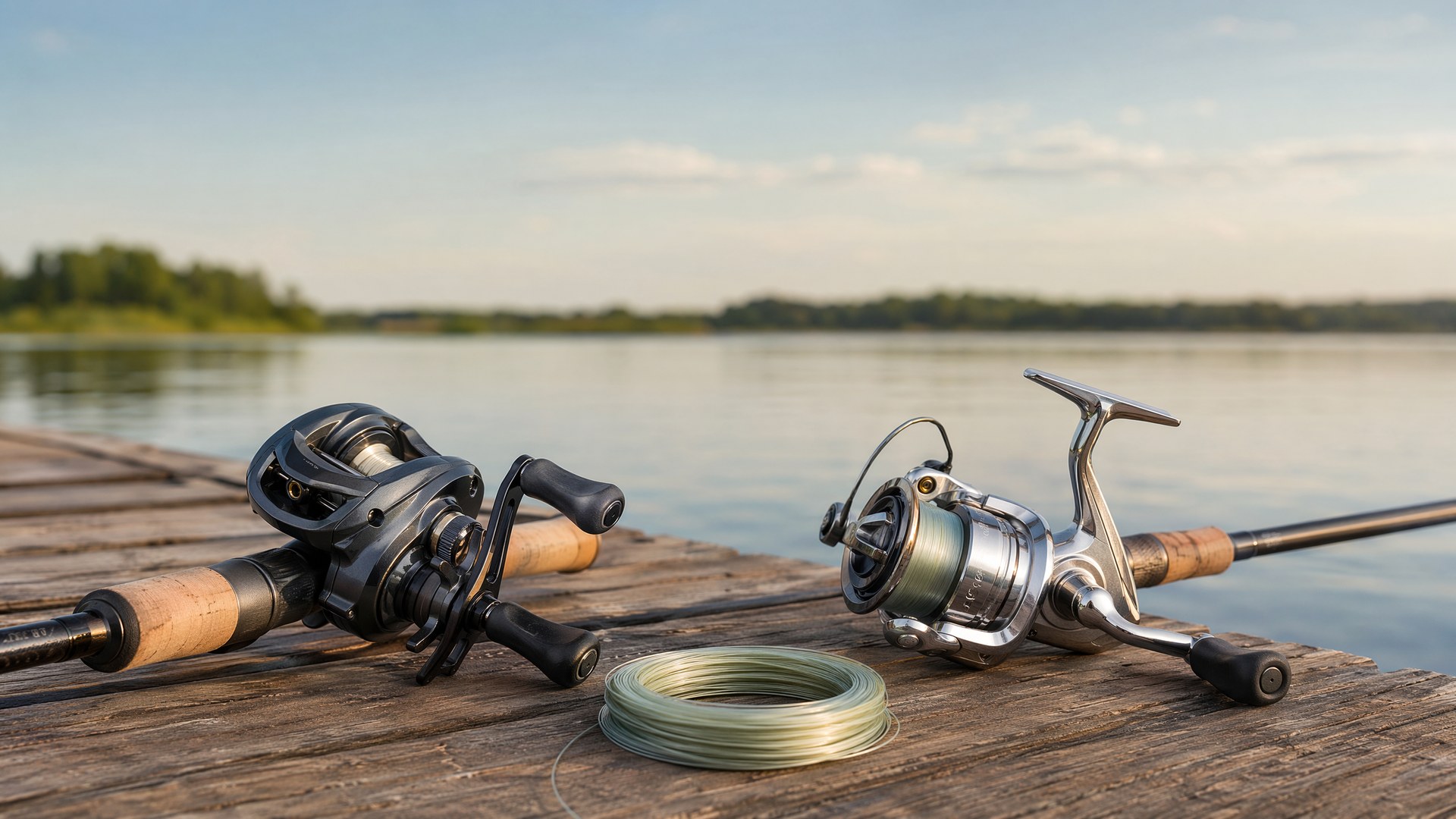
The choice between a baitcaster and a spinning reel trips up more new anglers than any other bit of tackle, and the honest answer is that neither is “better” — they’re built for different jobs. The whole difference comes down to the spool. A spinning reel hangs under the rod with a fixed spool that never turns; line simply peels off the lip as the lure flies, so it can’t over-run and it can’t give you the tangle that catches out beginners.
A baitcaster sits on top of the rod with a spool that spins to release line. That direct drive gives more cranking power, better control and pinpoint accuracy in a practised hand, and it handles heavy line and lures far better — but if the spool outruns the line you get a backlash, the infamous bird’s nest. So the real question isn’t which reel wins; it’s where you are as an angler and what you actually fish.
Quick Picks
- Best first reel: an all-round spinning reel in a 2500–4000 size.
- Best for finesse and light lures: a light, sensitive spinning reel.
- Best for salt and surf: a sealed saltwater spinning reel with strong drag.
- Best for accuracy around cover: a low-profile baitcaster.
- Best for heavy lures and big fish: a strong baitcaster with a good brake.

How to Choose Between Them
Be honest about your casting first. If you’re learning, a spinning reel lets you fish from the first cast with no backlash to untangle, while a baitcaster asks for a session or two of practice before it stops nesting. That single fact settles the choice for a lot of people. After that, look at what you throw: light soft plastics, small hardbodies and bait suit spinning, whereas heavy lures, big surface baits and thick braid are baitcaster territory.
Here’s the myth worth killing: baitcasters do not cast further. With light lures a spinning reel casts further and easier, every time — the baitcaster only pulls ahead once the lure is heavy enough to drive the spool. You also don’t need a baitcaster to land big fish; a sealed saltwater spinning reel with real drag stops plenty of hard-pulling fish. Match the reel to the lure weight and the fight, and both types punch above their reputation.
Budget is the last piece. Rand for rand, spinning reels give more smoothness and drag for the money because they’re simpler to build, so a mid-price spinning reel feels better than a same-price baitcaster. If you can only buy one, that value plus the gentle learning curve makes spinning the sensible first outfit — and you can add a baitcaster later when your fishing genuinely asks for one.
One thing the shop never tells a first-time baitcaster buyer: it is only as tangle-prone as its setup. Every baitcaster has a spool-tension knob and a brake system, magnetic or centrifugal or both. Snug the tension so a lure drops slowly and stops the instant it lands, start with the brakes high, and thumb the spool through the cast — that, not the price on the box, is what tames the dreaded backlash while you learn. The flip side lives on a spinning reel: because line peels off a fixed spool it slowly adds twist, and a slack line can throw a wind-knot, especially behind a lure that spins. So the honest trade-off is a baitcaster that lays line dead straight but punishes a lazy thumb, against a spinning reel that forgives everything but nags you with the odd loop. Neither is a fault; it is the tax each design charges.
The Reels Worth Buying
Check today’s prices on Amazon →
The all-round spinning reel
A 2500 to 4000-size spinning reel is the most useful reel most people can own: light to fish all day, tangle-free, and happy with everything from soft plastics to bait. A Shimano Sedona covers the budget end and a Daiwa BG steps up in toughness for not much more. If you’re starting out, or you just want one reel that does nearly everything, start here — you won’t fish yourself into a corner. See what all-round spinning reels cost
The finesse spinning reel
Working light lures and light line all day rewards a lighter, faster reel with a smooth, sensitive drag — something like a Daiwa Fuego LT or Shimano Stradic in a 1000 to 2500 size. You feel every tick through the line, and the light body saves your wrist over a long session. It’s the specialist for bream, trout and finesse plastics, not a one-reel-does-all, so pair it with a heavier outfit for bigger jobs. Compare finesse spinning reels
The saltwater spinning reel
Salt kills unsealed reels fast, so for the surf, the rocks or offshore you want sealed internals and a strong, sealed drag — a Penn Spinfisher or a larger Daiwa BG. Sizes climb past 5000 for surf and big fish, with the drag pressure to slow a hard first run. Rinse it in fresh water after every session and it’ll outlast three cheap reels that seize up by their second summer. Look at sealed saltwater spinning reels
The low-profile baitcaster
Once you’ve got the casting stroke, a low-profile baitcaster like a Daiwa Tatula or an Abu Garcia puts a lure exactly where you want it — tight against cover, under branches, on a dime. The palm-sized body and an adjustable magnetic brake make it the natural first baitcaster. It shines with medium to heavy lures and pulls hard fish out of structure; it’s wasted on tiny finesse offerings, which is spinning’s job. Check current low-profile baitcaster prices
The heavy-duty baitcaster
For big lures, heavy braid and hard-pulling fish, a stronger baitcaster gives you cranking power and line control a spinning reel can’t match. Shimano and Abu Garcia both build tough low-profile and round models for the job. Set the brake firmly at first, thumb the spool, and give it a couple of sessions — the power and accuracy are exactly why serious lure anglers put up with the steeper learning curve. Price up a heavy-duty baitcaster

Comparison
| Property | Spinning reel | Baitcaster |
|---|---|---|
| Learning curve | Easy, no backlash | Steeper (backlash) |
| Best lure weight | Light | Medium to heavy |
| Casting light lures | Excellent | Poor |
| Power and accuracy | Good | Excellent once learnt |
| Value for the money | Higher | Lower |
Frequently Asked Questions
Which should a complete beginner start with?
A spinning reel, almost every time. There’s no backlash to fight, it casts light lures easily, and you’ll spend your time fishing instead of picking out tangles. Move to a baitcaster later, once your casting is second nature and you want more power or accuracy.
Do baitcasters really cast further?
Not with light lures — a spinning reel casts light offerings further and more easily. Baitcasters only pull ahead with heavier lures and heavy line, where they add distance and control. Match the reel to the lure weight and the “casts further” argument mostly disappears.
Can one reel really do everything?
One well-chosen spinning outfit covers a huge range, which is why it’s the usual single-reel answer. But each type shines at different jobs, so most keen anglers end up with a spinning reel for light and finesse work and a baitcaster for heavy lures and big fish.
How do I stop a baitcaster backlashing?
Set the brake and spool tension high to start, then back them off as you improve. Thumb the spool lightly through the cast and feather the release. A few sessions of steady lobs rather than power casts, and the bird’s nests mostly stop happening.
The Bottom Line
There’s no outright winner here, only the right tool for where you are. A spinning reel is the easier, more forgiving, more versatile choice and the right first reel for almost everyone — and it keeps a spot in your kit for light and finesse work for life. A baitcaster rewards a little practice with more power, control and accuracy for heavy lures and big fish. Unsure? Start spinning, and add a baitcaster when your fishing asks for it. Most of us, in the end, own both.
For specific picks, see our guides to the best spinning reels, the best baitcaster combos, and the best beginner spinning combos.