
This page contains affiliate links. Far Cornel may earn a commission if you buy through them, at no extra cost to you.
If a fire is bigger than a small bin or is spreading, get everyone out, stay out and call Triple Zero (000).
See the top-rated gear on Amazon →
Quick answer: For a vehicle or caravan the single best buy is a certified dry-powder ABE extinguisher — it knocks down the wood, fuel and electrical fires a vehicle actually throws at you, all in one unit. A compact one-kilogram unit is the sensible minimum in the cab, step up to 1.5 to 2 kilograms in a caravan, keep a fire blanket by the stove, and treat foam or a little aerosol as a supplement, never your only line of defence.
A fire extinguisher is the one item you pack hoping never to touch, and the one that matters most when everything goes wrong. A vehicle fire — from a chafed wire, a gas appliance, or a dragging brake — goes from a wisp of smoke to an inferno in a couple of minutes, and out on a trip there is no fire crew around the corner. A certified extinguisher, mounted where you can grab it without thinking, is the whole difference between a scare and a burnt-out shell.
Vehicle fires escalate fast because everything nearby is fuel: wiring, upholstery, plastics, gas and the fuel itself. A small extinguisher used in the first thirty seconds can smother a fire that would be unstoppable a minute later. That tiny window is the entire point — it is why the unit has to be certified, correctly sized and within arm’s reach, not the biggest one on the shelf buried under a week’s gear.
Quick Picks
- Best overall: a certified 1 kg dry-powder ABE extinguisher within the driver’s reach.
- Best for a caravan: a 1.5 to 2 kg dry-powder ABE unit mounted by the door.
- Best for the cooktop: a fire blanket kept by the stove for pan and clothing fires.
- Best low-mess on fuel: a foam extinguisher, kept away from live electrics.
- Best grab-and-go backup: a small aerosol extinguisher, never your only one.

How to Choose a Vehicle Fire Extinguisher
Buy an extinguisher certified to AS/NZS 1841, the Australian standard for portable fire extinguishers (the standard number is printed on the label). AS 2444 is the Australian standard for choosing extinguisher types and where to mount them.
Start with the type, because most household extinguishers are wrong for a vehicle. The fires you are likely to meet involve flammable liquids, gas and live electrics, not just paper and timber, so you want a dry-powder unit rated to handle all three. Water and basic foam are out for live electrics, which rules them out as your only unit in a modern rig full of wiring and a dual-battery system. Buy a certified unit with a working pressure gauge; an uncertified bargain is a gamble on the one day you cannot afford to lose.
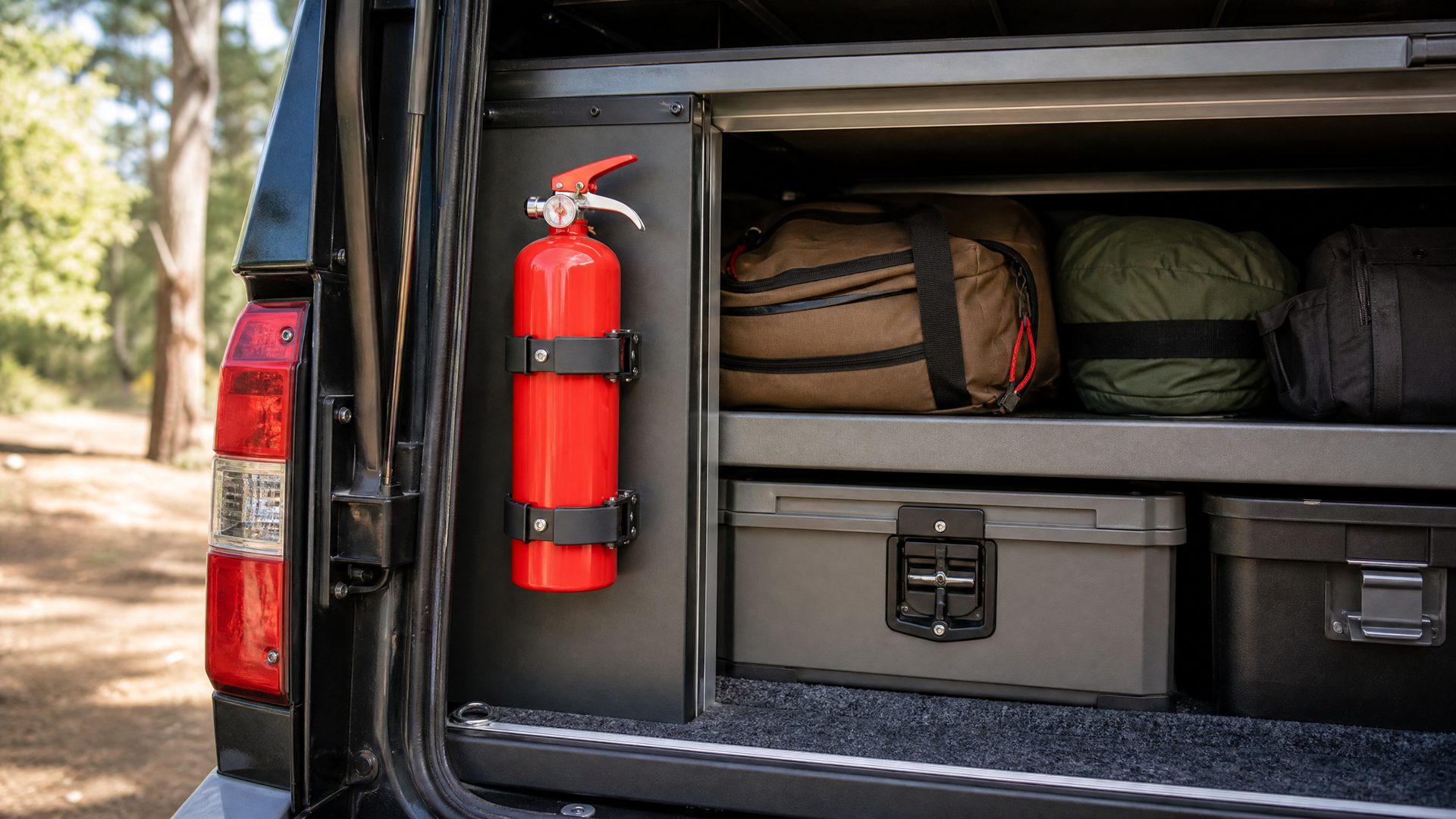
Then get the practical trio right: size, bracket and reach. Too small and you have an aerosol that empties in seconds; a one-kilogram powder unit is a sensible floor, and a kilogram and a half to two is better if it fits. The bracket is the most overlooked part of the whole purchase — a solid metal mount keeps the unit put over corrugations and instantly to hand, where a flimsy plastic clip rattles loose and leaves the extinguisher rolling round the floor as a projectile. Mount it where you can reach without leaning through where a fire would be: by the driver’s seat, or near the exit rather than the stove in a caravan.
The myth worth dropping is that simply having an extinguisher aboard means you are covered. You are not, if it is a tiny can, on a cracked bracket, buried under bags, with a gauge that fell out of the green months ago — an unchecked extinguisher is a decoration. Check the needle before every trip and tap a powder unit now and then so it does not cake. And do not rely on a single small aerosol or a foam-only unit for a modern vehicle: the aerosol runs dry too fast, and foam leaves you exposed on the electrical fires a 12V rig is most likely to start.
The Fire Extinguishers
Check today’s prices on Amazon →
Compact 1 kg dry-powder ABE unit
This is the one that lives in the vehicle, and for a typical touring rig it is the whole answer. A one-kilogram dry-powder unit rated for combustibles, fuel and electrical fires covers every likely vehicle blaze in a single compact bottle you can mount within reach of the driver’s seat. The powder is messy and mildly corrosive to clean up, but in the moment, saving the vehicle is the only thing that matters. Buy a certified one from an established fire-safety brand and fit it on a metal bracket, not the plastic clip it usually ships with. Compare today’s dry powder fire extinguisher prices on Amazon.
Larger 1.5 to 2 kg dry-powder unit
A caravan is a big, gas-and-fuel-laden box you sleep in, so it earns a bigger charge than the cab. A kilogram and a half to two of dry powder buys more seconds against a fire that has had a moment to take hold. Mount it near the main door so you can grab it on the way out or reach it from outside, and keep the smaller cab unit as well — two units in two places beats one you have to run toward the flames to reach. Look over the current 2 kg dry powder extinguisher options on Amazon.
Foam extinguisher (fluorine-free only)
Foam smothers fuel and combustible fires under a blanket that resists re-ignition, and it is far less messy than powder, which is its real appeal. The catch is a big one for a vehicle: foam is not for live electrical fires, and a modern rig is full of wiring and a dual-battery system waiting to be the ignition source. That makes it a reasonable second unit for fuel handling — around a jerry can or a generator — rather than the primary extinguisher. Keep it well away from anything live. Buy a unit labelled fluorine-free and avoid older AFFF (aqueous film-forming foam) units: AFFF foams have used PFAS “forever chemicals”, and since 1 July 2025 Australia’s national rules ban importing, using or making the three main PFAS chemicals unless an exemption applies (NSW EPA). Check the latest fluorine-free foam fire extinguisher range on Amazon.
Fire blanket
The most common caravan fire starts at the cooktop, and a fire blanket is the fastest, cleanest way to kill a pan fire or smother burning clothing without spraying powder through your kitchen. It costs little, stores flat in a pouch by the stove, and anyone can use it without training. It will not fight a developed fire or reach into an engine bay, so it complements rather than replaces an extinguisher, but for the single most likely fire in a van it is the right first grab. Mount it where you cook, not across the other side of the van. See the newest fire blanket listings on Amazon.
Aerosol extinguisher
Small aerosol extinguishers are the size of a spray can, weigh almost nothing, and are dead simple for anyone to point and use — which makes them a handy backup in a glovebox, a tent or a daypack. The honest limitation is capacity: they empty in seconds and are meant for a small, early flare-up, not a growing fire. Treat one as a supplement to a proper powder unit, never as your only extinguisher, and you get a genuinely useful grab-and-go option for the little fires that would otherwise become big ones. Check current aerosol fire extinguisher stock on Amazon.

Comparison
| Product | Good on | Safe on live electrics | Mess | Best role |
|---|---|---|---|---|
| 1 kg dry powder ABE | Wood, fuel, electrical | Yes | High | Primary in the vehicle |
| 1.5–2 kg dry powder ABE | Wood, fuel, electrical | Yes | High | Primary in a caravan |
| Foam (fluorine-free) | Wood, fuel | No | Low to moderate | Second unit for fuel |
| Fire blanket | Cooktop, clothing | Yes, smothers | None | By the stove |
| Aerosol | Small early flare-ups | Usually | Low | Grab-and-go backup |
Frequently Asked Questions
What type of extinguisher should I carry in a vehicle?
A certified dry-powder unit, because it handles the flammable-liquid, gas and electrical fires a vehicle blaze usually involves, all in one bottle. Water and plain foam are unsafe on live electrics, which rules them out as your only unit. For touring, certified dry powder is the sensible single choice.
What size do I actually need?
A one-kilogram unit is a common minimum for a cab, and 1.5 to 2 kilograms is better in a caravan, since a bigger charge buys more seconds against a growing fire. Whatever the size, favour a certified unit on a solid metal bracket over a larger but flimsy one you cannot trust.
Do I need more than one?
Ideally, yes. A powder extinguisher within the driver’s reach and a second near the caravan door cover the vehicle, and a fire blanket by the stove handles the most common cooktop fire without spraying powder everywhere. A small aerosol makes a useful backup, but it is not a substitute for a proper unit.
How do I mount and maintain it?
Fit it in a metal bracket within easy reach, not loose in a drawer, and position it so a fire cannot block your path to it. Check the pressure gauge sits in the green before each trip, invert and tap powder units occasionally so the powder does not cake, and replace or service the unit by its stated date.
The Bottom Line
Fitting a reliable extinguisher is one of the cheapest and most important safety steps you can take before a trip. Choose a certified dry-powder unit rated for fuel, gas and electrical fires, sized to fit without being a token gesture, on a solid metal bracket within reach — a compact one in the cab, a bigger one by the caravan door, and a fire blanket where you cook. Check the gauge before every trip, tap the powder loose now and then, and learn how to use it before the day you must.
A fire extinguisher pairs naturally with the rest of your safety kit — see our guides to travel first aid kits and a recovery gear checklist, or keep comms handy with a UHF radio.
Compare your options on Amazon →
Sources: NSW EPA: Regulation of PFAS firefighting foams; Standards Australia AS/NZS 1841 (portable fire extinguishers) and AS 2444 (selection and location of portable fire extinguishers and fire blankets).