
This page contains affiliate links. Far Cornel may earn a commission if you buy through them, at no extra cost to you.
See the top-rated gear on Amazon →
Quick answer: For families and car campers a two-burner propane stove is the workhorse — enough heat for real meals and, just as importantly, a flame low enough not to scorch them. Going solo or light, a single-burner canister stove or an integrated jet-style system is faster and lighter. Pick liquid or dual-fuel for cold weather and long trips. Never judge a stove on burner output alone; simmer control and wind resistance are what decide whether cooking is a pleasure or a fight.
The thing that turned me off my first camp stove was not power — it was a light breeze. It had one roaring setting, no wind protection, and it managed to burn the outside of an egg while the middle stayed raw, all while half the heat blew sideways into the grass. A good stove is the opposite of that: it lights first go, holds a gentle simmer, and keeps its flame in a wind instead of surrendering to it.
Raw output gets all the attention on the box, but it is the least interesting number. What separates a stove you enjoy from one you fight is a wide heat range and some defence against the wind. Sort out how you cook and how many you feed, then match the stove to that, and you will eat properly at camp instead of gnawing something half-cooked. Here are the five types worth knowing.
Quick Picks
- Best all-round: a two-burner propane stove with real simmer control.
- Best for going light: a single-burner canister stove.
- Best for fast boils: an integrated jet-style cooking system.
- Best for cold and long trips: a liquid or dual-fuel stove.
- Best cheap and simple: a flat tabletop butane stove.

How to Choose a Camping Stove
Start with how you camp and how many you feed. A family cooking full meals wants a two-burner that runs a pan and a pot at once; a solo walker counting grams wants a compact canister stove. Feeding four off a tiny screw-on burner, or lugging a two-burner up a track, is the classic mismatch.
Then look past the headline output. Most two-burner stoves manage around 10,000 BTU per burner, which is plenty, but the number that really matters is how low the flame will go — a stove that only roars burns sauces and scrambles eggs to rubber. Fuel is the other call: propane copes with cold and altitude, while butane is lighter but sulks below roughly 5°C. And respect the wind, because a built-in or clip-on shield is the difference between a four-minute boil and a ten-minute one.
One thing the burner rating never tells you: how the stove behaves in the cold. A standard canister runs on a butane-propane mix, and as the temperature drops the butane stops vaporising — below about five degrees the flame sags to a weak yellow lick just when you want a hot brew. Propane (the squat bottles a two-burner runs on) copes far better, and a liquid or dual-fuel stove you pump to pressure does not care about the cold at all. If your trips run into frosty mornings, that is worth more than any headline output figure — a regulated canister stove, or one that runs the canister inverted, also holds its heat as the gas drops where a cheap unregulated burner fades with the can.
The Camping Stoves
Check today’s prices on Amazon →
The two-burner car-camping stove
This is the stove most campers should own. Two burners let you cook a main in the pan while a pot simmers alongside, which is the whole game when you are feeding a group. Coleman have made the dependable version for decades, and Camp Chef push more power and a bigger cooking surface if you cater for a crowd. The features that matter are unglamorous: adjustable wind shields that fold out, a simmer that goes genuinely low, and a frame sturdy enough to hold a full pan without wobbling. It is heavy and lives in the boot, and that is exactly where it belongs. see what a solid two-burner runs to
The single-burner canister stove
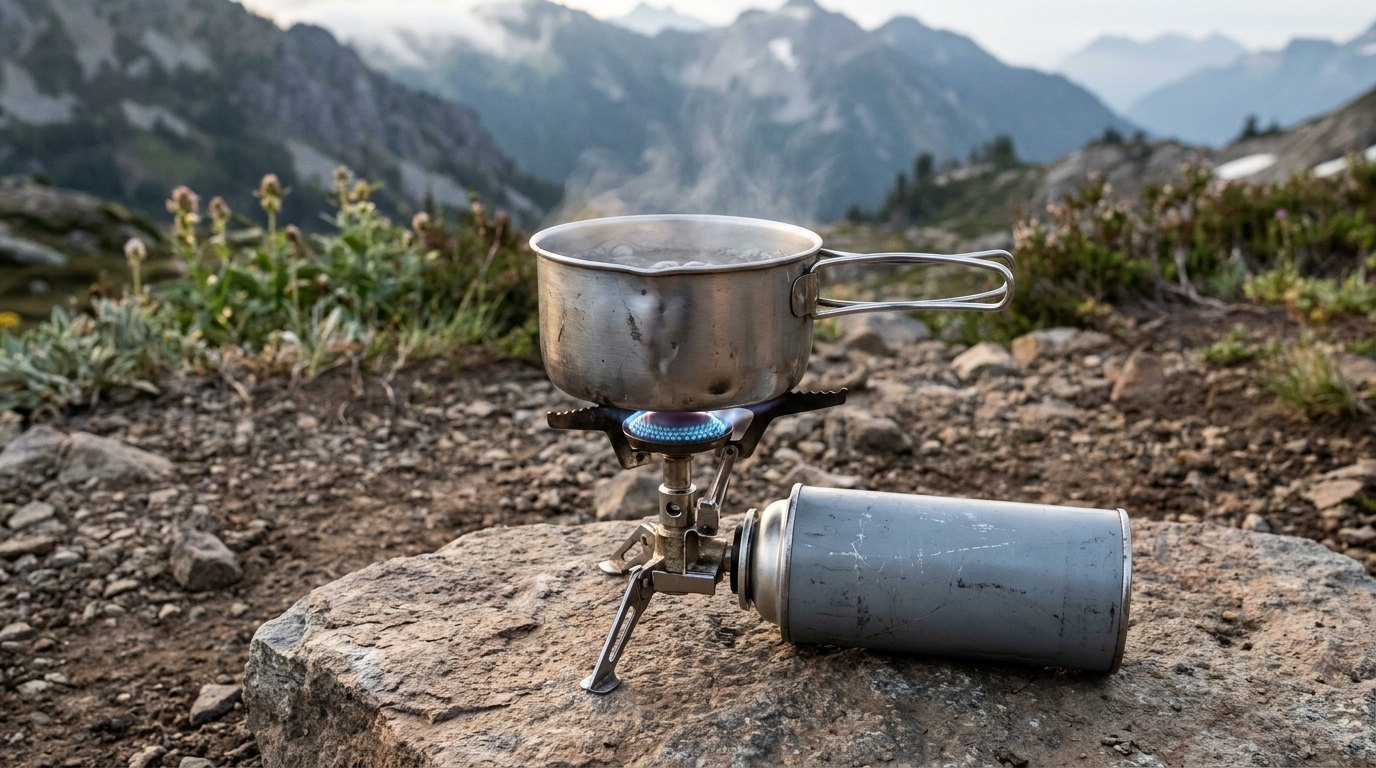
For going light, a screw-on canister stove like the MSR PocketRocket is the trekker’s default for good reason. It weighs next to nothing, folds down to fit inside a mug, threads onto a gas canister and boils water fast, trip after trip. It is built for boiling and simple one-pot cooking rather than gentle simmering, and it needs a windscreen to perform in a breeze, but for one or two people counting every gram nothing is more proven or more packable. compare the little canister stoves for going light
The integrated jet-style system
If your camp cooking is mostly “boil water, add food”, an integrated system is the most efficient tool for it. A Jetboil or an MSR WindBurner locks the pot to the burner over a heat exchanger, so it boils remarkably fast, shrugs off wind, and squeezes more meals out of a canister than a bare burner ever will. The trade-off is versatility: they are boiling machines, not gourmet simmerers, and the tall narrow pot suits brews and freeze-dried meals more than frying. For fast solo mornings, though, it is hard to beat. look at the jet-style boil-in-a-hurry systems
The liquid or dual-fuel stove
When trips get cold, long or remote, a liquid-fuel or dual-fuel stove comes into its own. Running on refillable liquid fuel — and in dual-fuel form on more than one type — these keep pumping out heat when the mercury drops and canisters go sluggish, and a refillable bottle beats hunting for the right cartridge miles from a shop. MSR liquid-fuel stoves and the classic meths-burning Trangia are the reference points. They need priming and a little maintenance, so they ask more of you than a screw-on canister, but they reward it with reliability nothing else matches in the cold. price up a liquid or dual-fuel burner for the cold
The flat tabletop butane stove
The cheapest way into decent camp cooking is a flat single-burner butane stove — the kind that takes a push-fit canister and folds into a hard case. Brands like Gas One sell them for very little, they light with a click, and the wide low profile is stable under a big pan. They struggle in the cold and give you only one burner, but for warm-weather weekends, a second cooking spot, or a first stove you will not cry over, they are honest value. Add a cheap windscreen and one will cook better than its price suggests. check what a flat butane tabletop stove costs

Comparison
| Type | Fuel | Burners | Cold-weather? | Best for |
|---|---|---|---|---|
| Two-burner car-camping | Propane | Two | Good | Families, real meals |
| Single-burner canister | Gas canister | One | Fair | Backpacking, light trips |
| Integrated jet-style | Gas canister | One | Good | Fast boils, solo |
| Liquid or dual-fuel | Liquid or mixed | One | Excellent | Cold, long, remote |
| Tabletop butane | Butane | One | Poor | Cheap, warm-weather |
Frequently Asked Questions
One burner or two?
Match it to how many you feed. A single burner is light and quick for a brew or a one-pot meal for one or two people; a two-burner lets you run a main and a side at once, which is what families and groups need. If in doubt and you drive to camp, two burners is the more useful choice.
What fuel should I choose?
Propane is the safe all-rounder and copes best with cold and altitude. Butane is lighter and cheaper but fades below about 5°C. Liquid and dual-fuel stoves handle the cold best of all and let you refill a bottle rather than chase canisters, at the cost of a little more fuss.
Does a high BTU number mean a better stove?
No, and this is the most common mistake. A high output boils water a bit faster but tells you nothing about whether the flame will drop low enough to simmer. A stove with modest output and a genuinely low simmer will cook far better than a screaming burner you cannot turn down.
How do I cook in the wind?
Shelter the burner. Wind steals heat and wastes fuel faster than anything, so use a built-in or clip-on windscreen and put the stove behind a natural break where you can. A cheap screen turns a struggling stove into a capable one.
The Bottom Line
For the money and the versatility, a two-burner propane stove with a low, controllable simmer is the smart buy — power when you want it, gentleness when you need it. Drop to a canister stove or an integrated system when weight rules, step up to liquid or dual-fuel for cold and remote trips, and keep a cheap butane burner around as a spare. Whatever you choose, judge it on simmer control and wind resistance rather than the biggest number on the box, and add a windscreen on day one.
Round out the camp kitchen with the camping cookware sets, quiet portable power stations to run a fridge, and the best sleeping bags for a warm night after dinner.