
This page contains affiliate links. Far Cornel may earn a commission if you buy through them, at no extra cost to you.
See the top-rated gear on Amazon →
Quick answer: Match the charger’s amps to your battery bank and its profile to your battery chemistry, and you are most of the way there. The Redarc BCDC1225D is the buy-once pick for hard remote use, the Renogy DCC50S is the value 50-amp all-in-one, the CTEK D250SE is the easiest install, the Victron Orion-Tr Smart wins on monitoring, and the Enerdrive ePOWER 40A suits a larger bank. Wire and fuse it to the manual, or get an auto electrician.
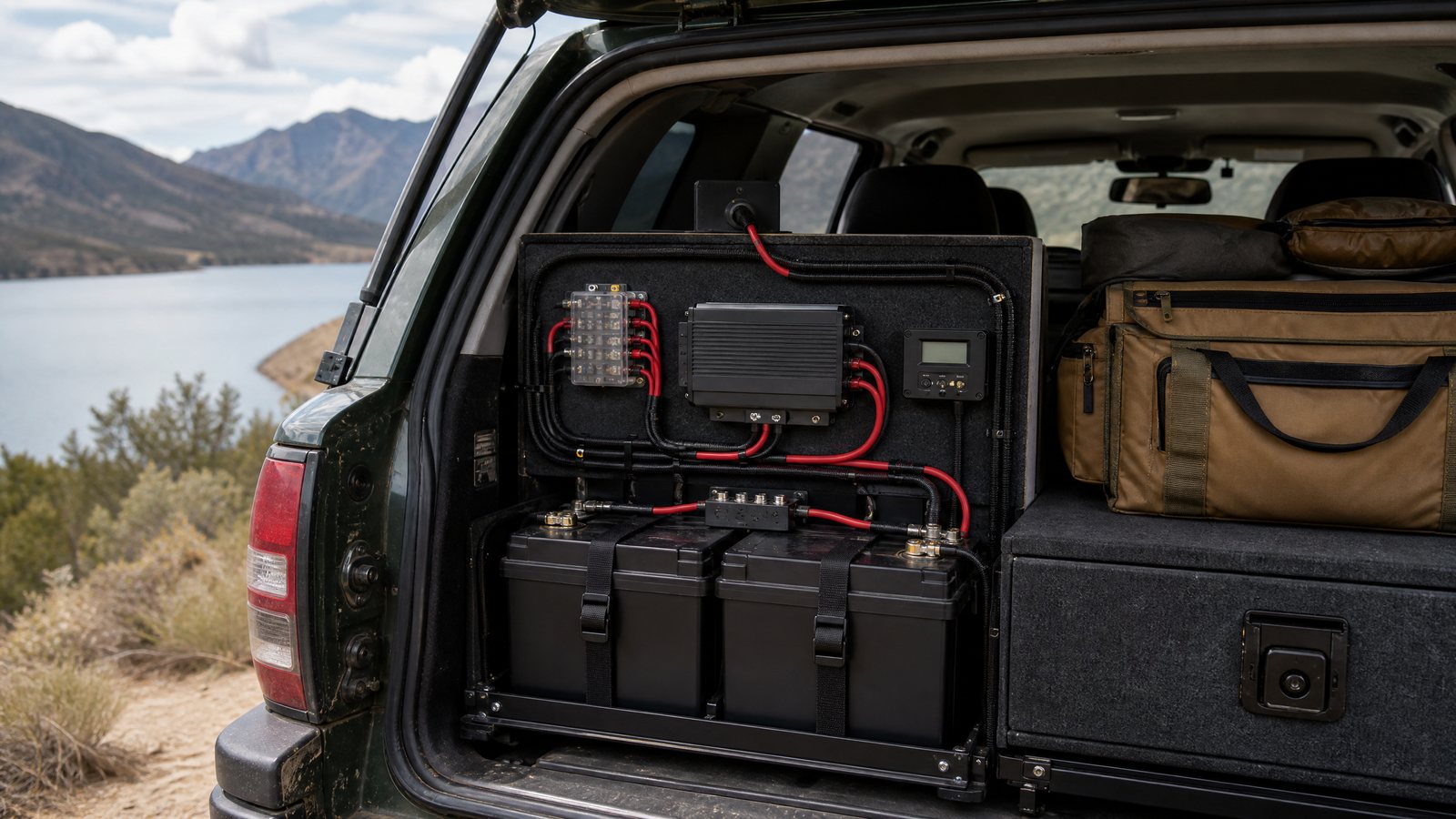
Plenty of tourers fit a second battery, wire it to the starter through a cheap voltage-sensing relay, then wonder why the fridge dies overnight. The reason is nearly always the same: a modern vehicle’s smart alternator varies its voltage to save fuel and rarely pushes hard enough to fully charge a deep-cycle battery through a simple relay. A DC-DC charger fixes that. It takes whatever the alternator gives while you drive, boosts it to the right voltage, and pushes the auxiliary battery through the correct multi-stage profile for its chemistry — which is why it has all but replaced the old isolator for anyone running a fridge.
Get a second battery earning its keep and the trip changes: cold food, charged devices, lights and a fan overnight, all without a nervous glance at the starter battery each morning. The buying decision comes down to three things — enough charging amps for your bank, the right profile for your battery chemistry, and whether you want solar folded into the same box — plus one the spec sheet never mentions: the cable you feed it with. Get those right and any of the chargers below will serve you for years.
Quick Picks
- Best overall for remote touring: the Redarc BCDC1225D.
- Best value all-in-one (50A): the Renogy DCC50S.
- Easiest install: the CTEK D250SE.
- Most monitorable: the Victron Orion-Tr Smart.
- Best well-supported 40A: the Enerdrive ePOWER 40A.

How to Choose a DC-DC Charger
Start by matching the charger’s output to your battery bank. As a rough guide, a 100 Ah auxiliary battery pairs well with a 20 to 30-amp charger, while a 200 to 400 Ah bank wants 40 to 60 amps to make a meaningful dent during a drive. There is a ceiling, though: drawing much more than about half your alternator’s rated output is asking for trouble, so the biggest chargers suit big alternators only. Think about how far you actually drive between camps, because that decides how many amps you can put to use.
Battery chemistry is non-negotiable. The charger must have a dedicated profile for your battery type — AGM, gel, calcium or lithium (LiFePO4) — because the wrong profile undercharges the battery at best and damages it at worst. If you have gone lithium, a proper lithium profile is essential. Then decide on solar: many DC-DC chargers build in an MPPT regulator so you can wire a panel straight in with no separate controller, and most will favour free solar over alternator power to save fuel. For a very large array or maximum flexibility, separate components can still be the better path.
Finally, weigh monitoring and mounting. Sealed, resin-potted units can live in the engine bay and shorten expensive heavy-gauge cable runs; others add Bluetooth so you can watch the charge from your phone. Here is the myth worth killing: a DC-DC charger is not just a fancy relay you can drop in anywhere. Long runs from the engine bay drop voltage, so cables must be sized for both current and distance, and both ends of every heavy cable need fusing close to the battery. Wire and fuse it to the manual, or use an auto electrician — a good charger wired badly will quietly disappoint, or worse, melt a cable.
The detail that makes or breaks a DC-DC install is the cable, and it is where cheap kits fall down. These chargers only switch on above a threshold voltage, so a long run of undersized wire from the engine bay to a rear battery drops enough voltage that a 40-amp unit either loafs at a fraction of its rating or never starts at all. As a rough guide, a 25-amp charger on a typical front-to-rear run wants around 6 B&S (about 13.5 mm²) cable, and a 40 to 50-amp unit steps up to 4 or 2 B&S; when in doubt go one size heavier, because thick cable is cheap insurance against voltage drop. Fuse both ends — a fuse within about 150 mm of each battery terminal, sized to protect the cable rather than just the charger — and earth back to a clean chassis point. None of this is difficult, but it is the step that quietly decides whether the charger you paid for delivers its rated amps. Skimp on the cable and you have effectively bought a 40-amp charger to run it at twenty.
The DC-DC Chargers
Check today’s prices on Amazon →
Redarc BCDC1225D
The benchmark for harsh conditions. It is fully potted — waterproof, dustproof and vibration-proof enough to bolt right in the engine bay — and it charges from the alternator and a solar panel at the same time, a genuine advantage on short drives or cloudy days. The 25-amp output suits a 100 Ah bank neatly, with a 40-amp BCDC1240D for larger setups. There is no built-in wireless monitoring, so mount the front panel where you can see it. For serious remote tourers chasing buy-once reliability, this is the one. Browse the current Redarc BCDC1225D listings on Amazon.
Renogy DCC50S
Outstanding value in a single box. It combines a 50-amp DC-DC charger with a 50-amp MPPT solar controller, which drastically simplifies the wiring and saves cabinet space, and it covers AGM, gel, flooded and lithium with Bluetooth monitoring through the app. If you are starting a new build or overhauling a tired system and want plenty of charging amps without piecing separate components together, this is the smart-value pick. Just check your alternator can feed 50 amps comfortably before you commit. Check current Renogy DCC50S stock on Amazon.
CTEK D250SE
The fit-and-forget favourite, and the unit a lot of installers reach for first. It handles smart alternators correctly, installs easily, and includes a built-in MPPT solar regulator. The 20-amp output suits a 100 Ah AGM or lithium battery, and there is a dedicated lithium profile. It is not the highest-amp option here, so it is not the pick for a big bank you need to refill fast, but for a proven, straightforward dual-battery setup that simply works, it is hard to beat. See how the CTEK D250SE options stack up on Amazon.
Victron Orion-Tr Smart
The data-lover’s choice. With Bluetooth and the app you get real-time charging figures and deep custom settings, and it slots into a wider ecosystem of solar controllers, battery monitors and inverters if you want everything talking to one another. The catch is it has no built-in solar input, so you add a separate MPPT, which means more boxes and wiring. For a tech-minded builder who wants full monitoring and a modular system, that trade is well worth making. See the newest Victron Orion-Tr Smart listings on Amazon.
Enerdrive ePOWER 40A
A popular, well-supported option for a bigger bank. You get 40 amps of charging plus a built-in MPPT solar regulator that handles a generous panel input, and a programmable LCD that shows the source, status, voltage and current at a glance. The screen is the draw for people who like to see exactly what the system is doing rather than trust a couple of LEDs. If you run a larger auxiliary bank and want plenty of amps with real visibility, it earns its place. See current Enerdrive ePOWER 40A prices on Amazon.

Comparison
| Charger | Output | Built-in solar MPPT | Monitoring | Best for |
|---|---|---|---|---|
| Redarc BCDC1225D | 25A | Yes | Panel only | Remote, sealed mount |
| Renogy DCC50S | 50A | Yes (50A) | Bluetooth | Value all-in-one |
| CTEK D250SE | 20A | Yes | Panel | Easy install |
| Victron Orion-Tr Smart | 18–30A | No (separate) | Bluetooth | Data and modular builds |
| Enerdrive ePOWER 40A | 40A | Yes | LCD screen | Larger banks |
Frequently Asked Questions
Do I really need a DC-DC charger, or will a relay do?
On an older vehicle with a traditional alternator and a lead-acid auxiliary, a voltage-sensitive relay still works. On anything recent with a smart alternator, or with a lithium battery, a relay cannot deliver a full, correct charge — the alternator sits too low and lithium needs a specific profile. For most modern setups the DC-DC charger is the right tool, not a luxury.
How many amps should I get?
Match it to your bank and your alternator. Roughly 20 to 30 amps for a 100 Ah battery and 40 to 60 for a 200 to 400 Ah bank, but never much above half your alternator’s output. A bigger charger refills faster only if the alternator and cables can feed it, so size the whole chain, not just the box.
AGM or lithium for the auxiliary battery?
Lithium is lighter, gives you nearly all its rated capacity, lasts far more cycles and charges faster, but costs more and needs a charger set to a lithium profile. AGM is cheaper and heavier and really only offers about half its capacity before it should be recharged. Either way, the charger’s profile must match the chemistry.
Can I install it myself?
Many people do, but the wiring is half the job. Size the cables for the current and the long run to the rear, fuse both ends close to each battery, make a solid earth, and keep a cabin-rated charger out of a hot engine bay. If any of that is unfamiliar, an auto electrician is money well spent.
The Bottom Line
Pick the amps to suit your battery bank, make sure there is a profile for your battery chemistry, and decide whether you want solar built in — get those three right and the rest is detail. The Redarc BCDC1225D is the gold standard for tough remote use, the Renogy DCC50S is the value all-in-one with amps to spare, the CTEK D250SE is the simplest install, the Victron suits anyone who wants full monitoring, and the Enerdrive covers a larger bank with a screen. Whatever you fit, wire and fuse it to the manual, and call an auto electrician if you are unsure — the install decides whether the system lasts.
To finish the power setup, see our guides to the best dual-battery monitors, the best lithium battery boxes, and the best portable solar panels for camping.