
This page contains affiliate links. Far Cornel may earn a commission if you buy through them, at no extra cost to you.
See the top-rated gear on Amazon →
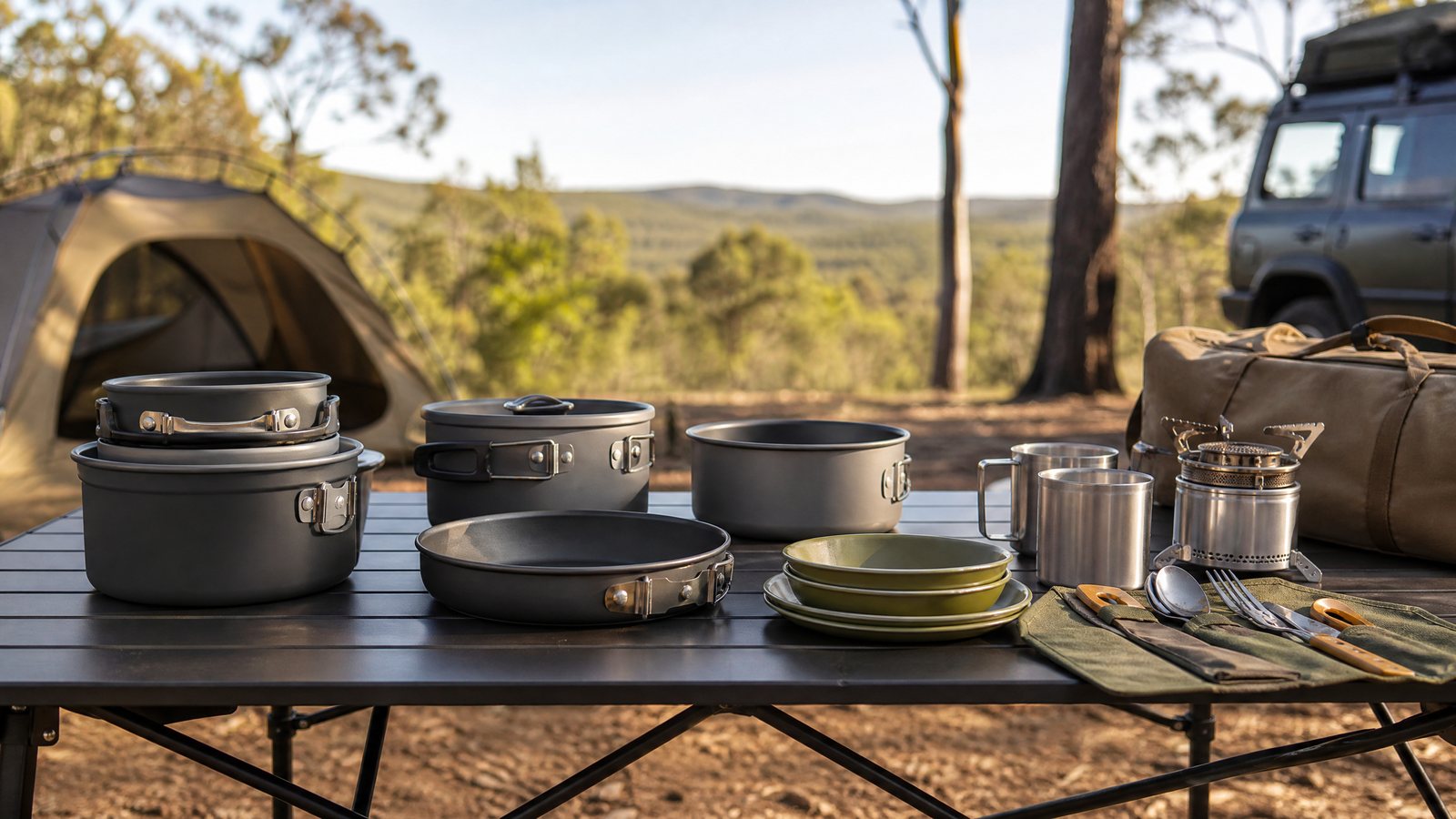
Quick answer: A hard-anodised non-stick nesting set handles nine camp dinners out of ten: it heats evenly, wipes clean and packs into itself. Choose stainless steel for a set you can abuse for a decade, collapsible silicone when boot space is the enemy, and titanium only if you carry your kitchen on your back. Whatever you pick, size the pot volume to the mouths you actually feed — not the piece count on the box.
A stove only makes heat. The cookware is what stands between that heat and your dinner, and it is the part campers get wrong most often. Buy badly and you end up scrubbing eggs off bare aluminium at a cold tap, nursing a pot warped into a rocking chair on the burner, or fighting a set that will not pack back into its own bag. None of that is the stove’s fault.
A handful of sensible choices sort it out for years. This guide splits camp cookware into five types and says which crew and stove each one suits.
Quick Picks
- Best overall: a hard-anodised non-stick nesting set that heats evenly and cleans up fast.
- Best for years of abuse: a stainless steel set that shrugs off scrapes and open flame.
- Best for tight storage: a collapsible silicone set that flattens into almost nothing.
- Best ultralight: a titanium two-pot set for campers counting grams on their back.
- Best for two: a compact two-person set with strainer lids and folding handles.

How to Choose a Cookware Set
Start with material, because it sets the weight, the price and how much you swear at clean-up. Stainless steel, as Stanley and the cheaper camp sets use, is tough, cheap and happy over a fire, but heavy and prone to hot spots that catch food. Hard-anodised aluminium with a non-stick coating, as GSI, Sea to Summit and MSR build, is the sweet spot: it heats evenly and a quick wipe does the washing up, as long as metal utensils stay away. Titanium is lightest and strongest, but dear and quick to scorch, so it earns its place on your back, not in the boot.
Then match capacity to your crew. As a rough rule allow about a litre of pot volume for every two people, and read the set’s own serving rating rather than the piece count. A “29-piece” set is often four sporks, four cups and a lot of marketing; what matters is a real pot or two, a frypan that fits your burner, and enough plates and bowls to go round. A weekend pair is well covered by a compact two-pot set, while a family wants a 2 to 2.5 litre pot, a proper pan and four of everything.
Last, look at how it nests and whether the base suits your stove. The best sets swallow the mugs, bowls and sporks inside the pots so the kitchen becomes one tidy bundle. A wide pot base sits stably on a two-burner; a narrow one balances better on a single canister stove, and a broad pan perched on a small burner is how dinner ends up in the dirt. My own day-one addition to any set is a cheap cast-iron or heavy steel frypan for the things you actually want to fry, plus a decent pot gripper.
One thing the box will not tell you: every non-stick coating is a consumable. Treat a hard-anodised set gently and it stays slick for years, but it wears out eventually, whereas bare stainless and titanium last essentially forever — so if you want a set you never think about, buy uncoated and make peace with the scrubbing. Watch the base metal too if you ever cook on a powered site, because a portable induction cooktop ignores aluminium and titanium outright; only a magnetic stainless base will heat on one. Gas and flame do not care, which is why most camp sets are aluminium.
The Cookware Sets
Check today’s prices on Amazon →
Hard-anodised non-stick nesting set
The set I would hand a first-time camper without a second thought. Ranges like the GSI Pinnacle and Sea to Summit’s hard-anodised kits pack two pots, a frypan and nesting plates, bowls and insulated mugs into a single bundle, often with a strainer lid so you can drain pasta without a separate colander. Even heating and a quick wipe-down make them a pleasure to cook on. The one discipline they ask is soft utensils and a gentle flame, because a coating scraped with a fork or cooked dry over a roaring fire will not forgive you. Browse the current hard-anodised cookware set listings on Amazon.
Stainless steel set
The one to buy if your gear leads a hard life. Stainless sets such as the Stanley Base Camp are close to indestructible: you can stir with a metal spoon, sit them in the coals, and scour them with sand. The trade-offs are weight and hot spots, so watch the flame under a thin base or you will burn the middle of the pancake while the edges sit raw. For families who want a set that outlives the tent, the extra grams are a fair price to pay. Run your eye over the stainless steel cookware set range on Amazon.
Collapsible silicone set
The answer when storage, not weight, is the enemy. Sets built around collapsible silicone pots, kettles and bowls, with Sea to Summit’s X-Set the obvious example, squash down to a fraction of their cooking height while a heat-resistant hard base does the real work on the burner. They are more capable than they look. Keep the flame under the base and off the silicone walls, and accept that they cost more than a plain set of the same size. Find the right collapsible silicone cookware set on Amazon.
Titanium two-pot set
The set for people who weigh their toothbrush. A titanium two-pot set is startlingly light and near-unbendable, which is what a backpacker wants and a car camper need not pay for. Titanium heats fast and unevenly, made for boiling water and one-pot meals rather than a lazy fry-up, and the thin walls scorch the moment you look away. If every gram on your back counts, though, nothing else comes close. See current titanium cookware set prices on Amazon.
Compact two-person set
The right amount of kitchen for a couple. A tidy two-person set such as the MSR Quick 2 gives you two pots, two bowls, two mugs and two plates that all nest together, usually with strainer lids and folding handles to keep the bundle small. If you mostly camp as a pair and hate clutter, this is the honest pick over a bigger set you will only half-use. See the newest two-person cookware set listings on Amazon.
Comparison
| Set type | Material | Serves | Packs down | Watch-out |
|---|---|---|---|---|
| Hard-anodised non-stick | Coated aluminium | 2–4 | Nests fully | No metal utensils |
| Stainless steel | Stainless | 4+ | Nests | Heavier, hot spots |
| Collapsible silicone | Silicone + hard base | 2–4 | Flattens | Costs more per litre |
| Titanium two-pot | Titanium | 1–2 | Nests small | Scorches, pricey |
| Compact two-person | Coated aluminium | 2 | Nests | Too small for groups |

Frequently Asked Questions
Will a non-stick coating actually survive camp cooking?
Yes, if you treat it like the non-stick pan at home. Stir with wood or silicone, never metal, and do not sit an empty coated pot over a big flame to heat up, because dry heat is what wrecks a coating. Looked after, a good hard-anodised set stays slippery for years.
Do I really need titanium?
Only if you carry the set on your back and count grams. For camping out of a vehicle, titanium’s weight saving is invisible and you pay a premium for it while giving up the even heating that makes cooking easy. Save it for backpacking and buy hard-anodised or stainless for the car.
How do I wash up away from a sink?
Scrape the plates clean first, then heat a little water in the biggest pot with a drop of detergent and work from smallest to largest. A flat pot scraper shifts stuck food better than any sponge. Pack everything away dry so it does not turn stale.
What size set suits a family of four?
Look for a 2 to 2.5 litre main pot, a second smaller pot or kettle, a frypan that matches your burner, and four plates, bowls and mugs. A set with an included wash basin or strainer bowl earns its keep at a busy camp.
The Bottom Line
Pick the material for your priority first: stainless for toughness and value, hard-anodised non-stick for easy cooking at a sensible weight, titanium only for the trail. Size the set to the mouths you feed, check the biggest pan sits stably on your burner, and make sure it all nests to one tidy bundle. Then add a cheap cast-iron pan for the meals a thin camp frypan will never do justice.
Round out your camp kitchen with our guides to the best camping stoves, the best camp kitchen tables, and the best camping mess kits and cutlery sets.