
This page contains affiliate links. Far Cornel may earn a commission if you buy through them, at no extra cost to you.
See the top-rated gear on Amazon →
Quick answer: A wired digital reversing camera is the best pick: a rock-solid picture, no dropouts, and the fiddly cable run is a one-time job. A digital wireless system is the easy-install choice if you can live with the odd glitch. Add a rear-view or twin-camera setup if you also want to watch traffic while towing, not just reverse into a site.
Reversing a van blind turns calm people short-tempered. You cannot see the back corners, the mirrors show the side of the van rather than what is behind it, and the person guiding you is using hand signals you last agreed on three arguments ago. A reversing camera quietly removes all of that: you glance at a screen, see exactly what is behind the tailgate, and back into a tight site without raising your voice.
The trap is assuming a van camera is the same as the one in your car. It is not. The signal has to travel the full length of the tow vehicle and the van, often through a big metal box, and cope with the two swinging apart on the drawbar. That is why picture and mounting matter more here, and why cheap car-grade kits disappoint. Brands like Uniden, Furrion and Haloview build systems for exactly this, and this guide breaks the field into five types.
Quick Picks
- Best overall: a wired digital reversing camera for a rock-solid picture.
- Best for easy install: a digital wireless system with no cable run to the van.
- Best for towing visibility: a rear-view monitoring camera you can leave on while driving.
- Best for blind spots: a twin-camera system covering the rear and the sides.
- Best budget: a simple wireless camera for occasional reversing.

How to Choose a Caravan Reversing Camera
The first fork is wired versus wireless, and it helps to know what “wireless” means. A wired system runs a cable the length of the rig, so the picture is sharp, lag-free and never drops out; the cost is a fiddly install through the drawbar and often some drilling. A wireless system sends the video over a radio link, saving that cable. Here is the myth to clear up: wireless does not mean no wires. The camera still has to be powered, usually wired into the van’s tail-light circuit or a battery — only the video signal is wireless. And if you go wireless, insist on a digital system; the old analog kits lag and drop out exactly when you are mid-reverse.
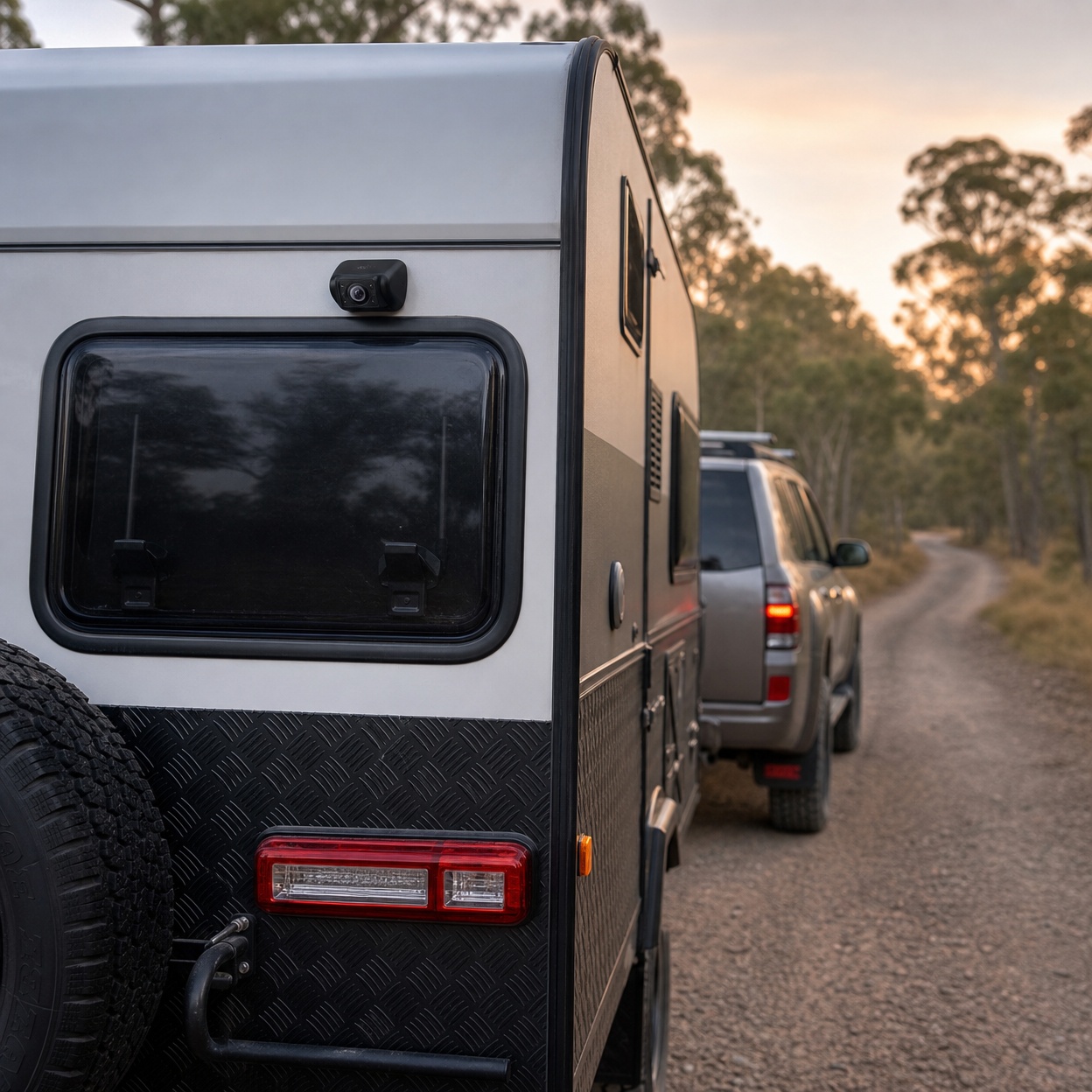
Then look at the picture. Viewing angle matters more than the spec sheet suggests: an ultra-wide 170-degree lens distorts distance, making a post look further away than it is, so 120 to 130 degrees is the practical sweet spot. Night vision is not optional, because you will set up after dark more than you expect, so look for genuine infrared LEDs, and a high seal such as IP69K to survive dust and water. The best day-one decision is to mount the camera high near the roofline rather than down by the bumper: you get a better view and the lens stays cleaner. Wiring it to a permanent feed also lets you run it as a rear-view while towing, which many owners value as much as the reversing help.
The Reversing Cameras
Check today’s prices on Amazon →
Wired digital system
If you want the best picture and the fewest headaches once it is in, a wired digital system is the one to buy. Because the camera is physically connected to the monitor, there is no interference, no lag and no dropout — the image is simply always there and clear. The price is the install: running the cable neatly through the drawbar and into the tow vehicle takes an afternoon and some patience. For a van you will own for years, that one-time effort is well worth the reliability. See what the wired reversing-camera systems cost
Digital wireless system
For people who do not fancy pulling cables through the drawbar, a digital wireless system is the sensible middle ground. Modern digital transmission is a big step up from the old analog kits, holding a stable picture over the length of a van with only the occasional brief glitch. You still wire the camera to power at the back, but skip the long video cable to the monitor. Choose digital, not analog, and check the claimed range comfortably exceeds your rig’s length. Find a digital wireless kit that suits your run
Rear-view monitoring camera
A camera that only wakes in reverse misses half its potential. A rear-view monitoring camera stays live while you drive, giving a constant view of the traffic stacking up behind a van that blocks your mirrors. It is genuinely useful on a long haul, showing when it is clear to move over or when someone is sitting on your tail. Many owners rate this as highly as the reversing function. Price up a standalone rear-view monitoring camera
Twin-camera system
Bigger rigs have blind spots a single rear camera cannot cover. A twin-camera system adds a second lens — usually a side or hitch camera — so you can watch the kerb side while manoeuvring or line the tow ball up to the coupling without a spotter. It costs more and there is more to install, but on a long van in tight, busy sites the extra angle removes the guesswork that causes low-speed knocks. Compare the twin-camera setups
Budget wireless camera
If you rarely reverse and just want occasional help, a simpler, cheaper wireless camera does a job. These entry-level kits are quick to fit and fine for the odd tight spot, as long as you go in with realistic expectations: lower resolution, weaker night vision, and a bargain analog unit can lag or drop out. Treat it as a helpful extra, not a system for constant rear-view duty — honest value for a light user. Look at the budget wireless options

Comparison
| Type | Picture reliability | Install effort | Best for |
|---|---|---|---|
| Wired digital | Best | High | Long-term ownership |
| Digital wireless | Very good | Low | Easy install |
| Rear-view monitoring | Very good | Medium | Watching traffic while towing |
| Twin-camera | Very good | High | Big rigs and blind spots |
| Budget wireless | Fair | Low | Occasional reversing |
Frequently Asked Questions
Wired or wireless — which should I choose?
Wired gives the most reliable picture with no lag or dropout, at the cost of a fiddlier install; digital wireless is far easier to fit and good enough for most, provided the signal comfortably covers your rig’s length. Decide whether reliability or an easy install matters more.
Does “wireless” mean I do not have to wire anything?
No, and this trips people up. Wireless refers only to the video signal from the camera to the monitor. The camera still needs power, so it is wired into the tail-light circuit or a battery at the back of the van. You save the long video cable, not all of the wiring.
Will it work at night and in the rain?
A good one will. Look for genuine infrared night vision, since you will set up after dark more than you think, and a high ingress rating such as IP69K so dust and water do not kill it. A camera you cannot see through when it matters is no help.
Can I just use my car’s reversing camera?
Not really. A van camera sends its signal much further, often through a large metal body, and must cope with the vehicle and van pivoting on the drawbar. Car-grade kits are not built for that distance or movement, which is why purpose-made van systems exist and the cheap car ones disappoint.
The Bottom Line
A reversing camera is one of the cheapest upgrades that takes real stress out of towing. For most owners a wired digital system is the best long-term buy, a digital wireless kit is the easy-install alternative, and a rear-view or twin-camera setup adds value if you want to watch traffic or kill a blind spot. Whatever you choose, mount it high, seal it well, and wire it so you can use it on the move.
For a safer towing setup all round, see our guides to caravan towing mirrors and tow ball weight scales.
A camera is one piece of towing vision. Add a set of towing mirrors so you can see down both sides, a dash cam for what is happening ahead, and a tyre pressure monitor to catch a trailer tyre going down before you feel it drag.