
This page contains affiliate links. Far Cornel may earn a commission if you buy through them, at no extra cost to you.
See the top-rated gear on Amazon →
Quick answer: A digital tow-ball scale with a backlit screen and around 300 kg of range is the one to own — accurate to a kilo or two and readable in the dark. Drop to a mechanical dial gauge like a Milenco if you want nothing to go flat, step up to a high-capacity scale for a heavy van, and treat bathroom scales as a rough sanity check, never the final number.
Tow-ball weight is the quiet figure that decides whether a van tows dead straight or starts wagging its tail at highway speed. It is the download the coupling puts on the towbar, and it changes every time you pack differently — a full water tank up front, the generator shifted to the rear boot, a slab of drinks in the wrong locker. Too little and the trailer sways; too much and the back of the tow vehicle squats, the steering goes light, and the brakes work harder than they should.
The catch is that almost nobody actually measures it. Most people read the number stamped on the van’s plate, assume that is what they are towing, and head off — but that figure is usually the empty ball weight, not the loaded reality sitting on your coupling today. A tow-ball scale swaps the guesswork for a real reading in under a minute, so you can shuffle a few heavy items and bring the number back into a safe window before you leave the driveway.
Quick Picks
- Best overall: a digital tow-ball scale with a backlit screen and roughly 300 kg of range.
- Best with no batteries: a mechanical dial gauge such as a Milenco, ready whenever you are.
- Best for a heavy van: a high-capacity scale rated well past your loaded ball weight.
- Best budget check: a compact digital scale for the occasional weigh.
- Best all-in-one: a jockey wheel with a built-in scale, so you weigh as you wind.

How to Choose a Tow-Ball Scale
Start with capacity, and give yourself headroom. If your loaded ball weight sits around 150 kg, a scale that tops out at 200 kg leaves almost no margin and often reads least accurately near its ceiling. A 300 kg unit covers most single and tandem-axle vans with room to spare. Accuracy comes next: look for a claimed tolerance of a kilo or two, because you are trying to land inside a window, not split hairs over a single kilo.
The reading is only as honest as the surface under it. Weigh on firm, level ground with the van sitting the way it will travel — laden, water where you carry it, nothing propped on the stabiliser legs. A backlit display earns its keep, since you will often check in a dim garage or at dusk. And be realistic about storage: a scale that lives in a padded case in the boot gets used, while a bulky one left at home never does a thing.
Here is the myth worth killing: more ball weight is not automatically safer. Piling load over the coupling to “stop sway” overloads the rear axle, lightens the front wheels and dulls your steering — the goal is the right number, usually around a tenth of the loaded trailer weight and inside your towbar and vehicle limits, not the biggest one you can reach. And skip a fancy scale altogether if you tow one fixed setup that never changes; a single trip to a public weighbridge tells you what you need.
The Tow-Ball Scales
Check today’s prices on Amazon →
Digital tow-ball scale
This is the one I would put in most people’s boot. You lower the coupling onto a stout column, the load presses on an internal sensor, and a large screen shows the weight to the kilo. The good ones add a backlit display, a hold function so the number stays put after you wind the jockey wheel back up, and a switchable kg or lb readout. Buy one rated to about 300 kg even if your van is lighter, because these sensors tend to be most accurate through the middle of their range rather than pinned near the top. Browse the current digital tow ball scale listings on Amazon.
Mechanical dial gauge
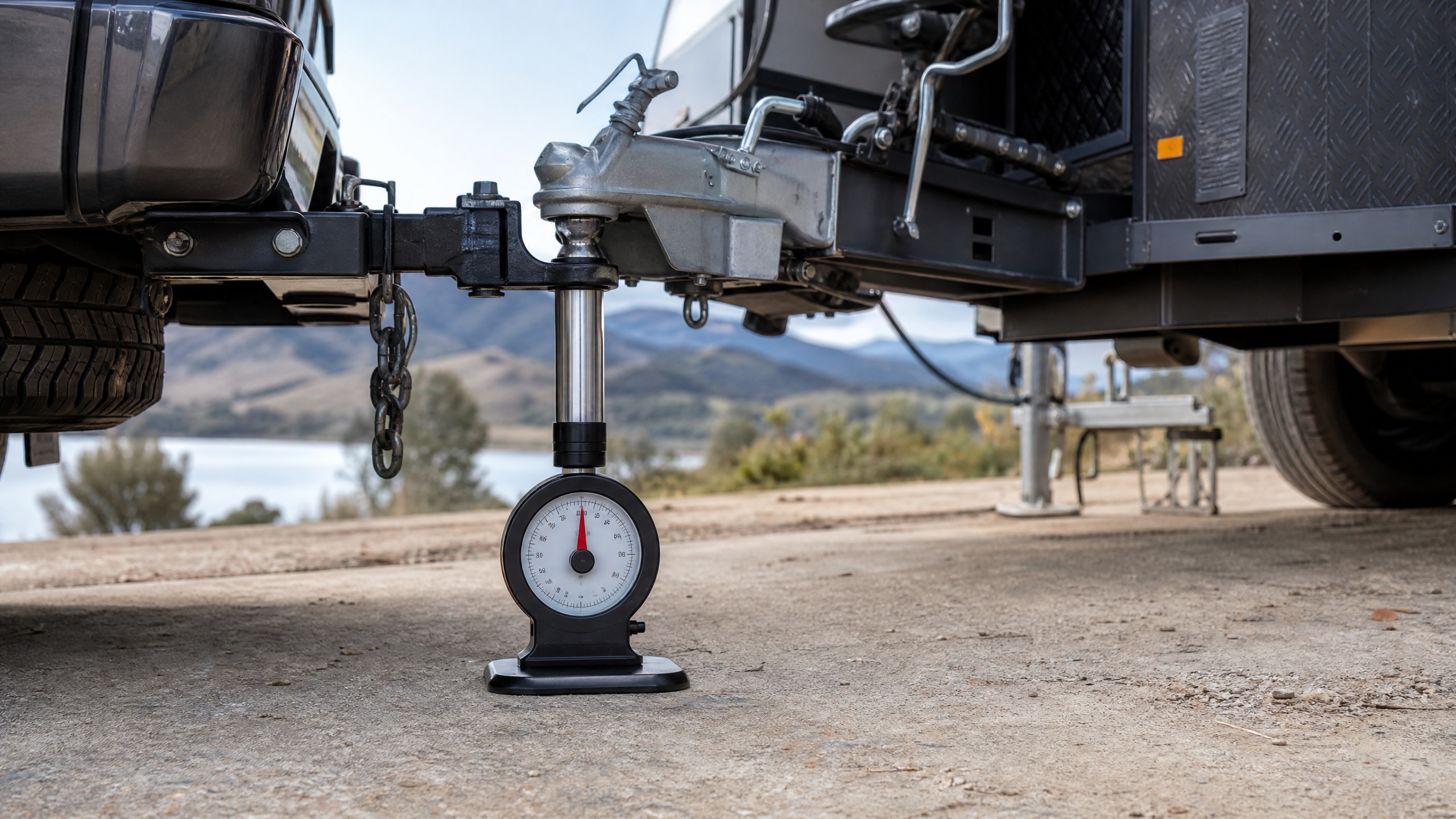
No batteries, nothing to go flat, nothing to scramble in the heat — a mechanical gauge like the well-known Milenco reads the load on a hydraulic dial and simply works, year after year. You stand it under the coupling, wind down, and read the needle. It is the pick if you distrust electronics or your gear bakes in a hot vehicle for months on end. The trade-off is a coarser scale and no hold or backlight, so you crouch and eyeball it in good light. For a set-and-forget tool that outlasts three digital units, it is hard to argue with. See current mechanical tow ball weight gauge prices on Amazon.
High-capacity scale for heavy vans
Big tandem-axle vans, semi-off-road rigs and anything with a loaded ball weight nudging 200 kg deserve a scale that is not straining at its limit. A high-capacity unit rated to 350 kg or more keeps its accuracy where a cheap 200 kg scale would be reading right at the edge. It is heavier and dearer, and complete overkill for a light camper trailer, but if your rig is genuinely heavy this is the honest choice over trusting a figure at the very top of a small scale’s range. Run your eye over the heavy duty tow ball scale range on Amazon.
Compact budget scale
If you weigh once or twice a season and your van is light, a compact digital scale does the job for less. These smaller units stash easily, run off a coin or AAA cell, and give a reading that is far better than a guess. Just respect the limits: lower capacity, a smaller footing under the coupling, and usually no hold function. Treat it as a real measuring tool for a light rig, not as the scale you lean a 200 kg download onto and hope it copes. Compare today’s compact tow ball scale prices on Amazon.
Jockey wheel with a built-in scale
The neatest idea of the lot: a jockey wheel with a load sensor built into the leg, so the weight shows up as you wind the coupling down onto the towbar. There is no separate tool to find, drop or forget, and you get a reading every single time you hitch or unhitch. It costs more than a standalone scale and you are replacing a working jockey wheel to fit it, so it suits people building or refreshing a rig rather than someone who just wants a quick one-off check. When it fits the plan, it is the scale most likely to actually get used. Check current jockey wheel with scale stock on Amazon.

Comparison
| Type | Best for | Capacity | Power | Watch-out |
|---|---|---|---|---|
| Digital scale | Most vans | ~300 kg | Battery, backlit | Cheap ones drift near the top |
| Mechanical dial | Set-and-forget use | ~250–300 kg | None | Coarser to read |
| High-capacity | Heavy tandem vans | 350 kg+ | Battery | Overkill for light trailers |
| Compact budget | Light campers, occasional use | ~150–200 kg | Coin or AAA | Little headroom |
| Jockey wheel scale | New or rebuilt rigs | ~300 kg | Battery | Replaces your jockey wheel |
Frequently Asked Questions
What tow-ball weight should I be aiming for?
As a rule of thumb, around ten percent of the loaded trailer’s weight, kept inside your towbar, hitch and vehicle limits — whichever of those is lowest. Check the figure laden, since that is what you actually tow, not the empty number on the plate.
Can’t I just use bathroom scales and a length of timber?
You can get a rough figure with the scale-and-lever trick, but household scales are not built for a heavy point load and are easy to misread. A dedicated scale is quicker, sturdier and repeatable, which matters when you are chasing a safe window rather than a ballpark.
Do I weigh the van empty or fully loaded?
Loaded, exactly as you travel — full water where you carry it, gear in its lockers, gas bottles on. Ball weight can swing by tens of kilos between empty and packed, so an empty reading tells you almost nothing useful.
My ball weight is too high — what do I move?
Shift heavy items rearward, behind the axle line, a little at a time and re-weigh. A water tank, a generator or a full toolbox mounted ahead of the axle are the usual culprits. Move the load rather than exceeding a limit, and re-check before you leave.
The Bottom Line
A tow-ball scale is a small, cheap tool that quietly heads off an expensive and dangerous problem. A digital scale with a backlit screen and around 300 kg of range is the sweet spot — accurate, easy to read and happy to live in the boot. Go mechanical if you want a lifetime tool with nothing to go flat, size up for a heavy van, and remember the number you are chasing is the right one for your rig, not the highest one you can pile on. Weigh it laden, move a few heavy items if you must, and tow knowing the figure instead of hoping.
For more on setting up a rig that tows straight and reverses cleanly, see our guides to caravan towing mirrors and caravan reversing cameras, or keep your pressures right with a tyre pressure monitoring system.