
This page contains affiliate links. Far Cornel may earn a commission if you buy through them, at no extra cost to you.
See the top-rated gear on Amazon →
Quick answer: For occasional towing a good clamp-on set is the sensible buy: cheap, near-universal, and stored between trips, as long as it matches your mirror shape. Tow often and door-mount or full replacement mirrors earn their cost with a steadier image and no daily refitting. Powered replacement mirrors with indicators are the tidiest and priciest end. Match the mount to your actual mirror, not to the lowest price.
A caravan turns the car behind you into a blind spot on wheels. Standard door mirrors were designed to see past a car’s width, not a van sitting half a metre wider on each side, so a large slab of road down both flanks and directly behind simply vanishes from view. Towing mirrors give that space back, and on anything longer than a short hop they are the difference between changing lanes because you can see it is clear and changing lanes because you hope it is.
The snag is that cheap mirrors shake into a useless blur at speed and good ones cost more and take longer to fit. Knowing which compromise suits your setup is the whole job. It comes down to how often you tow, how much fiddling you will accept at the start of each trip, and, above all, whether the mount actually matches the shape of your wing mirror. This guide sorts the types and the few features that decide whether you keep a set or curse it.
Quick Picks
- Best for occasional towing: a quality clamp-on set that stores between trips.
- Best all-rounder: door-mount mirrors for a steadier image.
- Best for full-time towing: full replacement extendable mirrors.
- Best for killing blind spots: a convex dual-lens add-on.
- Best premium option: powered, heated replacement mirrors with indicators.

How to Choose Towing Mirrors
Sort the law first, because it decides whether you have a choice at all. Rules vary from place to place, so confirm the detail that applies where you drive, but the principle is consistent: if the van or trailer is wider than the tow vehicle, you must fit mirrors that give a clear view down each side for a set distance behind. It is enforced, and an insurer can lean on it after an incident, so it is not a corner worth cutting.
Once it is legal, four things separate a set you keep from a set you bin. The first is how steady the image is, since a mirror that vibrates at highway speed turns the traffic behind into a shimmer and tires your eyes. The second is field of view, where a flat main glass plus a small convex section clears the most blind spot. The third is the mount, and the fourth is fit: a modern wing mirror packed with indicators, blind-spot cameras and puddle lights needs a mount that clears all of it.
Here is the myth worth busting: a reversing camera does not replace towing mirrors. A camera is brilliant for backing into a tight site, but it shows you almost nothing about the fast lane beside you when you want to overtake. The two solve different problems. Brands like Milenco, Clearview and MSA build across the clamp-on and replacement range, and the common thread on the good ones is a rigid arm and a mount that grips your exact mirror shape rather than a generic oval.
The Mirrors
Check today’s prices on Amazon →
Clip-On and Strap-On Mirrors
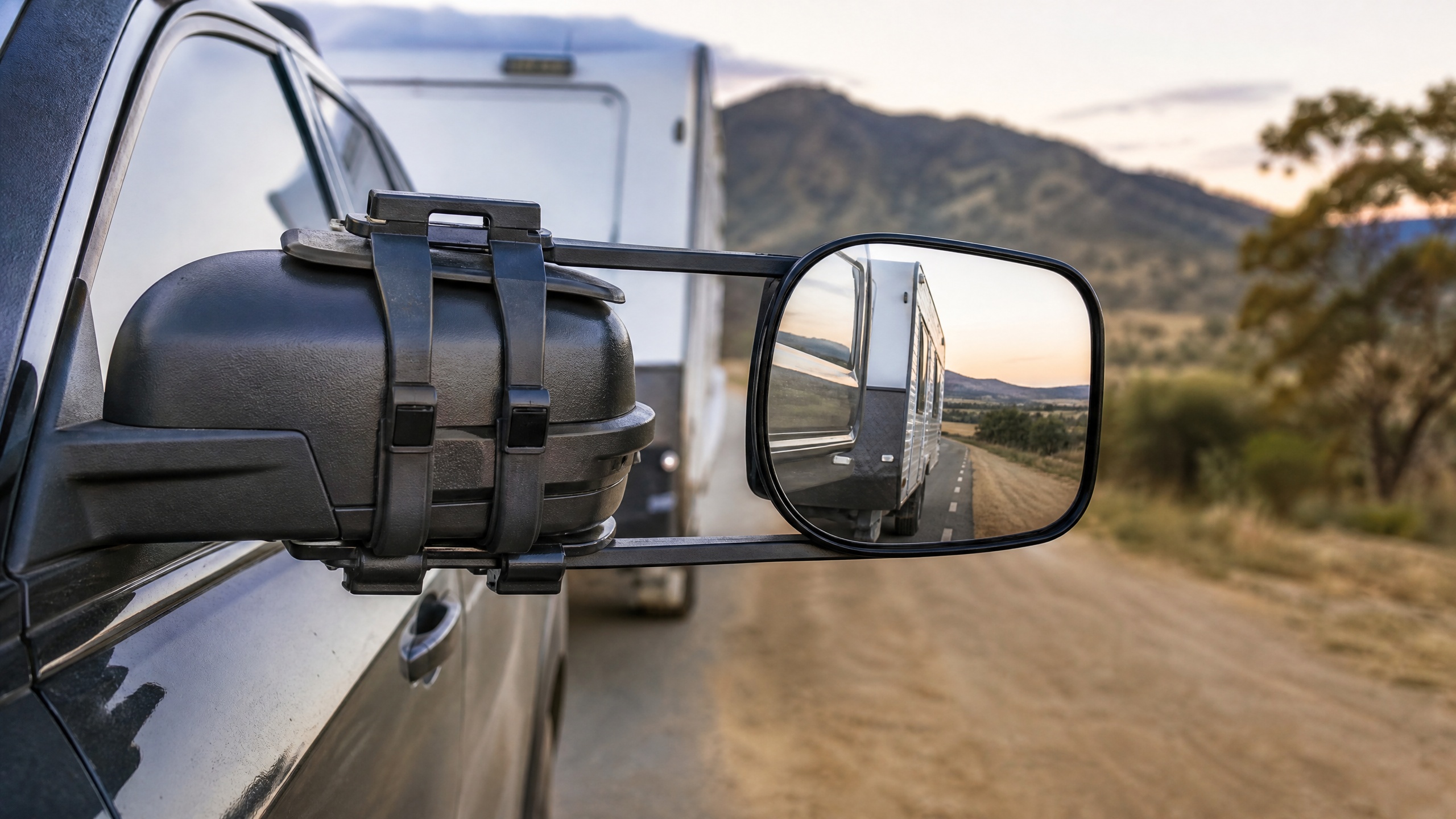
The default for anyone who tows a few times a year. These clamp over your existing mirror with rubber straps or ratcheting arms, cost the least, fit almost anything, and live in a cupboard between trips. Milenco’s clamp-on range is the benchmark for a set that actually holds still. The catch is the fit: heavily contoured modern mirrors give the clamps little flat to grip, so a set that suits one car will shake on another. Buy for your mirror shape and re-check the clamps before you pull away. Check clamp-on mirror sets that match common mirror shapes.
Door-Mount Mirrors
Door-mount mirrors clamp to the door frame rather than the mirror glass, which gives a far steadier platform and a bigger, clearer view. They are the sensible middle ground for someone who tows often but does not want to alter the vehicle permanently. The downsides are honest ones: they are bulkier to store, fiddlier to fit the first time, and a poorly placed clamp can foul a window or a door seal. Set them once with care and they repay it every trip. Look at door-mount mirrors for a steadier image.
Full Replacement Extendable Mirrors
For the full-time tourer, replacement mirrors are the tidiest answer. They swap out the factory mirrors entirely and carry an arm that pulls out for towing and pushes back in for everyday driving, so there is nothing to fit or remove at the start of a trip. Clearview and MSA are the names here, and the payoff is a rock-steady image and a factory look. They cost the most and really want professional fitting, but if you tow constantly they end the daily ritual of strapping mirrors on. Compare extendable mirrors that fold back for town.
Convex Dual-Lens Add-Ons
A small convex or blind-spot lens is the cheapest visibility upgrade going. Some towing mirrors build a convex section into the corner of the main glass; others are a stick-on spot mirror you add to what you have. The wider, slightly distorted view catches the vehicle sitting in the lane beside your van that a flat mirror misses. Treat the convex image as a warning that something is there, then confirm distance and speed on the flat glass before you move. See convex heads that widen the blind-spot view.
Powered, Heated Replacement Mirrors
At the top sit replacement mirrors that keep the vehicle’s powered folding, heating and indicators, so you lose none of the factory features when you upgrade. Heated glass clears fog and rain on an early start, the indicators keep you legal and visible, and powered adjustment means you aim them from the seat. This is the dearest option and needs wiring into the loom properly, so it suits a permanent, heavily used towing setup rather than a car that tows twice a year. Price up powered replacement mirrors with indicators.

Two things the box never tells you. First, aim them properly: set each mirror so just a sliver of the van sits at the inner edge and the rest shows the lane and the wheels of anything overtaking — angled too far out and all you get is a grand view of your own van and a brand-new blind spot. Second, clamp-on mirrors walk loose; road vibration works the straps a little looser every hour, so give them a firm re-check at each fuel stop before the image turns to jelly at highway speed.
Comparison
| Mirror type | Stability | Fit fuss | Best for |
|---|---|---|---|
| Clip-on / strap-on | Moderate | Refit each trip | Occasional towing, tight budgets |
| Door-mount | High | Fiddly once, then quick | Frequent, long-distance towing |
| Full replacement | Very high | Professional fit | Full-time tourers |
| Convex add-on | N/A | Minimal | Killing a stubborn blind spot |
| Powered, heated | Very high | Wired-in fit | Heavy, permanent setups |
Frequently Asked Questions
Do I legally need towing mirrors?
In most places, yes, once the van is wider than the tow vehicle, because standard mirrors cannot see past it. Even where the wording is vague, fitting them is the sensible and safer choice. Confirm the exact rule that applies where you drive before a long trip.
Clamp-on, door-mount or replacement?
Clamp-on suits occasional towing on a budget but shakes more and needs refitting each trip. Door-mount is steadier and better for frequent runs, at a fussier fit. Full replacement is the steadiest and lowest-hassle over time, but costs the most and wants professional fitting.
How do I stop them vibrating?
Fit them firmly on a clean, square surface, share the load across both clamps, and re-check before each trip and at fuel stops, because vibration works them loose over a day. A mirror that still buzzes almost always does not match the shape of your wing mirror, and no amount of tightening fixes that.
Do I still need them if I have a reversing camera?
Yes. A camera helps you back into a site, but it shows you little about the lane beside you when you want to overtake or merge. Mirrors and a camera cover different jobs, so keep the mirrors for moving traffic and use the camera for reversing.
The Bottom Line
The right mirror stays put, shows both sides of the van, and suits how you actually tow. Spend where it counts, on a stable mount and clear glass, and skip features you will not use. A clamp-on set is right for a few trips a year, door-mount or replacement mirrors pay off if you tow often, and powered replacements are for heavy, constant use. Whatever you fit, aim them with the van attached, re-check after the first few kilometres, and take them off the moment you unhitch.
Related: caravan reversing cameras, tow ball weight scales, and a dash cam for the road behind.