
This page contains affiliate links. Far Cornel may earn a commission if you buy through them, at no extra cost to you.
See the top-rated gear on Amazon →
Quick answer: On a powered site, a compact single-burner induction cooktop is the best pick: fast, flameless, easy to wipe clean, and cheap. Choose a dual-burner for family meals, a low-wattage adjustable unit if you run off a battery and inverter, and a built-in model for a permanent van kitchen. If you free-camp off-grid for days, gas still wins.
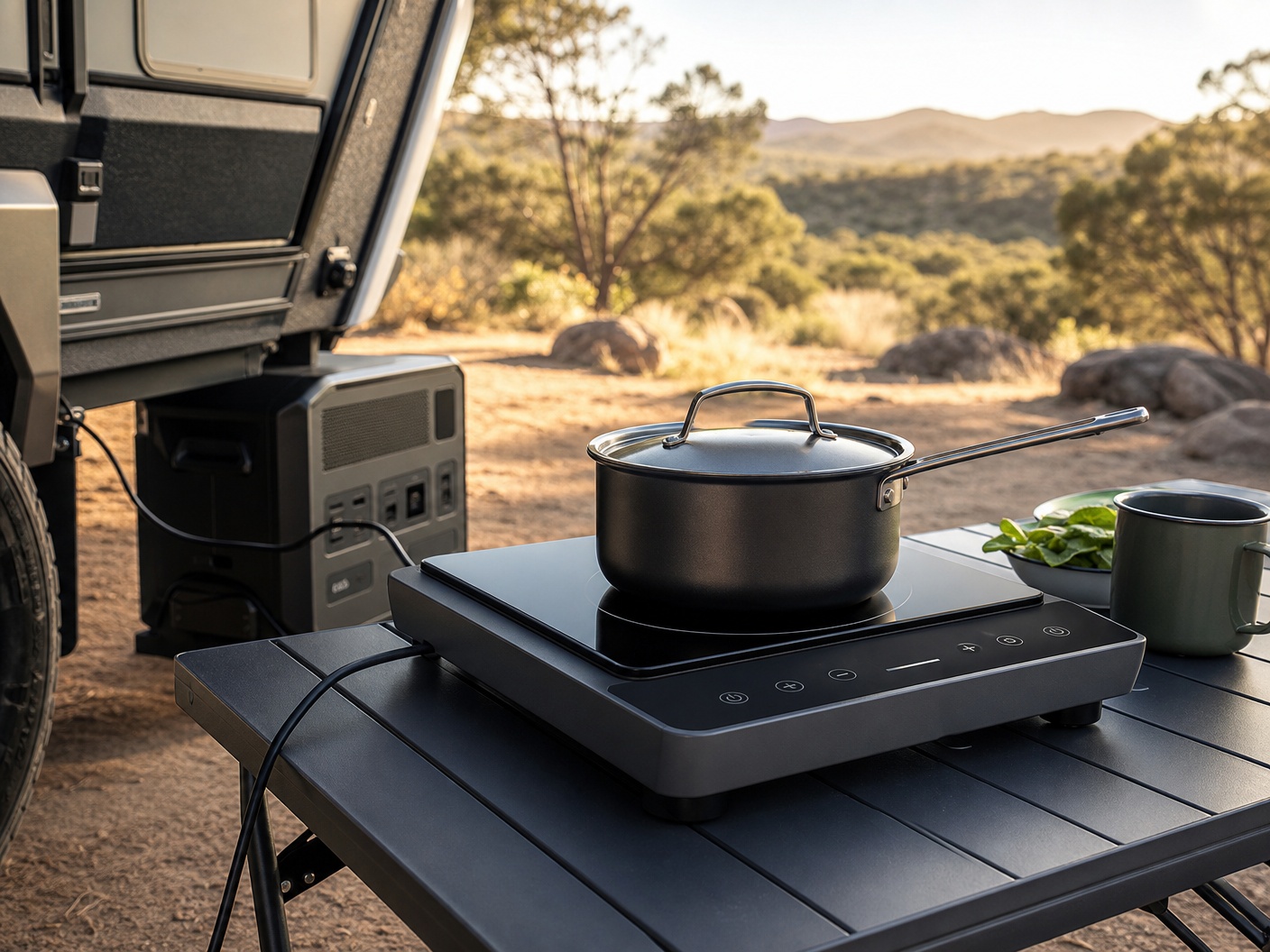
Induction cooking has quietly taken over caravan kitchens, and once you have used a good one it is easy to see why. You put a pot on cold glass, turn a dial, and the pan itself heats in seconds with no flame, no fumes and no gas bottle to run dry mid-stew. On a powered site or a serious battery setup, it is faster and cleaner than the gas burner it replaces.
The catch, and it is a big one, is power. Induction is brilliant when you have the electricity to feed it and frustrating when you do not, and many buyers only find out which side of that line they are on after the unit will not run off their battery. Breville, Duxtop and NutriChef all make capable portable units, but the smart decision has almost nothing to do with the badge and everything to do with how and where you get your power.
Quick Picks
- Best overall: a compact single-burner induction cooktop for powered sites.
- Best for families: a dual-burner unit for cooking a full meal at once.
- Best for battery setups: a low-wattage, adjustable cooktop that is kinder to an inverter.
- Best permanent install: a built-in drop-in cooktop for a fitted van kitchen.
- Best hedge: an induction-and-gas combo so you are covered either way.

How to Choose a Portable Induction Cooktop
Start with power, because it decides whether an induction cooktop is a joy or a paperweight. Most portable units draw 1200 to 1800 watts, and here a stubborn myth needs killing: people hear “induction is efficient” and assume it sips electricity. Efficiency means it puts more heat into the pan and less into the air — it does not mean low power. At 1800 watts a cooktop pulls on the order of 150 amps from a 12V system, which flattens a modest battery quickly and is far beyond what a small inverter can supply. On a powered site that is a non-issue; off-grid, it is the whole issue.
Next, check your cookware, because induction only works with ferromagnetic bases. Hold a fridge magnet to the bottom of your pots: if it grabs firmly they will work, if it slides off they will not, so budget for a couple of induction-ready pans if your set fails. On the cooktop, look for genuine stepped or stepless power control rather than just high and low. The best day-one move is to sort power first — if you are not on mains, buy a pure-sine inverter around 2000 watts with headroom, not a cheap modified-sine unit — and magnet-test every pan before you rely on it.
Two hard truths save a lot of disappointment. First, power: induction is a hungry beast. A 2000 W cooktop draws around 8 to 9 amps at 240 V, off-grid meaning a large pure-sine inverter and a battery bank that can stand the load — that same 2000 W pulls close to 170 amps from 12 V, a boil that flattens a small battery in minutes. Induction is superb on mains, shore power or a decent generator, and only realistic off the grid with a big lithium bank and a serious inverter; if you free-camp a lot, keep a gas burner as backup. Second, cookware: induction only heats ferrous (magnetic) pots — most stainless and cast iron work, but aluminium, copper and much titanium will not, so check the base with a fridge magnet before you rely on it, and make sure it is flat and matches the coil size or it heats unevenly.
The Induction Cooktops
Check today’s prices on Amazon →
Single-burner portable cooktop
For touring on powered sites this is the unit to buy. A compact single-burner cooktop is cheap, light, quick to boil and simple to store, and one burner covers more cooking than people expect once you get used to staging dishes. It is the natural first induction purchase: low outlay, minimal storage cost, and if induction turns out not to suit your power setup you have not sunk much into finding out. Look for solid power control and a stable, flat top. See what a single-burner induction cooktop costs
Dual-burner portable cooktop
Cooking for a family changes the maths. A dual-burner unit lets you run a pot and a pan at once, so you can brown meat while a sauce simmers instead of juggling one burner and a queue of hungry people. The cost is power: two burners together can approach 3000 watts, which really only works on mains or a large battery-and-inverter system. For anyone regularly plating up a full meal, the second burner is worth the space and the draw. Compare the dual-burner cooktops for two pots
Low-wattage adjustable cooktop
If you cook off a battery and inverter rather than mains, a lower-wattage unit with fine control is the pick. Running at 1200 to 1500 watts instead of 1800 eases the load on your inverter and stretches your battery further, at the cost of slightly slower boiling. The key is real adjustability, so you can hold a genuine simmer rather than cycling between blast and off. It will not make a small setup limitless, but it makes induction realistic for a decent lithium system. Look at the low-wattage adjustable cooktops
Built-in drop-in cooktop
For a permanent van kitchen, a built-in induction unit is the tidy solution. Dropped into the bench and wired in, it gives a flush, wipe-clean surface with nothing to unpack and stow, and frees the bench space a portable occupies. This is a fit-out decision rather than a grab-and-go one: it suits vans on powered sites or with substantial house-battery systems, and it commits you to induction, so be sure that is how you want to cook before you cut the hole. Price up a built-in drop-in cooktop for a caravan
Induction and gas combo cooktop
If you cannot decide, a combination unit hedges the bet by pairing an induction zone with a gas burner. On a powered site you use the induction side; free-camping with no mains and a flat battery, you fall back to gas, which needs no electricity at all. It is the most flexible option for people who mix powered and off-grid trips, and it removes induction’s single biggest weakness on the road. The trade-off is a larger, pricier unit that does neither job in the smallest package. Check the induction-and-gas combo cooktops

Comparison
| Type | Typical power | Needs mains or big battery? | Best for |
|---|---|---|---|
| Single-burner | 1200–1800W | Yes on mains power | Powered-site cooking |
| Dual-burner | Up to ~3000W | Yes, mains or large system | Family meals |
| Low-wattage adjustable | 1200–1500W | Workable on a big battery | Battery and inverter setups |
| Built-in drop-in | 1500–1800W | Yes | Permanent van kitchens |
| Induction + gas combo | Induction plus gas | No, gas covers off-grid | Mixed powered and off-grid trips |
Frequently Asked Questions
Can I run an induction cooktop off my battery and inverter?
Only with a capable setup. An 1800-watt cooktop needs a pure-sine inverter rated well above that and pulls heavily on the battery, on the order of 150 amps at 12V. Brief boiling is very different from long simmering, so check the wattage against your inverter and battery before relying on it off-grid.
Does induction really use less power because it is efficient?
This is the common myth. Induction is efficient in that it heats the pan directly rather than the air, but it is not low-power. A unit still draws its full 1200 to 1800 watts while cooking. Efficiency saves a little energy over a gas flame; it does not turn a big draw into a small one.
Will my existing pots and pans work?
Only magnetic ones. Hold a fridge magnet to the base of each pot: if it sticks firmly it will work on induction, if it slides off it will not. Aluminium and copper pans are out unless they have a magnetic base built in, so budget for a couple of induction-ready pans.
Induction or gas for touring?
Induction is fast, clean and flameless, which suits powered sites and large battery systems. Gas needs no electricity, so it wins for remote, off-grid trips where power is precious. Plenty of tourers carry both, or a combo unit, so they are covered whether plugged in or free-camping.
The Bottom Line
Buy for your power situation first and the cooktop second. If you mostly stay on powered sites, a compact single-burner induction unit is a cheap, clean, fast upgrade, and a dual-burner earns its space for family cooking. If you run off a battery, choose a lower-wattage adjustable unit and a proper pure-sine inverter, or hedge with an induction-and-gas combo. Sort the power and the pans and induction is the tidiest way to cook on the road; get them wrong and it is an expensive glass chopping board.
To power it properly, see our guides to inverters and portable power stations.
Power it properly with our guides to the best inverters, what size power station you need, and the best camp kitchen tables.