
This page contains affiliate links. Far Cornel may earn a commission if you buy through them, at no extra cost to you.
See the current 12V inverters on Amazon →
Quick answer: a 1000–1500W pure sine wave inverter is the sweet spot for most setups — enough to run a pod coffee machine, a toaster or a laptop charger one at a time without bullying the battery. Drop to a 300–600W unit if you only top up devices, step up to 2000–3000W for an induction cooktop or microwave, and keep a modified sine wave inverter only for simple resistive gear like a work light or a drill charger. Whatever the size, the cable and fuse behind it matter as much as the box.
The inverter on the shelf is almost never the part that lets you down — the wiring feeding it is. Ask a 2000W inverter to run a kettle and it will happily try to pull around 170 amps out of your battery, a current most people’s cable and battery cannot deliver cleanly. Undersize that cable or skip the fuse and you get an inverter that browns out and cuts under load at best, and a hot cable and a real fire risk at worst. Choosing the box is the easy half; wiring it so it can actually do its job is where the money and the safety live.
An inverter turns the 12V sitting in your battery into the 240V your appliances expect, and that one conversion is what makes a vehicle or van feel like a small flat instead of a campsite. Two specs decide whether it does that well — the waveform it produces and the continuous and surge watts it can hold — and then the install decides whether it lasts. This guide walks the sizing, the pure-versus-modified-sine call, and the cabling and fusing that matter, because those are the parts a spec sheet quietly skips.
Quick Picks
- Best overall: a 1000–1500W pure sine wave inverter for everyday appliances.
- Best for device charging: a compact 300–600W pure sine unit that sips power.
- Best for cooking: a 2000–3000W high-output pure sine inverter.
- Best for a permanent build: an inverter-charger that adds mains charging to 240V output.
- Best budget, limited use: a modified sine wave inverter for resistive loads only.

How to Choose an Inverter
Start with the appliance that pulls the most, not the tally of everything you own. Add the continuous draw of whatever runs at once and leave roughly 20% headroom so the unit is not sweating at its ceiling all day. The number that catches people out is surge: anything with a motor or a compressor — a microwave, a drill, a small fridge — demands a brief spike well above its running figure, so a 1000W microwave can want closer to 1800W for a heartbeat at start-up. Size the continuous rating to the running load and the surge rating to that spike, or the inverter will trip exactly when you switch the appliance on.
Then choose the waveform, because it decides what you can safely run. Pure sine wave is a clean copy of mains power; modified sine is a cheaper, stepped approximation that simple resistive gear like a work light or an element tolerates, but that makes anything with a microprocessor or a variable-speed motor buzz, run hot or fail — laptops, a CPAP machine, battery chargers and inverter appliances all want pure sine. Prices have closed up enough that pure sine is the sensible default, and modified sine is now a narrow, budget choice for basic loads only.
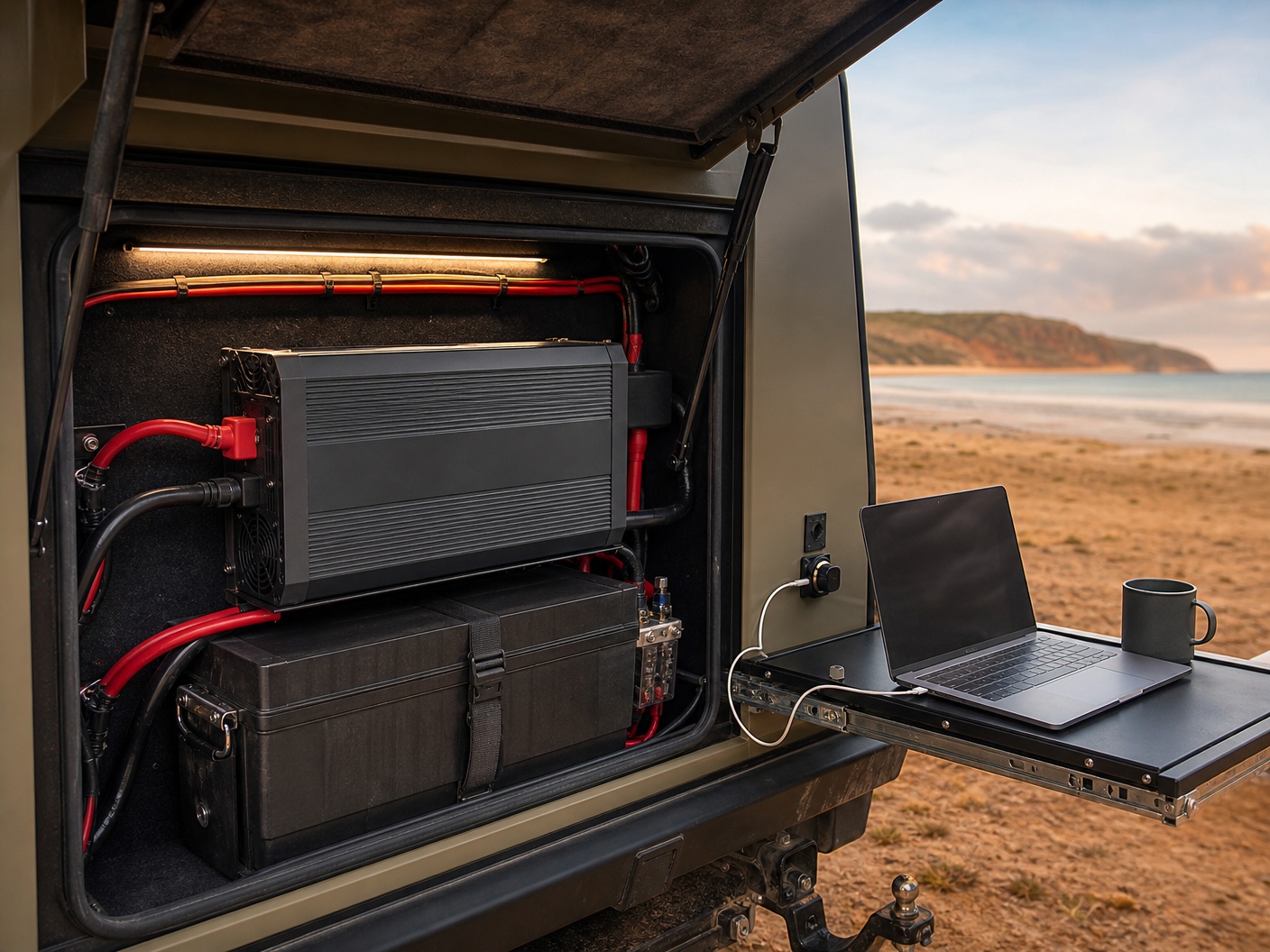
Last, size the wiring and protection to the current, because this is where installs fail or catch fire. High-power draw at 12V means big amps: that 2000W unit pulling around 170A needs short, heavy cable — think 2 B&S, roughly 35mm², or larger for the big units — to avoid the voltage drop that makes an inverter cut out on a half-full battery, plus a DC fuse or breaker rated to the cable and mounted within about 150–300mm of the battery positive so a fault cannot turn the cable into a heating element. Fixed inverters over about 700W want proper mounting, ventilation and, on the 240V side, correct earthing and ideally a residual-current device — the point at which it is worth having someone who wires vehicles for a living do the install. Run it from an auxiliary battery, never your starter, and remember the inverter’s own idle draw will flatten a battery overnight if you leave it switched on.
The Inverters
Check today’s inverter prices on Amazon →
Compact 300–600W pure sine
The quiet achiever for anyone whose 240V needs are really just a laptop that will not charge over USB-C, a camera battery or a set of clippers. A 300–600W pure sine unit sips power at idle, runs cool, and can hang off a modest battery without special cabling or a big fuse. It will not boil a kettle, and that is the point — it is the inverter you fit and forget. Giandel and Renogy both make tidy, honest units in this bracket. Compare the compact pure sine units.
Mid-size 1000–1500W pure sine
The sweet spot for most builds. A 1000–1500W pure sine inverter covers the appliances people actually miss — a pod coffee machine, a toaster, a blender, power-tool chargers, a laptop — run one at a time. It is the size that rewards a lithium battery and decent cable without demanding a full rewire, and the one to buy if you want a single inverter to suit the way most people camp and work. Feed it heavy cable and a proper fuse and it runs clean. See the mid-size pure sine options.
High-output 2000–3000W pure sine
Only worth it if you genuinely cook with 240V. A 2000–3000W pure sine inverter will run an induction cooktop, a microwave or a decent kettle, but it also pulls the big amps that demand a serious battery bank, very heavy cable and a high-rated fuse — the box is the cheap part of this decision. Buy it if a proper camp kitchen is the goal; skip it if you are really only charging gear, because it will idle-draw and stress a small system for capability you will not use. Check the high-output inverters.
Inverter-charger
For a permanent build, an inverter-charger combines 240V output and mains or shore-power battery charging in one unit, so plugging into power at home or a site tops up the battery while the same box still runs your appliances off-grid. It is neat, saves a second unit, and suits anyone wiring a proper system rather than trailing a lead to a portable inverter. The trade-offs are cost and the fact that you really do want it installed by someone who knows the wiring. Compare inverter-charger units.
Modified sine wave (budget, resistive only)
The honest use for a modified sine wave inverter is narrow: simple resistive loads with no clever electronics — an incandescent work light, a basic drill charger, an old soldering iron. They are cheap and light, which is the whole appeal. What they are not is safe for sensitive gear: run a laptop, a CPAP machine or a variable-speed tool off one and you invite buzzing, heat or a dead appliance. Buy it with clear eyes about that limit, or spend a little more and go pure sine. See the modified sine options.
Comparison
| Inverter type | Typical power | Waveform | Runs | Watch out for |
|---|---|---|---|---|
| Compact | 300–600W | Pure sine | Laptops, chargers, clippers | Will not run heating appliances |
| Mid-size | 1000–1500W | Pure sine | Coffee machine, toaster, tools | Needs heavy cable and a fuse |
| High-output | 2000–3000W | Pure sine | Induction, microwave, kettle | Big battery and serious wiring |
| Inverter-charger | 1000–3000W | Pure sine | Full 240V plus mains charging | Cost; wants a pro install |
| Modified sine | 150–1000W | Modified | Work lights, simple chargers | Not for electronics |

Frequently Asked Questions
Can I run an air-conditioner off an inverter?
Usually not a standard one — the compressor’s start-up surge can spike far past its running figure and trip the inverter, and even if it starts, cooling for hours drains a battery fast. Small inverter-style or soft-start air-conditioners are the exception. Size for the surge, not the label, and be honest about what the battery can sustain.
Pure sine or modified — does it really matter?
For anything with a microprocessor, a variable-speed motor or a delicate charger, yes. Modified sine can make gear buzz, run hot or fail outright. Pure sine mimics mains and is the safe default now that prices have closed up; keep modified sine only for simple resistive loads.
What size cable and fuse does an inverter need?
Bigger than most people expect, because the current is high. As a rough guide, heavier cable for higher wattage — a 2000W unit at 12V pulls around 170A and wants roughly 35mm² (2 B&S) kept short — with a DC fuse or breaker rated to the cable and fitted within about 150–300mm of the battery. If that is outside your comfort zone, have it wired by someone who does it for a living; this is the part that catches fire when it is wrong.
Can I run it off my starter battery?
For anything but a tiny inverter, no. A big draw flattens a crank battery fast and can leave you unable to start the vehicle. Run inverters from an auxiliary or dedicated house battery, ideally lithium, fed through a DC-DC charger, and keep the starter battery for its one job.
The Bottom Line
Buy the inverter for the way you actually cook and work, then spend the rest of the budget behind it. A 1000–1500W pure sine unit suits most people, a compact 300–600W unit is plenty if you only charge gear, and the big 2000–3000W units earn their keep only if you genuinely cook with them — and go pure sine unless your loads are dead simple. Whatever the size, the battery, the cable and the fuse decide whether it delivers or disappoints, so size those to match, fuse it close to the battery, and get the big installs wired properly. Do that and it will run clean 240V for years.
Related guides
More from the 12V side of the build: our guides to DC-DC chargers, dual-battery monitors and lithium battery boxes cover the charging, monitoring and storage that sit behind a good inverter.