
This page contains affiliate links. Far Cornel may earn a commission if you buy through them, at no extra cost to you.
See the top-rated gear on Amazon →
Quick answer: A 30 to 45 lb thrust motor on a 12V LiFePO4 battery is the sweet spot on most fishing kayaks: enough push to hold position and cover water without wrecking the boat’s trim. Drop to a compact 18 to 30 lb motor for small, calm water, step up to 45 to 55 lb with a saltwater rating for wind, current and a loaded boat, and add GPS spot-lock only if you fish deep or drift a lot. Buy the battery as carefully as the motor, because run time, not thrust, is what ends a day early.
Watch a new kayak angler shop for a trolling motor and they almost always reach for the biggest number on the shelf, certain that more thrust means more speed. It doesn’t. A kayak hull has a low top speed set by its length and shape, and no motor bullies it past that; thrust buys the ability to hold a spot in wind and nudge across a drift all day, not knots. Chase the big number and you carry dead weight, flatten the battery faster, and pay for push you cannot use.
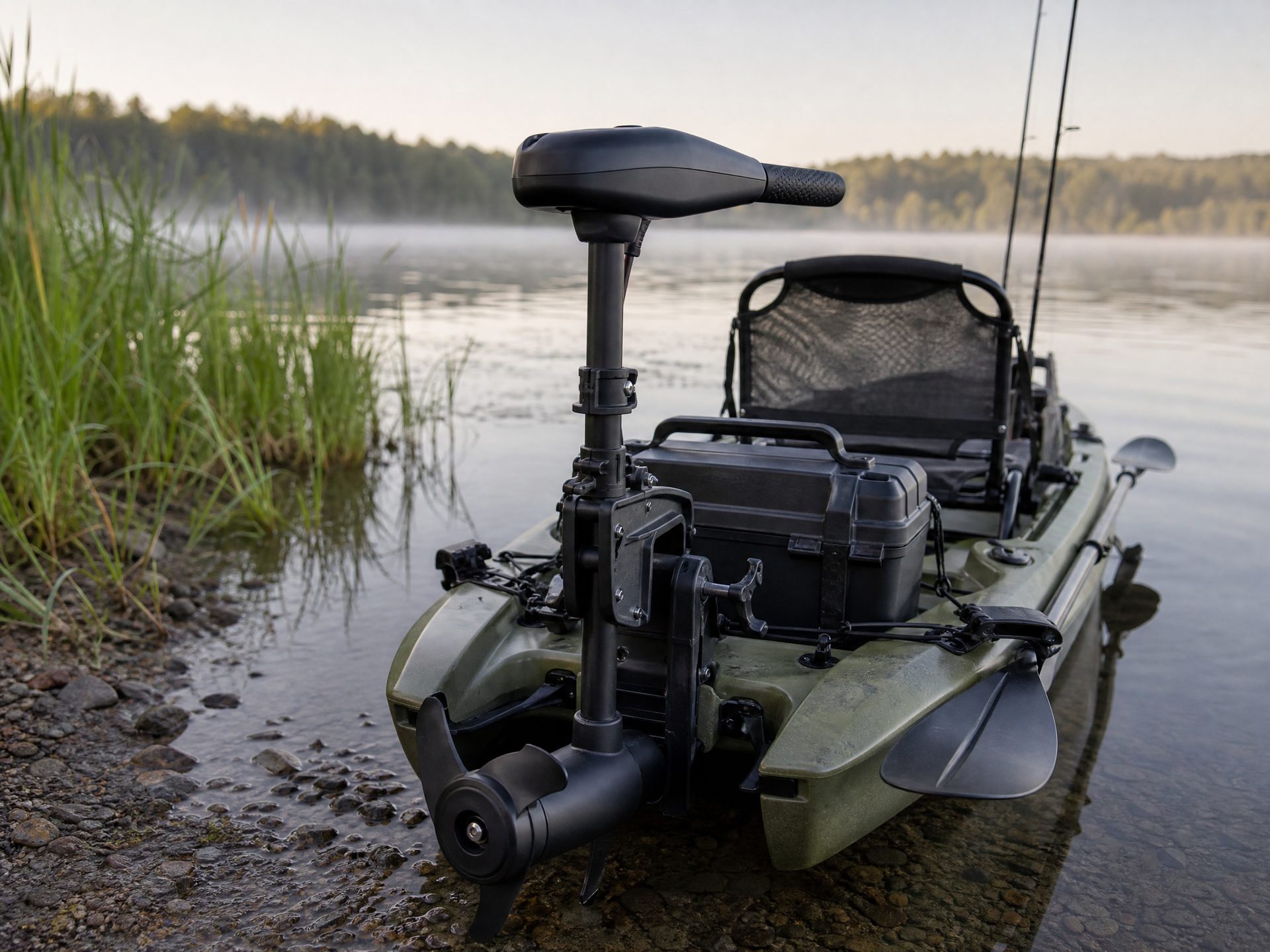
A trolling motor turns a kayak into a hands-free fishing platform: you hold on a snag, sit on a drift line, and cover water without lifting a paddle. The catch is that it is a system, not just a motor — the battery, the mount and the wiring matter as much as the thrust number on the box. Names like Minn Kota, Newport Vessels, Watersnake and Haswing cover the field, and the right build depends on your water, your hull’s usable capacity, and if you fish salt or fresh.
Quick Picks
- Best all-round: a 30–45 lb thrust motor with a 24–30 in shaft.
- Best for small calm water: a compact 18–30 lb motor.
- Best for wind and current: a 45–55 lb saltwater-rated motor.
- Best for hands-free holding: a GPS spot-lock motor.
- Best power: a 12 V LiFePO4 battery in a sealed box.

How to Choose a Kayak Trolling Motor
Match thrust to your boat and water, not to a bigger-is-better instinct. As a rough guide, aim for around 5 lb of thrust per 90–100 kg of loaded weight, which puts most fishing kayaks comfortably in the 30–45 lb range. A compact 18–30 lb motor is ample for a light hull on calm water; step up to 45–55 lb only when wind, current or a heavily loaded boat demand it. Extra thrust buys holding power in tough conditions, never real top speed.
Then get the shaft length right, because a motor that ventilates and sucks air is useless. A 24–30 in shaft suits most kayaks, keeping the prop deep enough to bite when you and the boat pitch in chop. If you fish saltwater, buy a motor built and sealed for it: freshwater motors corrode fast in salt, and the repair or replacement quickly costs more than the saltwater model would have. Rinse everything in fresh water after every salt session regardless of what the label promises.
The battery is half the decision, so do not skimp. A 12 V LiFePO4 lithium battery weighs roughly a third of a comparable lead-acid one, holds voltage steadier as it drains, and lasts far more cycles — all of which matters when every kilo eats into a kayak’s usable capacity and trim. Size the amp-hours to your typical session, keep it in a sealed box, and wire it with a fuse and a proper connector. A great motor on a heavy, tired battery is still a poor setup. Size it by run time, not by the motor’s headline number. A 30 to 45 lb motor might pull around 30 amps flat out, but you rarely run flat out; at a steady hold-and-nudge you average more like 10 to 15 amps, so a 50Ah lithium gives roughly three to five hours of real fishing. Match the amp-hours to how long you stay out, not the peak draw. And treat the wiring as part of the buy: a trolling motor is a 30-amp-plus load, so run heavy cable and fit an inline fuse or breaker right at the battery. Thin wire quietly bleeds voltage and thrust, and an unfused short in a wet boat is a real fire risk.
The Kayak Trolling Motors
Check today’s prices on Amazon →
The compact 18 to 30 lb motor
For a light hull on calm, sheltered water, a compact motor is all you need and the easiest to live with. An 18–30 lb thrust unit from Watersnake, Newport Vessels or the Minn Kota Endura range is light to lift, gentle on the battery, and cheap enough to justify on a modest kayak. It will hold you on a spot and troll a lure happily on a still morning. What it will not do is fight a strong wind or a running current, so if your water regularly turns rough, treat this as a fair-weather motor rather than your only option. Shop kayak trolling motor on Amazon
The 30 to 45 lb all-round motor
This is the sweet spot for the majority of fishing kayaks. A 30–45 lb thrust motor has the push to hold position in a moderate breeze, correct a drift and cover water between spots, without the weight and battery drain of a bigger unit. It balances power against the two things a kayak cares about most — weight and trim — which is why it suits most anglers most of the time. Pair it with a sensible LiFePO4 battery and a 24–30 in shaft and you have a setup that fishes well across a wide range of conditions. See 30 to 45 lb trolling motor options on Amazon
The 45 to 55 lb saltwater-rated motor
When you fish exposed water, run a loaded boat, or push against real wind and current, a stronger motor stops being overkill and starts being sensible. A 45–55 lb saltwater-rated unit, such as a sealed Minn Kota Riptide or an Endura Max, gives you the holding power to stay put when a compact motor would lose the fight, and the corrosion resistance to survive salt. The trade-offs are more weight and a thirstier draw, so you will want a larger battery. Buy this for demanding conditions, not for a calm lake where it is simply dead weight. Find the right saltwater trolling motor on Amazon
The GPS spot-lock motor
For anglers who fish deep or drifty water where dropping an anchor is awkward, a GPS spot-lock motor is a genuine luxury that earns its keep. Systems like Minn Kota’s i-Pilot hold the boat on a set point electronically, so you can fish a mark hands-free without fighting the wind or resetting an anchor every few minutes. It is premium, heavier and more power-hungry, and it is more motor than a small, calm-water kayak needs. But for serious anglers working structure in current or depth, the electronic anchoring is transformative. Price up a GPS spot-lock trolling motor on Amazon
The 12 V LiFePO4 battery and mount
The upgrade that makes any of these motors work properly is the power and mounting behind it. A 12 V LiFePO4 battery in a sealed box saves roughly two-thirds of the weight of lead-acid, holds voltage steadier, and protects your kayak’s trim and capacity, while a solid transom or side mount keeps the motor rigid and safe. Wire it with an inline fuse and a quick connector and the whole system becomes reliable rather than a source of flat-battery and loose-mount headaches. It is the least exciting purchase here and quietly the most important. See current kayak lithium battery and mount prices on Amazon

Comparison
| Motor type | Thrust | Best water | Battery need | Watch-out |
|---|---|---|---|---|
| Compact | 18–30 lb | Small, calm water | Modest | Struggles in wind |
| All-round | 30–45 lb | Most conditions | Mid-size | Few, if sized right |
| Saltwater-rated | 45–55 lb | Wind, current, loaded | Larger | Heavier, thirstier |
| GPS spot-lock | Varies | Deep or drifty water | Larger | Premium and heavy |
| Battery and mount | — | Powers any motor | Sized to session | Do not run lead-acid |
Frequently Asked Questions
How much thrust does a kayak trolling motor need?
Around 30–45 lb suits most fishing kayaks, using a rough guide of about 5 lb of thrust per 90–100 kg of loaded weight. Compact 18–30 lb motors handle light hulls on calm water, while 45–55 lb is for wind, current and a loaded boat. More thrust is about control, not speed.
Will a trolling motor make my kayak faster?
Not really. A kayak’s top speed is capped by its hull length and shape, so more thrust does not push it meaningfully faster — it just holds position better and drains the battery quicker. Buy thrust for control against wind and current rather than for outright speed.
Lithium or lead-acid battery?
LiFePO4 lithium, almost always. It weighs about a third of a lead-acid battery, holds voltage steadier through the session, and lasts far more cycles, all of which matters on a weight-sensitive kayak. It costs more up front but protects your usable capacity and trim, and lasts far longer.
Do I need a saltwater-rated motor?
If you fish salt, yes. Freshwater motors corrode quickly in saltwater, and the replacement soon costs more than the saltwater model would have. Whichever you run, rinse it thoroughly with fresh water after every salt session to keep the seals and fittings alive.
The Bottom Line
A trolling motor is one of the best upgrades a kayak angler can make, but only if you buy the whole system well. On most boats a 30 to 45 lb motor with the right shaft length, fed by a 12V LiFePO4 battery sized to your session and fused at the terminal, does everything a kayak needs. Buy bigger only when wind, current or a loaded hull genuinely demand it, add spot-lock if you fish deep, and remember the day ends when the battery does, not when the thrust runs out.
For more on setting up your boat, see our guides to the best fishing kayaks and the best kayak fish finders.