
This page contains affiliate links. Far Cornel may earn a commission if you buy through them, at no extra cost to you.
See the top-rated gear on Amazon →
Quick answer: The best all-round choice is a pre-wired box built around a quality LiFePO4 battery: rugged, customisable, easy to re-battery. Want no wiring? An all-in-one power station is plug-and-play. Handy with a crimp tool? A bare DIY kit saves money. A compact 50 to 75Ah box suits weekends; a high-capacity box with a pure sine inverter runs mains appliances.
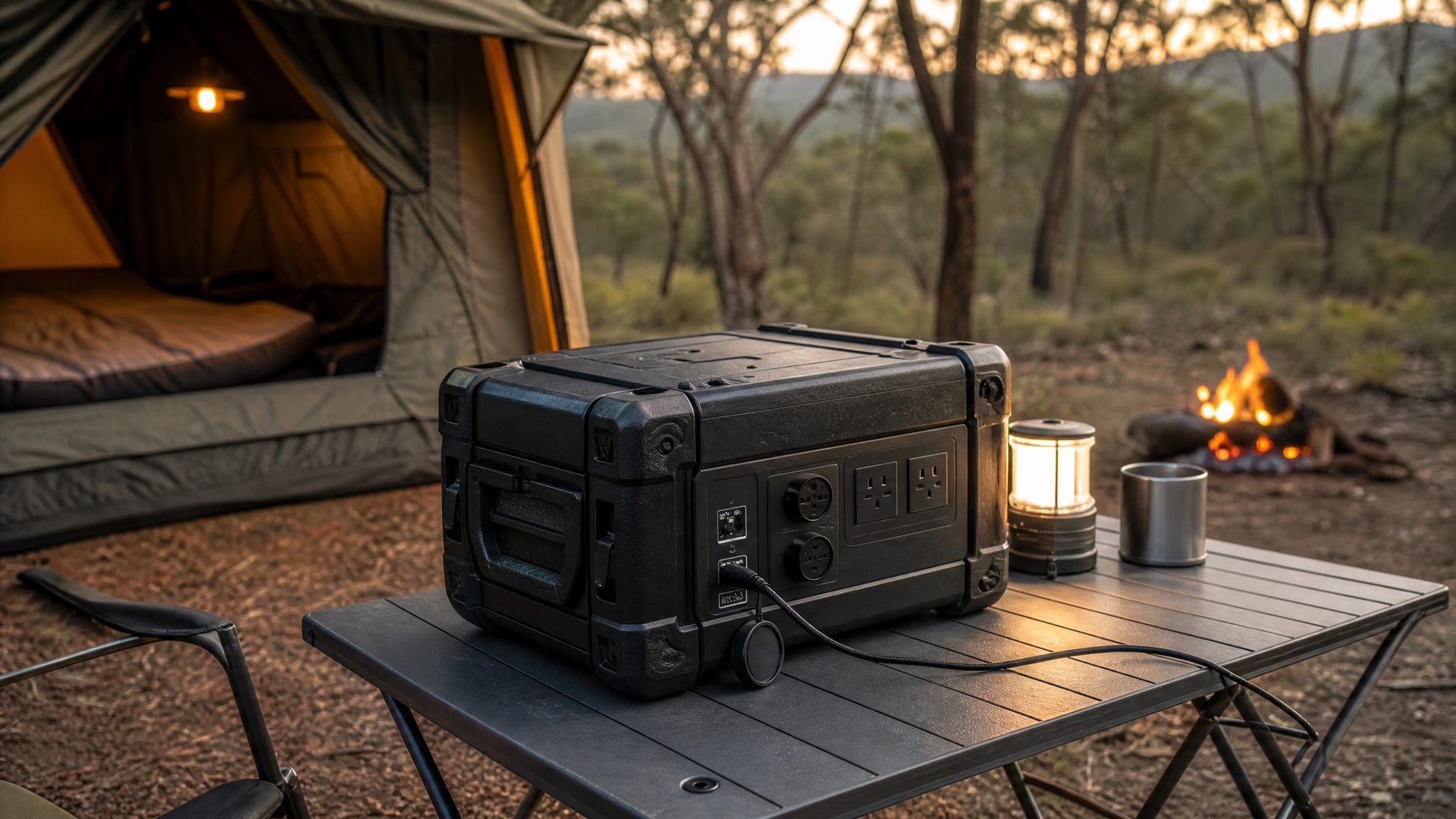
A battery box is the quiet engine room of an off-grid camp: it runs the fridge overnight and charges phones and lights while you barely think about it. Switch an old lead-acid or AGM battery for lithium and two things change at once: the box gets lighter, and you draw far more stored power before recharging.
The confusion starts because “battery box” covers three things: a sealed power station you charge like a laptop, a rugged case you drop your own battery into, and a bare box you wire yourself. Each suits a different camper and budget. This guide covers the chemistry, the capacity you need, and the charging inputs that make the box useful, so you match a setup to your trips.
Quick Picks
- Best overall: a pre-wired box housing a quality LiFePO4 battery.
- Best plug-and-play: an all-in-one power station with the inverter built in.
- Best value: a bare DIY kit you wire to your own spec.
- Best lightweight: a compact 50 to 75Ah box for weekends.
- Best for mains appliances: a high-capacity box with a pure sine inverter.

How to Choose a Lithium Battery Box
Size capacity to your real daily draw, not the biggest number you can afford. Add up what you run in a day in amp-hours: a 12V fridge might pull 30 to 50Ah, lights and charging a few more, an inverter a lot more. A LiFePO4 figure is also more honest than an old AGM: lithium safely gives up around 80 to 90 percent of its rated capacity, while lead-acid should only go to half. So a 100Ah lithium box delivers close to a 180Ah AGM, at roughly half the weight.
Then look at outputs and charging: a battery only helps if power gets in and out easily. For outputs you want a couple of 12V sockets, fast USB-A and USB-C ports, and an Anderson-style plug for higher-draw gear like a fridge. For charging, three inputs matter off-grid: mains before you leave, a DC-DC charger from the alternator as you drive, and a solar input with a built-in MPPT controller. Take all three and you stay full on a long trip.
Finally, check the battery’s built-in protection and the case. A proper battery management system guards against over-discharge, overcharge, heat and short circuits — the difference between a battery that lasts thousands of cycles and one that dies early. The case should be tough impact-resistant plastic or alloy with a lid that keeps dust and splash out, because it lives in a moving vehicle.
One detail the spec sheets skip is temperature. A LiFePO4 cell must never be charged below about 0°C — do it and lithium plates onto the anode and permanently strips capacity, so a good box runs a battery-management system that blocks charging when the cells are cold, while the cheapest ones simply don’t. Two more things worth getting right: set your DC-DC or mains charger to a lithium profile, because an AGM profile leaves a lithium battery loafing at ninety-odd percent and never truly full; and fuse the positive lead right at the terminal, because a lithium cell can dump hundreds of amps into a dead short and it is the cable, not the battery, that catches fire.
The Battery Boxes
Check today’s prices on Amazon →
The pre-wired battery box
This is the setup I would point most people to. You buy a rugged case already fitted with sockets, a voltage display and often a DC-DC charger, then drop in the LiFePO4 battery of your choice. You get the ruggedness of a custom build without the wiring headache, and when the battery ages you swap it, not the whole unit — your money stays in the box while the battery evolves. For long touring, it is the sensible middle ground. See current pre-wired battery box prices on Amazon.
The all-in-one power station
If you never want to see a wire, an all-in-one power station seals the battery, inverter, solar controller and every port into one case you charge like a laptop. It is grab-and-go, quiet and dead simple, which suits casual campers, van setups and anyone who wants backup power at home too. The downsides are cost per usable amp-hour and repairability: when one part fails, the whole unit goes away, not just a component. Buy it for simplicity, not the lowest price. See how the all-in-one power station options stack up on Amazon.
The DIY battery box kit
For the hands-on camper, a bare box and a few components is the cheapest route to exactly the setup you want. You choose the sockets, fuses, monitor and charger, and can change things later. The honest caveat: you need a real understanding of 12V wiring and fusing to do it safely, because a lithium battery is not the place to learn. Enjoy this stuff and respect it, and DIY gives the most control for the least money; if wiring makes you nervous, buy pre-wired. Compare today’s DIY battery box kit prices on Amazon.
The compact 50 to 75Ah box
Not every trip needs a slab of battery. A compact 50 to 75Ah box is light enough to carry one-handed and easily covers a couple of nights running a small fridge, lights and charging. It slides under a seat or into a drawer and recharges quickly from a modest solar panel. The limit is obvious: run an inverter or a big fridge for long and it drops fast. For weekenders, it is the right power without the weight penalty. See the newest compact lithium battery box listings on Amazon.
The high-capacity box with an inverter
To run mains appliances a long way from a power point, a high-capacity box of 100Ah or more with a built-in pure sine wave inverter is the tool. Pure sine matters because it runs sensitive electronics and motors cleanly rather than buzzing or damaging them. This is the setup for long stays, families, and anyone running a coffee machine or charging camera and laptop daily. It is heavier and dearer and drinks power through the inverter, so pair it with plenty of solar. Run your eye over the high-capacity box with an inverter range on Amazon.
Comparison
| Setup type | Battery included | Charging built in | Best for |
|---|---|---|---|
| Pre-wired box | You supply it | Often, DC-DC and solar | Long touring, easy upgrades |
| All-in-one power station | Sealed inside | Yes, solar and mains | Plug-and-play simplicity |
| DIY kit | You supply it | Your choice | Custom builds, lowest cost |
| Compact 50 to 75Ah | Usually included | Solar input | Weekends, light loads |
| High-capacity with inverter | Included | Yes, plus 240V out | Mains appliances, long stays |
Frequently Asked Questions
Why choose lithium over an AGM or lead-acid battery box?
LiFePO4 weighs around half as much, safely delivers far more of its rated capacity, holds a steadier voltage as it drains, and lasts thousands of cycles rather than hundreds. It costs more up front, but per usable amp-hour over its life it usually works out cheaper. Lithium wins clearly for camping.
What capacity do I actually need?
Add up your daily draw in amp-hours, with the fridge as the big number, then choose a battery that covers a night or two with headroom. Many campers land around 100Ah of lithium for a fridge-based setup. Undersizing leaves you flat by morning, so allow a buffer for hot days and cloudy solar.
How do I recharge it while camping?
Solar is the mainstay off-grid, ideally through an MPPT controller, topped up by a DC-DC charger from the alternator as you drive and by mains when available. A box that takes all three inputs stays full on longer trips without you thinking about it.
Do I need an inverter?
Only if you run 240V mains appliances. Most camp gear, including fridges, lights, fans and USB charging, runs straight off 12V and needs no inverter. If you do want mains power, choose a pure sine wave inverter sized to your appliances, and remember it pulls power quickly, so back it with more solar.
The Bottom Line
A lithium battery box is one of the best off-grid upgrades, but the right one matches your real power use. Work out your daily amp-hours, pick a LiFePO4 capacity that covers it with headroom, and make sure you can charge from solar, alternator and mains. Most people want a pre-wired box they can re-battery later; go all-in-one for simplicity, DIY to save money, or high-capacity with an inverter for mains power. Get that right, and the box becomes the part of camp you never think about.
Related guides
Compare your options on Amazon →
