
This page contains affiliate links. Far Cornel may earn a commission if you buy through them, at no extra cost to you.
See the top-rated fridge slides on Amazon →
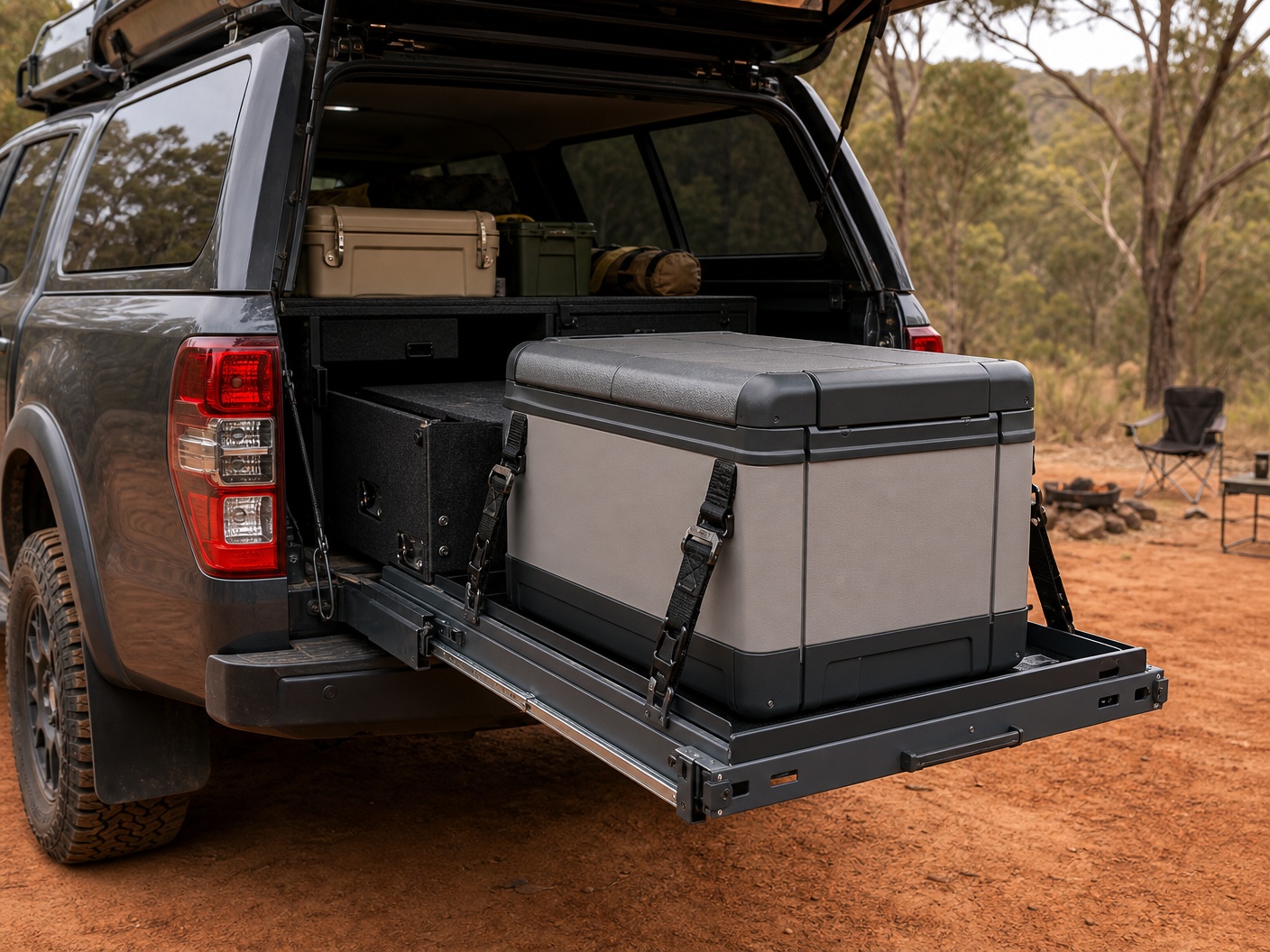
Quick answer: The best fridge slide for a typical touring setup is a straight fixed slide rated well above your loaded fridge weight — simple, strong, and it pulls the fridge to a sensible height off a floor or low drawer. Step up to a tilt or drop-down slide if the fridge sits high on a drawer system or a lifted rig, a heavy-duty over-extension slide for a big fridge that needs full lid clearance past the tailgate, or a slide-and-drawer unit if you are building a complete fit-out. Whatever you pick, the load rating and the way you bolt it down matter more than the badge.
A fridge slide looks like the simplest thing you can bolt into a 4×4 — a tray on runners. Then you load a fridge full of food and ice, hit a corrugated track, and the cheap one you saved money on either jams half-open or, worse, works its mounts loose and turns a 40-kilogram fridge into a projectile. The slide is easy; choosing one is about three numbers the box tends to downplay.
Those numbers are how much it is rated to carry loaded, how far it extends, and how you fix it down. Get them right and a fridge slide is one of the best-value upgrades in the back of a touring vehicle: no more hauling a dead-weight fridge over the tailgate, no more digging for the milk at the bottom. Get them wrong and it is an expensive way to spill your dinner. Here are the five types worth knowing, and how to choose between them.
Quick Picks
- Best overall: a straight fixed slide rated well above your loaded fridge weight, for a floor or low drawer.
- Best for mid-height mounts: a tilt slide that angles the fridge toward you as it extends.
- Best for tall or lifted rigs: a drop-down slide that lowers the fridge to an easy reach.
- Best for big fridges: a heavy-duty over-extension slide that clears the tailgate for full lid access.
- Best full fit-out: a combined fridge-slide-and-drawer unit that integrates cold storage and gear.

How to Choose a 4×4 Fridge Slide
Start with the load rating, because it is the number that fails first. A slide has to carry the fridge full — fridge, food and ice can be half again the empty weight — and then survive the pounding of corrugations, which multiplies that load hard. Read the rated capacity rather than the marketing, and buy one rated comfortably above your loaded fridge weight. A slide that feels solid in the driveway can flex, sag or jam once a full fridge is hammering down a rough track.
Then extension and the latch. You need enough travel to clear the tailgate and still open the fridge lid fully; a slide that only pulls two-thirds out leaves the lid fouling the roof or the drawer above it, which defeats the point. Look for a strong positive locking latch that holds on a hill climb and over corrugations — a fridge that creeps out on an incline is dangerous — and ball-bearing runners rather than cheap rollers, which cope with grit and side-load far better.
Finally, mounting, which is where good gear gets let down. A loaded fridge on a slide is a heavy projectile in a hard stop or a roll, so it must be bolted down properly: rated bolts through the floor or drawer top with large backing plates or big penny washers to spread the load, ideally into or near a chassis cross-member — never a handful of self-tappers into thin sheet. Remember the slide also lifts the fridge, so check the lid still opens under whatever sits above it, and that the extra height has not raised your centre of gravity more than you want.
The Fridge Slides
Check current fridge slide prices on Amazon →
Straight fixed slide
The value default, and the right answer on most builds. A straight slide simply runs the fridge out at the same height it sits, so it shines when the fridge lives on the floor or a low drawer where that height is already comfortable. It is the cheapest, strongest and simplest option, with the least to go wrong on a corrugated track. Skip it only if your fridge is mounted high — then you are reaching down into a chest fridge from above, which a tilt or drop-down solves. See what straight fridge slides are selling for.
Tilt slide
A tilt slide angles the fridge toward you as it comes out, which turns an awkward mid-height mount into an easy reach without the weight and bulk of a full drop-down. It is the sensible compromise when the fridge sits on a moderate drawer system: you get better access to the bottom of the fridge than a straight slide gives, while keeping the install simpler and lighter. If your mount is only slightly too high for comfort, this is often all you need. Price up a tilt fridge slide.
Drop-down slide
A drop-down slide lowers the whole fridge as it extends, dropping a high-mounted fridge to a height you can actually open and reach into. It is the pick for tall drawer systems and lifted rigs where the fridge otherwise sits at chest height or above. The trade-offs are real: it is heavier, costs more, and needs clearance behind the vehicle to swing down, so it is a poor choice if you are tight on rear space. Compare drop-down fridge slides.
Heavy-duty over-extension slide
An over-extension slide pulls the fridge fully past the tailgate so the lid clears completely, and it is built with the higher load rating a big, heavy fridge demands. If you run a large dual-zone unit, this is the slide that lets you open it without the tailgate or a drawer fouling the lid. You pay for it in weight and price, and it is overkill under a small fridge — but for a big one it is the difference between easy access and a daily wrestle. See heavy-duty over-extension slides.
Fridge slide and drawer unit
A combined slide-and-drawer unit builds the fridge platform and a storage drawer into one module, which is the tidy answer if you are fitting out the whole back end at once. Everything is integrated and squared away, and the fridge height is set as part of the system rather than stacked on top of it. The catch is cost and commitment: it is a big, heavy install that is not quickly changed, so it suits a settled, long-term touring build. Compare fridge slide and drawer units.
Comparison
| Type | Access height | Extension | Best for |
|---|---|---|---|
| Straight fixed | Same as its mount | Standard | Low floors and drawers |
| Tilt | Angled toward you | Standard | Mid-height mounts |
| Drop-down | Lowered | Standard, then drops | Tall drawers, lifted rigs |
| Heavy-duty over-extension | Clears the tailgate | Full over-extension | Big, heavy fridges |
| Slide-and-drawer unit | Same as its mount | Standard | Complete fit-outs |

Frequently Asked Questions
Do I really need a fridge slide?
Not always. If you run a small fridge you can lift out easily, a slide is a nice-to-have rather than a must. It earns its place when the fridge is big and heavy, or lives deep in a wagon where you cannot reach the lid — then it saves your back and stops you unpacking half the load to get to the food.
What load rating do I need?
Work out your fridge’s weight with a full load of food and ice, then buy a slide rated comfortably above that — not at the fridge’s empty weight. Corrugations multiply the load a slide sees, so headroom in the rating is what stops it flexing or jamming when the track gets rough.
Straight, tilt or drop-down?
Match it to how high the fridge sits. A straight slide is perfect on the floor or a low drawer; a tilt slide helps at moderate height; a drop-down is worth its weight when the fridge is mounted high on a tall drawer system or a lifted rig and you cannot see into it otherwise.
How do I mount one safely?
Bolt it down — do not trust a couple of self-tappers into thin sheet metal. Use rated bolts through the floor or drawer top with large backing plates or penny washers to spread the load, and locate it into or near a chassis cross-member where you can. A loaded fridge becomes a projectile in a crash, so the mount is a safety part, not an afterthought.
The Bottom Line
The fridge slide that suits the widest range of setups is a straight fixed slide rated well above your loaded fridge weight — strong, simple and cheap to get right. Move to a tilt or drop-down when the fridge sits high, a heavy-duty over-extension slide when it is big and needs full lid clearance, or a slide-and-drawer unit when you are building the whole back end. Whatever you choose, spend your care on the load rating and the mounting — that is what keeps the fridge, and everyone in the vehicle, safe on a rough track.
Kitting out the rest of the cold-storage setup: our guide to the best portable fridges covers the unit that sits on the slide, 4WD drawer systems sorts what it mounts to, and wireless fridge thermometers help you keep an eye on the temperature without opening the lid.